• The move to the new server is done. There are some software and database maintenance updates in process. This has us passing the hat around to help out. We appreciate any donations. Seriously, even a dollar helps. The payment page may be found here - https://www.audiokarma.org/support.html

Luxman Suck Face Stack - My Restoration

haha, you aren't wrong. Funny enough, it's normal... but it does take away from the effect.

It would be a cool project to dampen and spring load the face. Push it in then have a button that releases it back out slowly or vice-versa.
 
Ok. We are almost done on the KX-102.

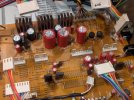
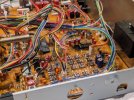
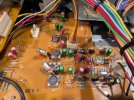
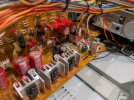
My order from Mouser showed up a few days ago so I was able to recap the polarized capacitors on the main board. Again, I am using 90% Wurth branded red caps for the device, as they have always been quite good for me, and the red color honestly lets anyone know that this has been recapped. Doesn't hurt than the red is quite pretty. The 3 black caps in the power stage are new Panasonic's, as Wurth's 25v 470uf cap was much too small and would look goofy.

PXL_20250221_225504502.MP.jpgPXL_20250221_225525886.jpgPXL_20250221_225522178.jpgPXL_20250221_225517190.MP.jpg

The navy colored caps that are dotted red on top are all non-polarized and I had to order those special... and they haven't come in yet. There are ~23 bipolar caps left, and I ordered those from Germany. I'll do a special post on them. I should point out that I am indeed matching exact voltage. So, if there are '10v 100uf' caps and '16v 100uf' caps, I am literally buying both voltages... I am not just buying the highest common voltage and replacing all uf caps with the highest voltage I can. I am doing this because I want to get as close to the original spec as I can... and I know it wouldn't necessarily hurt the circuit to upgrade the voltages, but I have still chosen to follow the service manual exactly.

As far as functionality goes, it is all still working as before, no issues, but I will say, the sound is so. much. better. Listening to the same tape through the same headphones, it has way more of a sound stage to it, more energetic, more bass, and a wider sound. It was a tad narrow and flat before, but now.... truly great. The difference was immediately noticeable, and severe enough to where I was very surprised straight away.

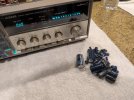
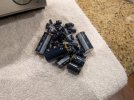
PXL_20250222_012426945.jpgPXL_20250222_020149976.jpg

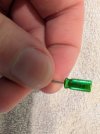
These are all of the caps that came out. Some of the bigger power caps had super dry rubber seals that had leaked some. All of these old caps smelled terrible when removed, and it wasn't just the solder... These caps are horrible and stunk up my entire house.

There will be one more post on this deck, probably with a video showing it completed and ofc the non polar caps being done.

I am beyond excited because of how smooth and well sorted this deck has become.
 
Last edited:
Don’t just leave it there, I might flip it over and grab the battery cover I’m missing.
Lol, well if it makes your feel any better, half the buttons do not work, this remote had a bad liquid spill so the entire PCB was coated. That's uhhh, a future post...
 
I looked at recapping my cheapo Sanyo cassette deck and there were 50+ caps in it. It can wait.

The KX-102 has nearly 200! And so many of them are the non-polar variety which is harder to source conventionally. This is because film caps are used today to replace a lot of these weird values bipolar ones but I wanted electrolytic ones.
 
Finally, the KX-102 is done.

Hooray, the last of the non-polar Nichicon MUSE caps arrived yesterday, so I got started finishing the recap straight away. I had maybe 45 caps to go, so I was anxious to get this thing buttoned up and ready to enjoy.

PXL_20250224_205054514.jpgPXL_20250224_205103182.jpg

The DBX/Dolby board was chock full of them. Around 20 to be exact, and the main board had maybe 23 of them. All 16v 10uf. These were the ones I had to source from Germany, and it took awhile and wasn't cheap. I don't know how circuit design works for bipolar caps, but I've never seen a device use so many.

PXL_20250224_211823181.jpgPXL_20250224_233542053.jpg

Here's some final photos of all caps replaced. I tried to make it as clean and factory fresh as I could.

PXL_20250224_220547262.jpgPXL_20250224_220555534.jpgPXL_20250224_233510016.MP.jpgPXL_20250224_233515735.jpg


I'm considering this totally restored. Here's what's been done:
  • Full Recap
  • New Motor
  • New Belts
  • New Micro Switch
  • Speed Adjustment
  • Azimuth Adjustment
  • CTS Checked
Truly so stoked for how its turned out! The receiver comes next, and I'm changing up some of my repair methods on that, so stay tuned!
 
Last edited:
Let's take a look at the RC-103.

Coming off the success of the tape deck refurb, I'm a bit tired from ordering and sourcing capacitors plus all the intense labor, so I thought I would tackle the remote as it seems like an easy win. This remote is an original RC-103 and is designed only for the RX-103. It's in decent cosmetic shape, but has a lot of little micro scratches, so it definitely feels quite used. Worst problem is, it doesn't work well... and I spent too much on this remote for it to arrive and be only halfway working. Most of the buttons do not respond, and when they do, you have to press really hard or push from the edge to get it to do respond. Let's take it apart and find out why.

PXL_20250226_212610772.jpg

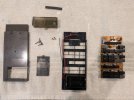
The first step to disassembling the unit is removal of the clear piece at the top. Simply put, you have to grab it by the bottom and mash it from both sides at the top where the two plastic tabs on the clear lens locate into the remote body. Next, you just need to undo 5 screws and then de-solder the red and black wires leading from the battery terminals to the main board. Finally, 2 more screws will get the board out of the case. It really wasn't too difficult to get apart, and the RX-103 service manual has details on how to disassemble it as well which was a huge help.

PXL_20250226_213000698.jpg

Here it is completely disassembled. This remote is very large, but I was still surprised with what I found inside... the circuit board looks like a proper control panel pcb in an actual component, not a wireless remote.

PXL_20250226_213500315.jpg

I was even more surprised by the switches inside. These switches are full sized and are also used for the 'ice cube' buttons on each component. The switches are an Alps part, which was the one thing I wasn't surprised about (I've read from many places that Luxman was flirting with Alpine around this time but hadn't actually hooked up yet, but the 'X' series was all manufactured by Alps/Alpine on commission from Lux). Anyways, I began testing the switches for continuity and learned some were shorted and others showed as open when actuated. Ok, so clearly all of the switches are bad, and need replacing. At this point, I was worried about finding the parts, but I went ahead and de-soldered the old switches.

PXL_20250226_215514231.jpg

When I removed all of the old switches, I noticed this corrosion around the board underneath where the switches had occupied. It definitely appears that a major liquid spill took place in here, and this photo was actually taken after I cleaned the most of it.

PXL_20250226_221332398.jpgPXL_20250226_221802523.jpg

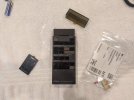
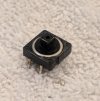
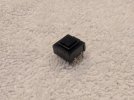
Parts time. So this unit has 19 switches: 18 of one type, and 1 of another. The odd one out looks like a keyboard switch... it's for the record button, and has more pins to change the circuit when pressed along with the play button. Something very worthy of note is that I learned if I take macro photos of parts at this angle behind a white backdrop, Google Lens would identify the parts in an image search! This made my life so easy.

PXL_20250303_214145427.MP.jpg

The common switch is still made after all this time, and it is an Alps SKHCBEA010. It is available on Mouser for a buck each. I ended up ordering the Alps SKHCBGA010 by mistake, which looks identical to the old one, except that the stem is grey instead of black and it is slightly stiffer to press. I don't mind the buttons being a tad stiffer, I'm just glad I could find something.

PXL_20250303_184128695.jpgPXL_20250226_221802523.jpg

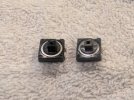
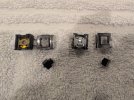
For the odd switch, I had to get more creative. Google identified the switch on the left as a replacement, but it was missing the joint stem for the button cap to attach too. I looked everywhere for the correct switch, but never could find it. The new switch is an Alps 'D' type SPDT momentary keyboard switch, and the old switch is an Alps 'G' type keyboard switch.

PXL_20250303_184231200.MP.jpg

Good news is, the two parts are the same apart from the joint stem on the old one, and they do come apart, so I ordered me some D types and swapped the stem part for the old one, and it worked a treat! You can see here how oxidized the old switch looks compared to the new.

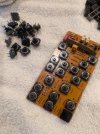
PXL_20250303_215550424.jpg

So, here the board is with all new switches installed. Very tidy looking I must say. It went back together perfectly with no fitment issue, and now every button and function works great. I'll post a video soon showing how the remote works, because it is kinda complicated and dare I say counterintuitive.

Bottom line, I'm very fortunate to have this remote given how truly hard to find it is... and if not for an eBay seller who owns an RX-103 who also decided to part ways with their remote and separate it from their receiver, I may have never found one.

The receiver is actually next this time, coming very soon.
 
Last edited:
@Recaptcha, those switches and related types are commonly known to fail in a lot of 80's electronics. I've replaced a LOT of these on control panels in a number of mid 80's synthesizers by Roland and Korg, as well as some audio gear. Some were better than others, and Alps were usually of better quality, so I was little surprised to see these perished. It may be partly due to the spill you believe took place.
 
@Recaptcha, those switches and related types are commonly known to fail in a lot of 80's electronics. I've replaced a LOT of these on control panels in a number of mid 80's synthesizers by Roland and Korg, as well as some audio gear. Some were better than others, and Alps were usually of better quality, so I was little surprised to see these perished. It may be partly due to the spill you believe took place.

Very interesting, I had no idea. They looked quite uncommon to me, but I'm sure that's because I don't have any prior experience with tactile switches as you have. The data sheet for these Alps listed a lifespan of 1,000,000 cycles... I wonder if the old ones were pressed even a quarter of it's rated lifespan. Interesting to note, some of the old buttons were sticky like there was something inside of them, and also creaky.
 
Indeed. There were other suppliers for tact switches with this (and similar) form factor. These were used in many high end synthesizers in the 80's, for buttons on the control panels. Some models have a few dozen such switches in total, and at this ages it is a common issue to have to shotgun the circuit boards with all new switches due to the very sort of problem you were having, lack of responsiveness or complete failure to operate.

Many of these instruments were treated roughly back in their first life, being "gigged" by professional and semi-pro keyboardists, so it's not surprising they took a beating. Now that they are desirable again 40 years on (because "vintage"), those of us using them again are finding it necessary to replace these with regularity. I've bought lots of 100 a couple of times so I have them in hand.

There were some hifi components made around the same time frame (1981-89 roughly) that also used these for the logic based pushbutton controls that became so popular in the "computer controlled" digital era. There are small form factor tact switches as well, these are also prone to failure in the same manner.
 
Indeed. There were other suppliers for tact switches with this (and similar) form factor. These were used in many high end synthesizers in the 80's, for buttons on the control panels. Some models have a few dozen such switches in total, and at this ages it is a common issue to have to shotgun the circuit boards with all new switches due to the very sort of problem you were having, lack of responsiveness or complete failure to operate.

Many of these instruments were treated roughly back in their first life, being "gigged" by professional and semi-pro keyboardists, so it's not surprising they took a beating. Now that they are desirable again 40 years on (because "vintage"), those of us using them again are finding it necessary to replace these with regularity. I've bought lots of 100 a couple of times so I have them in hand.

There were some hifi components made around the same time frame (1981-89 roughly) that also used these for the logic based pushbutton controls that became so popular in the "computer controlled" digital era. There are small form factor tact switches as well, these are also prone to failure in the same manner.
Wow, that must be a lot of labor. I can understand the passion, those old synths have a sound that cannot be replicated in entirely on modern equipment... you can get pretty darn close, but not exact. I've always enjoyed watching people on YouTube with a synth collection recreate classic 80s hits... so fun. The only old keyboard I own is a 1st gen Kurzweil PC88, and it also has a few dozen buttons on the control panel. I think they are working reliably at the moment.
 
Last edited:
Not to go thread jacking here, but I'll agree synth technology, outside of samplers, really peaked about the mid to late 80s. I have a Roland JX-10, their last big analog, before everything went digital to compete with the Yamaha DX-7. Have a Korg DW-8000 as well (which is terribly underrated), a Kurzweil 2000S with every possible upgrade, and a Casio CZ-1, which is another underrated and overlooked unit, that has finally gained some real respect on the used market in the last few years. All of these but the K2000S had their control panels rebuilt with new tact switches. Have a number of modules by Roland, Korg and Kawaii as well. Almost forgot to mention I am have an Alesis QS8.1 mostly for the full 88 key weighted action keybed, everything else has a light synth action which isn't always suitable for performance, depending on the material.

I had an Oberheim Matrix 12 I extensively restored years ago. I really wanted to keep it, but when resale values topped $11K US a few years ago, I decided I didn't need it that badly, and cashed out. Kind of regret it now, but that funded a number of other toys I really wanted.

I will say a good vacuum desoldering rig is absolutely essential for this sort of work. I'd have gone mad trying to do all those tact switch replacements without it.

Anyway, excellent work on that stack of Luxman suckface, I've long been an admirer of that lineup. I settled for the "Status" series separates which lack the servo controlled panel, but do have the "ice cube" buttons. CX-100, MX-100, TX-101, GX-101 and D-03 CD player. Still need to track down a PX-101 turntable to finish out the set. Still debating whether I want or need a cassette deck to go with it all.
 
I've done my fair share of Luxman collecting and posting throughout the years, but I've always wanted something from the Servoface era, as I've heard some of the gear from this time, and it sounds extraordinary to me. I've owned a lot of components from the 'Brid' era, some early 90s stuff (L-570), and some decent 70s gear too!

I just recently found a seller on the bay selling a bunch of complete 1983 Luxman 'Suckface' components, all the best TOTL models, so I had to jump right on them! The seller had the entire set of these components, and was selling them all separately. I was able to get a good discount from the seller because I agreed to buy everything he had so the entire set would stay together... and boy do I have my hands full now:

View attachment 3408557
View attachment 3408558

Stunning. Perhaps even more stunning is the boxes:

View attachment 3408562

Combined with my L112 boxes, it looks like I just had these delivered from a boutique hifi store fresh! Incidentally, The L112s sound amazing with these components, it was a match made in heaven that I have seen other AKers attest too as well... I had these L112s previously from another setup, never liked them at all until now.

Back to the components themselves. I ended up with an RX-103 receiver, KX-102 cassette deck, a GX-101 equalizer, and a PX-101 turntable. They all work... mostly. The tape deck has a annoying squeak sound that occurs some, the amp has a bad speaker switch and some dodgy input relays. EQ has a good amount of leaking capacitors. Even with the squeak, the tape deck sounds great, and the EQ is responsive and working... even though it has noticable leakage on the legs of all Matsushita caps.

What I want to do is restore all of these components and log my progress here, but also hopefully have good discussion from those more knowledgeable than I. I haven't started on the restorations yet, but I completed some odd jobs to bring these back to a somewhat functional state:

  • I have replaced the belts in the cassette deck and rejuvenated the idler tire. This has been enough to revive it to full working order (for now).
  • I changed out all the bulbs in each component for fresh incandescent bulbs... to keep the original color. I don't want LEDs... I'm grumpy about that.
  • I did a thorough cleaning inside and out for each component... those acrylic buttons really accumulate dust around them.
  • I fiddled with the suckfaces, but turned them off shortly after because of how annoying they were to me. Such noise...
  • The tonearm on the turntable was broken in shipping, so I had to completely dismantle it and repair it. It also needs a new dust cover now.

Here's how the lights look now:

View attachment 3408572

Overall, I feel so lucky I found these in such good shape, and with the boxes! Usually, the silver paint is faded and there are deep scratches, but not on these!

More detailed repair updates, pictures, and sound opinions to follow.

P.S. Yes, the TV is getting raised haha
Awesome to see!! And the best thing about your post is that it's current, not from like 2008 or so... These were my first real stereo components, purchased brand new in 1985 at RogersoundLabs. Still got em, in excellent condition with some maintenance currently in order. Would really like to connect and learn all the details you've done, especially the tape deck. Here's a peek..
I've done my fair share of Luxman collecting and posting throughout the years, but I've always wanted something from the Servoface era, as I've heard some of the gear from this time, and it sounds extraordinary to me. I've owned a lot of components from the 'Brid' era, some early 90s stuff (L-570), and some decent 70s gear too!

I just recently found a seller on the bay selling a bunch of complete 1983 Luxman 'Suckface' components, all the best TOTL models, so I had to jump right on them! The seller had the entire set of these components, and was selling them all separately. I was able to get a good discount from the seller because I agreed to buy everything he had so the entire set would stay together... and boy do I have my hands full now:

View attachment 3408557
View attachment 3408558

Stunning. Perhaps even more stunning is the boxes:

View attachment 3408562

Combined with my L112 boxes, it looks like I just had these delivered from a boutique hifi store fresh! Incidentally, The L112s sound amazing with these components, it was a match made in heaven that I have seen other AKers attest too as well... I had these L112s previously from another setup, never liked them at all until now.

Back to the components themselves. I ended up with an RX-103 receiver, KX-102 cassette deck, a GX-101 equalizer, and a PX-101 turntable. They all work... mostly. The tape deck has a annoying squeak sound that occurs some, the amp has a bad speaker switch and some dodgy input relays. EQ has a good amount of leaking capacitors. Even with the squeak, the tape deck sounds great, and the EQ is responsive and working... even though it has noticable leakage on the legs of all Matsushita caps.

What I want to do is restore all of these components and log my progress here, but also hopefully have good discussion from those more knowledgeable than I. I haven't started on the restorations yet, but I completed some odd jobs to bring these back to a somewhat functional state:

  • I have replaced the belts in the cassette deck and rejuvenated the idler tire. This has been enough to revive it to full working order (for now).
  • I changed out all the bulbs in each component for fresh incandescent bulbs... to keep the original color. I don't want LEDs... I'm grumpy about that.
  • I did a thorough cleaning inside and out for each component... those acrylic buttons really accumulate dust around them.
  • I fiddled with the suckfaces, but turned them off shortly after because of how annoying they were to me. Such noise...
  • The tonearm on the turntable was broken in shipping, so I had to completely dismantle it and repair it. It also needs a new dust cover now.

Here's how the lights look now:

View attachment 3408572

Overall, I feel so lucky I found these in such good shape, and with the boxes! Usually, the silver paint is faded and there are deep scratches, but not on these!

More detailed repair updates, pictures, and sound opinions to follow.

P.S. Yes, the TV is getting raised haha
That's awesome to see. Best thing about your post is that it's current, not from like 2006 out something. These pieces were my first real hi-fi investments and I've kept them all the way. In excellent condition, albeit some normal 40 year old required maintenance . Especially the KX-100, which has a long, productive mix-tape history! I'd really like to connect and pick your brain on some of the refurb details, especially the tape deck. Here's a peek..
 

Attachments

  • IMG_20250306_221743512_HDR.jpg
    IMG_20250306_221743512_HDR.jpg
    136.1 KB · Views: 15
Awesome to see!! And the best thing about your post is that it's current, not from like 2008 or so... These were my first real stereo components, purchased brand new in 1985 at RogersoundLabs. Still got em, in excellent condition with some maintenance currently in order. Would really like to connect and learn all the details you've done, especially the tape deck. Here's a peek..

That's awesome to see. Best thing about your post is that it's current, not from like 2006 out something. These pieces were my first real hi-fi investments and I've kept them all the way. In excellent condition, albeit some normal 40 year old required maintenance . Especially the KX-100, which has a long, productive mix-tape history! I'd really like to connect and pick your brain on some of the refurb details, especially the tape deck. Here's a peek..

Really cool, thanks for sharing. Sure, send me an IM, I'll do what I can.

Yeah, till I came along, the Suck face hadn't had much exposure since the early aughts. I'm not sure why, but people got really into them on this forum around that time and then just quit talking about them.
 
Last edited:
Ok, fellow AK tinkerers, I need YOUR expertise for this one.

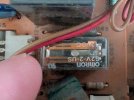
PXL_20250218_203221445.MP.jpg

I got the receiver apart, working on my first post here with it, and I need to replace this relay, which apparently isn't made anymore. It's an Omron G2V-2-US. It's the 12V variant. Looks to be a pretty common size & layout. Does anyone know a modern drop in replacement I can use? I have hit a roadbloak and could really use some advice.

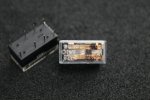
Better picture of it, this is the 5V version, but the pins are the same:

s-l1600.jpg

... Oh yeah, my receiver has 4 of these, all 12V, all for muting and input selection.

Thanks!
 
Ok, fellow AK tinkerers, I need YOUR expertise for this one.

View attachment 3452813

I got the receiver apart, working on my first post here with it, and I need to replace this relay, which apparently isn't made anymore. It's an Omron G2V-2-US. It's the 12V variant. Looks to be a pretty common size & layout. Does anyone know a modern drop in replacement I can use? I have hit a roadbloak and could really use some advice.

Better picture of it, this is the 5V version, but the pins are the same:

View attachment 3452816

... Oh yeah, my receiver has 4 of these, all 12V, all for muting and input selection.

Thanks!
There's not much to go wrong with a relay. I had intermittent speaker switching in my RX103 and resoldering the switch pins (not the relay) fixed it.
 
There's not much to go wrong with a relay. I had intermittent speaker switching in my RX103 and resoldering the switch pins (not the relay) fixed it.

Thanks for the replay. Yes, I have this issue too, but it's not the issue I'm currently working on. Let me explain WHY I believe I have a faulty relay.

There are two issues, first, the speaker selection has trouble. Whenever I jiggle the speaker A switch, the right channel comes in and out. This is definitely a faulty switch, and I ordered two new parts to replace both speaker A and B switches. (I already tried the resolder route)

My second problem is with input switching, more specifically with switching to the AUX input. Whenever I select the AUX button, a relay is heard clicking and the left channel is missing. Additionally, when I toggle back and forth between the AUX and FM inputs, sometimes I can get both channels to work. This is only an issue for the AUX input.

I'm 90% sure it's a relay because of how input switching works in the RX-103. The switches that toggle between the inputs are only momentary switches and do not latch, so no audio signal passes through them (like the speaker switches). Additionally, there is a muting relay for each input that clicks on or off depending on what input is selected. All of this is so that the remote can be used to switch inputs. And so because the remote can be used as a substitute for the input switches, the switches aren't important. Based on this, I believe the muting relay for the AUX input is faulty. It's a relay many other members have tried to find a replacement for, so it's going bad for someone.

I've probed the AUX switch, and it works perfectly and has no cold joints. Jiggling or moving the switch doesn't change anything either
 
Last edited:
There's not much to a relay- it's just a coil of wire and some movable contacts. Maybe you can pop the cover off and clean the contacts...
 
Back
Top Bottom