• The move to the new server is done. There are some software and database maintenance updates in process. This has us passing the hat around to help out. We appreciate any donations. Seriously, even a dollar helps. The payment page may be found here - https://www.audiokarma.org/support.html

Magnavox 169-BB mono block updates

TomD62

AK Subscriber
Subscriber
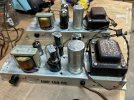
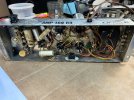
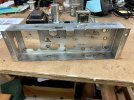
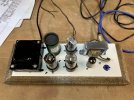
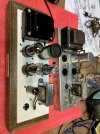
I acquired a couple of Magnavox 169-BB mono blocks from @newenglandj (Thanks Justin!) last year and finally got around to refurbishing the first one. The condition was what you would expect from 60 year old equipment; grungy, rusty, and in need of some love. The as found condition.
Magnavox 169-BB amps - as found (3).JPGMagnavox 169-BB amps - as found (5).JPGMagnavox 169-BB Amp 1 - as found (18).JPGMagnavox 169-BB Amp 1 - as found (23).JPG
 
Register to hide this ad
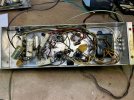
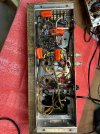
Purchased some extra 6V6GT tubes and sent everything to Western Glow for testing. Stripped one down as the only thing being reused are the transformers and chassis.
Magnavox 169-BB Amp 1 - rebuilding (2).JPGMagnavox 169-BB Amp 1 - rebuilding (3).JPG
 
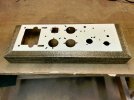
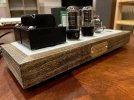
Drilled holes for new input and speaker connections, fuse holder, power cord, and had to make the octal socket holes larger to accommodate the new sockets. Sanded down the chassis and painted white. Made some accent trim out of poplar.
Magnavox 169-BB Amp 1 - rebuilding (4).JPG

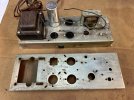
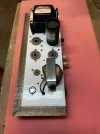
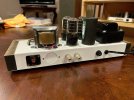
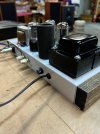
Installed the topside components first.
Magnavox 169-BB Amp 1 - rebuilding (7).JPG
 
Very nicely done. :thumbsup:
I use poplar a lot. Its cheaper than walnut, and very similar looking when stained.
I like the white paint also. With the dark wood they really look nice.
 
Very beautiful work! Very attractive.

Considering how much work you are putting into making these into an exceptionally attractive pair of monoblocks, it is worth mentioning that a LOT can be done to make the fidelity match the excellent appearances. (Unless you modified some of these issues?)

You are giving up quite a lot of fidelity by rebuilding to the original design schematic- Magnavox very much hobbled this amplifier to work within the constraints of the phonograph source and speaker it was paired with- rolling off the high end dramatically to limit dust noise from the ceramic phono cartridge, softening the harsh midrange, and giving up a lot of bass performance. To employ these as high fidelity stand alone amplifiers that work satisfactorily with modern line level sources and high fidelity speakers some aspects of the design really needs to be modernized- not only to ensure adequate fidelity, but to ensure adequate basic stability as well as transient performance with the wide range of possible external speakers, and even unloaded condition.

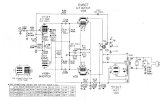
The bass performance is easy- the 6V6 cathode bypass capacitor C106D, 20uF is rather small, used by Magnavox because higher value capacitors were large and expensive, and also because the thin paper tiny magnet speaker they used could not handle the low frequencies that modern speakers can. With only 20uF across 270 ohms, the 3dB point is 30Hz, but 3dB is the half amplitude point so it starts to roll off below 60Hz. You can easily increase this capacitor- I typically use 100uF @ 100V at least, 220 is common, even 1000uF does not hurt, as long as you use a 50V capacitor or higher. The output transformers on these look pretty decent in size, so this one change could really add a lot to the bottom end.

The high end roll-off is more difficult. Using a global negative feedback loop with C103 (0.047uF for the BB) in series with R106, means that for bass frequencies, the amp is essentially running at full open loop gain. Normally this would result in an amplifier that was painfully sensitive, but the ceramic phono cartridges put out somewhat RIAA corrected audio at nearly line-level amplitude, so I'm guessing these monoblocks are not overly sensitive as is. With the C103 in series, global negative feedback only kicks in at higher frequencies, acting to then reduce the overall gain from mid-frequencies on up, meaning it will have a steep roll-off across the upper frequencies required to be considered anything near high fidelity. Additionally, there is a low pass (high cut) filter of R116 and C110 at the cathode of V101 with a 10kHz roll-off. These effects combined likely rolls off everything above midrange in an unsatifying manner. That is not necessarily a show stopper- My hearing rolls off at 15kHz, and I have immensly enjoyed germanium amplifiers that roll off badly above 8Khz, but in tube amps, the sparkling shimmering high frequencies are almost always a commentable aspect of perforance. It's a shame to leave that on the table.

To correct the high frequency response these various frequency limiters would have to be removed, the open loop gain of the amplifier characterized, and a proper global feedback network installed and tuned through measurements to give the desired final closed loop gain, flat bandwidth, and transient stability. This wheel has almost certainly already been invented. It would be worth seeing what others have done with tuning this on the AMP169- I'll poke about and see if I can find anything, otherwise it would be good to solicit feedback on suggested alterations. Without being able to do these measurements directly, it would be impossible to suggest the correct values.

Magnavox_AMP169.jpg
 

Attachments

Last edited:
Very beautiful work! Very attractive.

Considering how much work you are putting into making these into an exceptionally attractive pair of monoblocks, it is worth mentioning that a LOT can be done to make the fidelity match the excellent appearances. (Unless you modified some of these issues?)

You are giving up quite a lot of fidelity by rebuilding to the original design schematic- Magnavox very much hobbled this amplifier to work within the constraints of the phonograph source and speaker it was paired with- rolling off the high end dramatically to limit dust noise from the ceramic phono cartridge, softening the harsh midrange, and giving up a lot of bass performance. To employ these as high fidelity stand alone amplifiers that work satisfactorily with modern line level sources and high fidelity speakers some aspects of the design really needs to be modernized- not only to ensure adequate fidelity, but to ensure adequate basic stability as well as transient performance with the wide range of possible external speakers, and even unloaded condition.

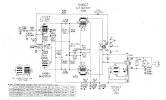
The bass performance is easy- the 6V6 cathode bypass capacitor C106D, 20uF is rather small, used by Magnavox because higher value capacitors were large and expensive, and also because the thin paper tiny magnet speaker they used could not handle the low frequencies that modern speakers can. With only 20uF across 270 ohms, the 3dB point is 30Hz, but 3dB is the half amplitude point so it starts to roll off below 60Hz. You can easily increase this capacitor- I typically use 100uF @ 100V at least, 220 is common, even 1000uF does not hurt, as long as you use a 50V capacitor or higher. The output transformers on these look pretty decent in size, so this one change could really add a lot to the bottom end.

The high end roll-off is more difficult. Using a global negative feedback loop with C103 (0.047uF for the BB) in series with R106, means that for bass frequencies, the amp is essentially running at full open loop gain. Normally this would result in an amplifier that was painfully sensitive, but the ceramic phono cartridges put out somewhat RIAA corrected audio at nearly line-level amplitude, so I'm guessing these monoblocks are not overly sensitive as is. With the C103 in series, global negative feedback only kicks in at higher frequencies, acting to then reduce the overall gain from mid-frequencies on up, meaning it will have a steep roll-off across the upper frequencies required to be considered anything near high fidelity. Additionally, there is a low pass (high cut) filter of R116 and C110 at the cathode of V101 with a 10kHz roll-off. These effects combined likely rolls off everything above midrange in an unsatifying manner. That is not necessarily a show stopper- My hearing rolls off at 15kHz, and I have immensly enjoyed germanium amplifiers that roll off badly above 8Khz, but in tube amps, the sparkling shimmering high frequencies are almost always a commentable aspect of perforance. It's a shame to leave that on the table.

To correct the high frequency response these various frequency limiters would have to be removed, the open loop gain of the amplifier characterized, and a proper global feedback network installed and tuned through measurements to give the desired final closed loop gain, flat bandwidth, and transient stability. This wheel has almost certainly already been invented. It would be worth seeing what others have done with tuning this on the AMP169- I'll poke about and see if I can find anything, otherwise it would be good to solicit feedback on suggested alterations. Without being able to do these measurements directly, it would be impossible to suggest the correct values.

View attachment 3699679

Always looking for ways to improve these old things and welcome any suggestions you or others may be willing to share. The only modification I did come across included changing the output transformer, which I don't really feel like doing. This is more of a learning experience to gain confidence with tube amplifier repair. I figured it was better to learn on these basic, inexpensive units than to delve into something like MC60's and perhaps make things worse.

I will do some additional research to see what can be reasonably done to improve sound quality without reinventing the wheel. I won't have a ton of money into these and don't expect them to replace my main system, but I would like them to be decent sounding when paired with some KG4's or other smaller bookshelf type speakers..
 
Aren't these basically the same as half an 8800 or 175? Tweaks to those have been published, might be worth a look.

**edit, never mind, triode pentode front end rather than twin triode*

So paraphase, could be modified to floating paraphase for better inverter performance. Possibly also some tweaks to feedback depending on square wave response and maybe also bias points depending on voltage
 
The only modification I did come across included changing the output transformer, which I don't really feel like doing.
Yes- I assume (like most Magnavox) that the output transformer is a 4 ohm unit, so to maximize output power with 8 ohm speakers you would want to swap transformers, but with this push-pull design you are looking around 10 watts per channel into a 4 ohm speaker, and with 8 ohm you will still get plenty to listen to, especially for smaller or more efficient speakers. I also note may newer speakers can be had in 4 ohm, and even 8 ohm units are closer to 6 ohms anyways so you may not be that far off. Changing the output transformers would much more likely require the analysis and tuning that I mention to get the best out of them.

This is more of a learning experience to gain confidence with tube amplifier repair. I figured it was better to learn on these basic, inexpensive units than to delve into something like MC60's and perhaps make things worse.
Absolutely. Here is the best place to start for sure. If you do intend to get more into tube amp repair/restore/upgrade it will pay to build a dummy load, and pick up a digital signal generator and small digital oscilloscope. I and many others can walk you through how to make the necessary measurements and tuning adjustments.

Say- In thinking further about he schematic (reposted below), there is a simple experiment you can do that might dramatically improve the performance of the amplifier just to see how you like the change- Try shorting across C103 (the 0.047uF in the feedback loop). This capacitor is totally preventing feedback through the bass frequencies, likely rolling off the low end so badly that suggested change to C106D may not even make a difference. It's also providing increasing feedback through higher frequencies, causing the high frequency roll-off. If you short across C103 temporarily (assuming it does not cause the amp to oscillate, squeal or motorboat, etc) I would expect the overall sensitivity would drop some, so it would require a stronger input signal from the pre-amp to drive it, but I bet it will very much improve the sonic presentation of the amp at both the low and high ends. Short it out with an alligator clip lead, or tack a quick jumper, etc. If it causes problems, or you don't like it, you can always remove it.

=If= you like that first one, you can do a second- lift one side of the connection between R116 or C110 to break only the path through those two components, and see how it does. Both/either can be easily undone if you don't like it, but I would be really interested to hear what difference it makes whether you like it.

Magnavox_AMP169.jpg
 
Wparks, thanks for the recommendations. I will try those once the second amp is completed and connected to some better speakers than my test speakers.

I do have a signal generator and a couple of scopes but have been lazy regarding the dummy load as I am still using a temporary bench. No excuse, I need to build one soon. And get my butcher block bench put together.

Thanks again.
 
C103 will provide a bass boost since it's impedance will increase as frequency drops. Basically less feedback down the bottom. Shorting it will flatten out the response a fair bit at the bottom.

R116 and C110 will provide treble boost, may want to lose those as well. Z of C110 drops as frequency increases so it will drop feedback at the top.

The stock respsonse on my AMP-197 looked more or less like a McDonald's logo. I wouldn't be surprised if this was similar.

curious what the voltages around the 6V6 look like.
 
C103 will provide a bass boost since it's impedance will increase as frequency drops. Basically less feedback down the bottom. Shorting it will flatten out the response a fair bit at the bottom.
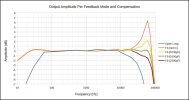
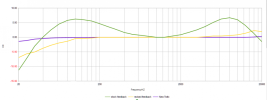
We are basically saying the same thing, shorting C103 will drop the gain for the lower frequencies down to the same gain as for the higher frequencies so more level, all at lower gain. However, by enabling the corrective action of global negative feedback to now work all the way to DC, it will extend the bandwidth to lower frequencies the same way it extends to higher frequencies. In the bandwidth plot for one of my amplifiers below, the blue line is running open loop, and with feedback enabled the bass response extended another 30Hz lower.

Output_dB_vs_Freq_vs_FB_Compensation.jpg
 
1771124686435.png

thats my AMP-197 with it's very-similar double filter in the feedback loop nonsense. Green is stock, yellow is removing both the high and low pass, and bumping the first stage bypass cap from 20 to 47. If I hadn't bumped the bypass cap it would have still been down over 10dB at 20hz. The transformers were junk on that.

purple is new transformers but thats a different ball of wax.
 
I would think even the lowest cost Edcore OPT's without end bells would have a better responce than those stock OPT's.
 
I would think even the lowest cost Edcore OPT's without end bells would have a better response than those stock OPT's.
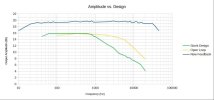
Oh easily. Keep in mind these were just mono record player amps. But, crank the open loop gain of the amp, apply a thick layer of global negative feedback with the right compensation, and you can make it flat as high as you really need to. Even my lowly Lowrey organ amp with OPT that rolled off below 10kHz (yellow is open loop) was flat to 30kHz (blue) with only 6dB of negative feedback and the right compensation.

Amplitude_vs_Design_Stock_vs_NewDesign.jpg
 
Sometimes no miracles of feedback can compensate for bad iron. Better chance with push pull than SE though. Less likely to saturate terribly. I wouldn't expect the transformer on this to be worse than an 8800 or 175, and those aren't terrible.
 
Back
Top Bottom