• The move to the new server is done. There are some software and database maintenance updates in process. This has us passing the hat around to help out. We appreciate any donations. Seriously, even a dollar helps. The payment page may be found here - https://www.audiokarma.org/support.html

Magnavox 6V6 monoblocks

Heck yeh, I was allready thinking they may be good enough for an output iron upgrade (but the Maggie iron seems to be awfully good allready). Are you thinking something like; cap upgrades, jack upgrades, nice wood cases, etc...? They just scream "make me pretty and I'll sing my a$$ off". :D


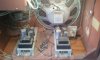
Hello> I am hoping that this thread can be revived. I have just picked up a console just like this and pulled those two monoblocks out. They're clean and I've got pics and I'd like to talk to some folks who know more about tube amps than I do (which is about everyone!). Just chime in if you're still following this thread. I'd love to hear from you.
 

Attachments

  • 2012-07-26 14.28.52.jpg
    2012-07-26 14.28.52.jpg
    58.9 KB · Views: 127
Magnavox monoblock rebuild (attempt - help!)

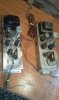
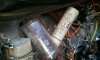
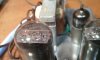
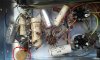
Hi audio electronic enthusiasts! My first post to this board. I have recently brought home a garage sale find, a vintage Magnavox phono console. This is the type that had two speakers, but this only came with the one with the amps in it, which is what I bought it for. They looked neat and I thought it would be a good way for me to expand my interest in vintage audio, which so far has been entirely solid-state. I really don't know much about electrical engineering, but I am handy, I have been a tech director for 15 years, so I know a lot about computers and networks. Tube amps are new to me though and I am excited to see what I can make happen with these. Ultimately I would like to see these as part of my home audio system. I've got the amps out of the console, inspected and cleaned as thoroughly as I can. I'm really not sure where to go from here, so any and all tips, advice, photos, schematics, warnings, websites, you know, pretty much a road map would be great!!! Thank you!
 

Attachments

  • 2012-07-27 14.35.46.jpg
    2012-07-27 14.35.46.jpg
    67.4 KB · Views: 84
  • 479954_3994926145767_346829084_n.jpg
    479954_3994926145767_346829084_n.jpg
    63.9 KB · Views: 81
Those look like either AMP164 or AMP169 monoblocks.

If the model number stamp isn't apparent on the side of the chassis, you can tell the difference, from the input tube. The AMP164 uses a 12AX7, while the AMP169 uses a 6AN8.

Both are well worth resurrecting, but the AMP164 is better known in the "modders circle". I'd like to see someone hot-rod the AMP169s with the 6AN8 in place- maybe re-jigger the input circuit to something like the Dynaco ST35 schematic?

Regards,
Gordon.
 
amp numbers

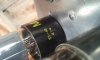
Here's what I have for numbers.

AMP 169 BB for both

6v6 GT is on two tubes

5YG is on the other tube

When these were in the console they definitely warmed up and seemed ready to put out sound, only the phono wasn't working. Now, I've plugged the amp back into the speakers after removing them from the cabinet and plugged in the amp to power and nothing happens. How do you turn it on? How do you regulate the volume? Is that all the function of a pre-amp? Sorry for these basic questions, I'm new to this.
 

Attachments

  • 2012-07-27 13.07.47.jpg
    2012-07-27 13.07.47.jpg
    55.3 KB · Views: 43
  • 2012-07-27 13.05.40.jpg
    2012-07-27 13.05.40.jpg
    75.4 KB · Views: 49
  • 2012-07-27 20.31.02.jpg
    2012-07-27 20.31.02.jpg
    41.8 KB · Views: 48
  • 2012-07-27 20.26.43.jpg
    2012-07-27 20.26.43.jpg
    58.5 KB · Views: 44
  • 2012-07-27 20.29.25.jpg
    2012-07-27 20.29.25.jpg
    52 KB · Views: 49
more numbers

more tube numbers.
 

Attachments

  • 2012-07-27 20.58.02.jpg
    2012-07-27 20.58.02.jpg
    50.1 KB · Views: 31
  • 2012-07-27 20.58.14.jpg
    2012-07-27 20.58.14.jpg
    48.9 KB · Views: 27
  • 2012-07-27 20.59.16.jpg
    2012-07-27 20.59.16.jpg
    46.9 KB · Views: 32
The preamp supplies the switching function for the amp, for power. Without the preamp connected, there's no power connection. Those power wires go out of the 12-pin plug, to the preamp, and back.

You will need to put a new power switch into each amp, and re-wire the correct AC power wires from that 12-pin plug, to the new switch. You should also put in a fuse/fuseholder inline, at that time.

There are several threads here, showing how to wire in that switch. A little searching should find a wealth of info on that subject.

Regards,
Gordon.
 
Newbie searching can be frustrating so here's a couple threads, there are more...
http://audiokarma.org/forums/showthread.php?t=293771#post3619195
http://www.audiokarma.org/forums/showthread.php?t=211157

You should be able to figure out how to get it to power on, and were to insert a switch based on the schematics in those threads.

Unlike solid state amps, tubes need an output load (ie speakers) hooked up to them, don't run the amps without.

You will need a preamp. It could be any stand alone preamp, a passive preamp, or the pre-out from another integrated amp. You could mod the chassis to add volume but since they are monoblocks it makes more sense not to do that route.

The old electrolytic capacitors in the power supply can over time dry out and cause failure, taking out more than just the caps, -- you don't want that. Replacing electrolytic caps in these old amps is often done first thing.

There are high voltages involved - much more potential for a nasty, potentially deadly, shock. There are some good threads here about precautions - find them, read them.

Questions...
What's your time frame for getting these up and running?
You mentioned your tech networking and solid state stuff, how much diy troubleshooting and repair do you have? Do you have and can you use a multi-meter? Can you solder? Can you follow a schematic? If so, it's not difficult to get them running again. Might be best to start a new thread if you run into difficulty and want to ask specific questions.

 
mounted - happy new tuber

Here they are, mounted to a board made from the lid of the original phonograph cabinet. I've boxed the control dials, brought the inputs to the front, installed an on/off switch and run the light from one of the amps across to light up the bulb which is behind the original little ruby lens from the cabinet. Right now, listening to old-tyme-radio sherlock holmes on my ipod. So nice. Ahh. Here's a photo. :music: :thmbsp:
 

Attachments

  • 2012-08-12 14.43.40.jpg
    2012-08-12 14.43.40.jpg
    57.6 KB · Views: 153
Here they are, mounted to a board made from the lid of the original phonograph cabinet. I've boxed the control dials, brought the inputs to the front, installed an on/off switch and run the light from one of the amps across to light up the bulb which is behind the original little ruby lens from the cabinet. Right now, listening to old-tyme-radio sherlock holmes on my ipod. So nice. Ahh. Here's a photo. :music: :thmbsp:

A really easy and wonderful mod on these is to replace the ceramic capacitor tied to the middle of the amp RCA connector, with a film cap of the same or slightly larger value. Seems like I remember .33 :scratch2: I never could understand why they would run the audio signal through a ceramic cap right at the get go. IMHO that sort of limits an otherwise really good 6V6 amp.:music:
 
A really easy and wonderful mod on these is to replace the ceramic capacitor tied to the middle of the amp RCA connector, with a film cap of the same or slightly larger value. Seems like I remember .33 :scratch2: I never could understand why they would run the audio signal through a ceramic cap right at the get go. IMHO that sort of limits an otherwise really good 6V6 amp.:music:

Totally agreed. Ceramics have a terrible phase response across the audio spectrum.
 
Totally agreed. Ceramics have a terrible phase response across the audio spectrum.

I wonder how much cheaper it could have been in the 50s to use a ceramic over a molded cap. I can only imagine how the designers hated the bean counters.:D
 
A couple of questions about these amps. They have a pair of wires coming off which I've tucked away which I originally thought were the output speaker wires, but they would not power any speakers, so I assume that they are 'pre-out' or the equivalent line-level. Is this correct? Is this for bridging purposes so that a mono source can be output from both amps? Also, I've grounded both chassis together to a ground wire in the new plug I installed. Does this sound ok? The other question I have is about ohms. I see near the 'external speaker' outputs an engraved '4-16' which I assume to be ohms. I've got 8 ohm speakers hooked up, but I've been reading that if an amp is rated for 4 ohms, you get twice the power or something if hook up a 4 ohm speaker to it, as opposed to an 8 ohm. The warning seems to be not to hook up a 4 ohm speaker to an 8 ohm source. Right? Obviously I want to get the most from my set up so should I be looking for a pair of 4 ohm speakers? What's the deal with pairs? If you connect two speakers that are 8 ohm (in series? in parallel?) the ohm rating becomes 4, or 16? Can someone help clarify this for me? Is there an article?
 
point it out?

A really easy and wonderful mod on these is to replace the ceramic capacitor tied to the middle of the amp RCA connector, with a film cap of the same or slightly larger value. Seems like I remember .33 :scratch2: I never could understand why they would run the audio signal through a ceramic cap right at the get go. IMHO that sort of limits an otherwise really good 6V6 amp.:music:

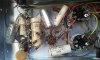
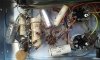
Can you point out which capacitor you're talking about specifically? Here's a photo of the underside.
 

Attachments

  • 2012-07-27 13.05.40 copy.jpg
    2012-07-27 13.05.40 copy.jpg
    72.9 KB · Views: 83
Last edited:
Can you point out which capacitor you're talking about specifically? Here's a photo of the underside.

The one circled in red. Remove, replace with a good quality film cap and then toss the ceramic cap into the nearest trash can.
 

Attachments

  • 6v6 ceramic.JPG
    6v6 ceramic.JPG
    83.6 KB · Views: 133
The one circled in red. Remove, replace with a good quality film cap and then toss the ceramic cap into the nearest trash can.

I'll do it. Next summer I'm going to re-cap my mach1 speakers, and I think I'll do the amps at the same time. Unfortunately this is my summer garage activity type project and we're a week away from leaving. It can wait thought, it'll be fun when I get back to it. Thanks and any more tips or thoughts very welcome.
 
Do yourself a favor...

...and replace all those caps in the picture. If you're going to go underneath it, do them all and never have to worry about it again....:thmbsp:
 
Very cool, I had an eariler version of that console, the mono version, hefty 6v6 PPP mono amp, tweeters were center of the 10" woofers, good sounding console too. Big output iron too...the 142 amp. Good lookin cabinet too
 
You might want to check those amps for equalization circuits if you plan to use them outside the consoles they came in. Magnavox tuned their designs for an overall effect of the console which is why these old Maggie console sound very musical as-is. Howver, if you remove the amps to use elsewhere you need to be aware of what they were "up to"

Right. I ran into this same issue on my circa 1960 Maggie console amp I am refurbishing. Mine has the elusive 6V6 single chassis quad amp in it (model number 8103-10, with separate bass and treble amps for each channel). It's got some EQ circuitry (basically speaker crossovers) on the frontend of the power amp!

Also, the preamp/AM/FM unit has no DC blocking capacitors coming off the outputs! Glad I noticed this as this would wreak havoc trying to use the preamp in another setup.
 
Back
Top Bottom