• The move to the new server is done. There are some software and database maintenance updates in process. This has us passing the hat around to help out. We appreciate any donations. Seriously, even a dollar helps. The payment page may be found here - https://www.audiokarma.org/support.html

Marantz 1090 right side fuse blows

gyrene

No Marconi:Gomer MacGyver
Had the power up for less than two minutes I'd say and the fuse on the right side popped.Its a 250v 5a.
Anyone have experience with the 1090?
I got a schematic from hifiengine and it looks like maybe the rectifier may be bad? Make sense to you guys?Here is the link http://www.hifiengine.com/manuals/marantz/1090.shtml
Its the fuse on the main amp board F702
I'll post more but for now I'd love to hear from anyone with knowledge on this unit.
Thanks
 
Register to hide this ad
Update: the system blows the fuse with a load on speaker system 1 or 2.
No load=no blown fuse.I can switch to system 1 and 2 and the fuse holds.Only with the speakers hooked up does it blow the fuse.
The load is an 8 ohm 25w car speaker.One on each side.
 
Swap the power output transistors from right side to left & vice versa & see if the problem follows the outputs.
 
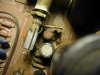
Thanks spear.Something is going on with C802.It looks "rusty" and the adjacent Q has a "thing" around it.Looks like an aluminum collar around the transistor with a wing coming off one side.I'm wondering if the aluminum wing shorted out across R802 & R803 killing something in the path?
I'll post some pics.
 
That avatar looks like BC at night from space?
Here are a few pics.You can see the "rusted" cap.
So if that capacitor is dead it may be causing the "short"...correct?
 

Attachments

  • marantz 1090 002.jpg
    marantz 1090 002.jpg
    76.4 KB · Views: 92
  • marantz 1090 003.jpg
    marantz 1090 003.jpg
    76.1 KB · Views: 84
Last edited:
I'm thinking one of your output transistors are bad, you can ohm them real quick. Best to take them out of circuit, but in circuit (power off and drained):

Tab of Q721 to Anode Q739 and Tab to R761
Tab of Q723 to Cathode of Q741 and tab to R773
Tab of Q724 to Cathode of Q742 and tab to R762
Tab of Q722 to Anode of Q740 and tab to R774

A dim bulb tester would be great with this problem, save you some fuses and the light will go bright as the current draw goes up.
 
From the looks of the picture you could have a short almost any were????

I think you are going to have to figure out more of what board is causing the short.

Start removing the power supply to one board at a time. Sorry to say but I don't know how much effort you should put into that unit?

charles
 
thanks Chief.
airtime...much,till it works.
Thanks
Think I will eliminate the common switch as a source of trouble.
Later
 
Update: the system blows the fuse with a load on speaker system 1 or 2.
No load=no blown fuse.I can switch to system 1 and 2 and the fuse holds.Only with the speakers hooked up does it blow the fuse.
The load is an 8 ohm 25w car speaker.One on each side.

Indicates that something is causing the amp to swing to one voltage rail or the other, bad driver, shorted cap, maybe one bad output.

Swap the power output transistors from right side to left & vice versa & see if the problem follows the outputs.

Never, ever, do that.:no:

Thanks spear.Something is going on with C802.It looks "rusty" and the adjacent Q has a "thing" around it.Looks like an aluminum collar around the transistor with a wing coming off one side.I'm wondering if the aluminum wing shorted out across R802 & R803 killing something in the path?
I'll post some pics.

That aluminum wing is a heatsink, it shouldn't touch anything. It would be a good idea to clean all of the crud out of there before proceeding.
It may be a good time to send this one off to your closest AK tech for some love.:D
 
tarior I really do appreciate your input and thank you for your advice.I see the shorted cap as a real good start.I got the heatsink part but did not think it would be needed.I was wrong...NewsFlash...I was wrong! Hey...it happens.
I look forward to your continued interest in this resurrection project.
Cleaning out the crud is going to happen soon.Like tomorrow probably.If I can chip the ice off everything that seems to have frozen solid.
There is plenty of love just pouring out of me on this one...I swear there is!
In fact I'm a love machine on these resurrection deals.
If anyone believes in luck throw some my way please.I may need it.
Updates and pics to follow.
Thanks everyone.
 
Update: After looking a bit more under the magnifying glass I'm thinking that I'll place an order at mouser.com.
Question is as long as I'm ordering a few caps that appear to be the offenders should I just go ahead and recap the entire thing?
Of course I'd find and fix the problem before committing to the big recap so as not to mask the real trouble.
Capacitors and transistors assuming I can get suitable replacements would be...lets say less than $50?
Since I don't have the correct caps on hand its looking like that'll be the plan.
What do you guys think?
Please don't tell me to bring it to a "tech"! That'd be quitting and after all who quits on a resurrection project? Not me.
And hey! it doesn't have to be mouser if you all have a place with high quality audio grade caps please inform me.Don't want to ruin a perfectly good Marantz now do I?
 
I would order all caps and transistors for driver boards-both sides-.
If the outputs are bad order replacements also.
Do not install the outputs until we know if drivers are good. Unit can be started without outputs in place.
Also find the power supply board and order caps for it.

Shouldn't add up to much $ at all. Usually it's best to order the smaller cap values in 10's as that is generally the price break and you'll find they are common sizes and you will need them again.
Don't worry too much about exact voltages as long as you go higher withing reason.
I.E. instead of 25v 10uf order more 10uf 50v if you get my drift.
 
O.K. I have the schematic from hifiengine.I'll use the parts list from that?
Any suggestions in that regard?
 
Before going any further, I would recommend buying a paper copy of a service manual from Stereomanuals.com or servicemanual.net. Working from a PDF sucks in a big way.
You can order all of the parts you want, but don't recap until you've solved the original problem. I don't even bother with the parts list in the SM, I just look at what's on the boards and go from there.
I use Nichicon PM, PW, HE caps almost exclusively, except where a low leakage type is called for (and for replacing most tantalums) in which case I usually use Nichicon KL series. I'm likely going to start using stacked film caps to replace small value e'lytics in signal path apps, though.
 
No load=no blown fuse...Only with the speakers hooked up does it blow the fuse.
The load is an 8 ohm 25w car speaker.One on each side.

Did you measure the DC voltage at the output, with no load?

Did you interchange the speaker from left to right? Could be a bad, almost shorted, speaker.

After your bad experiment (on post #10), do you have +38V at the emitter of Q803?

What test equipment do you have?
 
ecluser I did not do these things but I certainly will if you coach me through them.
As for equiptment...I have a digital multi meter and a curious mind with a ton of persistance.
If you tell me what to do like I was in the eight grade that usually works.
Thank you very much for your input and interest.
Look forward to working with you.
 
It's easy. Disconnect the speakers. Connect the negative probe of your meter (in DC volt range) to the chassis, and the positive probe on the speaker fuse. Check both channels. The DC voltage at the fuse should be below 0.1V. Anything larger than this is an indication of a trouble within the amplifier section.

Since the fuse doesn't blow without speaker, I think you may have a problem with your speaker and/or your connections to the speakers.

5A is a lot of current for a 25W speaker. Make sure there is no short in your speaker wires.
 
Outstanding.Thank you very much for sharing the how and why on this,ecluser.
Do you think I may have a problem with in the "speaker 1&2" switch?
Fuse blows when I engage either of the two speaker switches.
 
ecluser here is a question and my attempt to answer it myself.please help me understand the thought process.
Q.Can I measure the DC voltage at the speaker terminal instead of the speaker fuse?
A.You can but because the expected voltage is only .1v or less the reading may not be
accurate due to a voltage drop from the fuse to the speaker terminal.
 
ecluser would that be the .5a 250v fuse on the pre amp board?
As for orientation on putting the positive lead on the speaker fuse I can attach the positive lead to either side of that fuse and not cause damage?
Thank you
 
Back
Top Bottom