• The move to the new server is done. There are some software and database maintenance updates in process. This has us passing the hat around to help out. We appreciate any donations. Seriously, even a dollar helps. The payment page may be found here - https://www.audiokarma.org/support.html

Marantz 2215 HUM

Ryan Lahay

New Member
Hello! First post in this forum, hopefully this is the correct place for it.

As the title says, I have a Marantz 2215 that has a loud hum in the right channel. The hum is there regardless of input, and isn't effected by the balance knob or Volume knob (volume can be at zero and its still there). There is a "slight" hum in the left channel aswell when less than a foot away from it, but thats expected since I'm using High sensitivity speaker's (Klipsch Heresy).

When I first turn the unit on the hum is barley noticeable, but after a few minute's the right channels hum is loud enough to hear very clearly even throughout quiet parts of songs.

Any help is appreciated.

Edit** Hum is the same in headphones. Slight hum in left channel but very loud in right channel.
 
Last edited:
Register to hide this ad
Welcome to AK Ryan! You posted in the right place alright.

I'd be guessing that there is a bad electrolytic cap in the right channel amp circuitry. They are pretty dried out by now. When the electrolyte dries out it crystallizes and expands and can eventually pull one of the leads loose, killing the cap. If not the series resistance goes up as well as the capacitance so it works poorly. The light purple ones made by Panasonic are the worst ones I've come across so pop the cover and take some amp module pics for us.
 
Welcome to AK Ryan! You posted in the right place alright.

I'd be guessing that there is a bad electrolytic cap in the right channel amp circuitry. They are pretty dried out by now. When the electrolyte dries out it crystallizes and expands and can eventually pull one of the leads loose, killing the cap. If not the series resistance goes up as well as the capacitance so it works poorly. The light purple ones made by Panasonic are the worst ones I've come across so pop the cover and take some amp module pics for us.
Welcome to AK Ryan! You posted in the right place alright.

I'd be guessing that there is a bad electrolytic cap in the right channel amp circuitry. They are pretty dried out by now. When the electrolyte dries out it crystallizes and expands and can eventually pull one of the leads loose, killing the cap. If not the series resistance goes up as well as the capacitance so it works poorly. The light purple ones made by Panasonic are the worst ones I've come across so pop the cover and take some amp module pics for us.

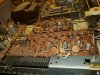
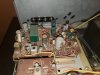
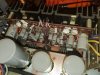
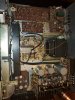
Not exactly sure where the amp module is, so i will post a few pics.
 

Attachments

  • 15964234280347784741634664148905.jpg
    15964234280347784741634664148905.jpg
    139.2 KB · Views: 45
  • 15964234535991028345809200946989.jpg
    15964234535991028345809200946989.jpg
    126.2 KB · Views: 43
  • 15964234712592139072179887795829.jpg
    15964234712592139072179887795829.jpg
    130.4 KB · Views: 46
  • 15964234815038413158027532297357.jpg
    15964234815038413158027532297357.jpg
    152.3 KB · Views: 41
One assumption I'll make is that the bottom cover is on as when it's off there's more hum. Was this working okay before and just failed or did you just get it that way. In the latter case some hack may have done some incorrect work.

Nice clean unit inside though. Picture 1 is the FM IF board, number 2 is the FM MPX decoder and number 3 is the winner, the amp! No light purple caps and these "look" okay as the plastic has not pulled back off the ends you see from swelling out the other end by the board. BUT, they can still be bad! I'd start with recapping the board. Many folks will say that's wrong but not me! I don't go for just shotgunning transistors and diodes as some have done though. That term means just blindly replacing parts. Time to look up some threads on recapping and give it a go if you have a decent soldering iron (not gun!) and soldering skills.
 
Bought it this way the other day. Didn't notice the hum when testing, but he had 2 different VERY cheap speakers connected to it.

I'm not sure what you mean by the "bottom cover", care to elaborate?
 
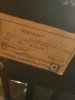
Yes, plate is there. I also noticed this sticker, assuming this is the place is what bought from?
 

Attachments

  • 20200803_004014.jpg
    20200803_004014.jpg
    47.3 KB · Views: 25
The metal cover plate on the bottom side of the receiver.
I found another post that u were involved in, with a similar issue on a 2215 and saw that the guy was getting a reading of "113v" on the "large cap" and that it didn't seem right. Well I measured mine using the "500v" setting instead if the 600v as he did, and i get 113v, assuming since we both got the same reading the cap isn't the issue?
 
There's no way there's 113V DC on that cap. Try measuring from the chassis ground to the "-"/minus/black dotted terminal where you should see near 0Vdc. If so, then move the probe to the other cap terminal and see what you get. I did a 2215 last May and shipped it home and sure don't recall that much voltage on it and I bring new filter caps up on a variac, which has a nice fat knob to adjust the line voltage at it's output.

I used a Nichicon 3300uF/63V main filter cap BTW. Mouser part number 647-LKG1J332MESCBK.
 
There's no way there's 113V DC on that cap. Try measuring from the chassis ground to the "-"/minus/black dotted terminal where you should see near 0Vdc. If so, then move the probe to the other cap terminal and see what you get. I did a 2215 last May and shipped it home and sure don't recall that much voltage on it and I bring new filter caps up on a variac, which has a nice fat knob to adjust the line voltage at it's output.

I used a Nichicon 3300uF/63V main filter cap BTW. Mouser part number 647-LKG1J332MESCBK.

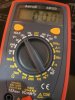
When using this setting (in pic) I get a reading of 51. I tried what you said and got 0 on the chassis, but still 112/113 on the terminal.

Edit** (i'm no pro at this) so I looked up the DC/AC symbols and im not getting 113 DC, im getting 113 AC.
 

Attachments

  • 15964898188973362078963800777352.jpg
    15964898188973362078963800777352.jpg
    87.6 KB · Views: 10
Last edited:
I believe that DC reading but if that AC reading is not in mV, meaning 0.113V, the filter cap is pooched.
 
Just had a brain flash... hopefully you have clip leads or probes with clips. Attach the test leads and have the meter in dc volt mode and watch the display at power down. If it slowly goes down the main filter is probably okay. If it goes off very fast the cap is likely a goner - open circuit and useless.
 
Just had a brain flash... hopefully you have clip leads or probes with clips. Attach the test leads and have the meter in dc volt mode and watch the display at power down. If it slowly goes down the main filter is probably okay. If it goes off very fast the cap is likely a goner - open circuit and useless.

No alligator clips, but i used my steady hand skillz and held the leads on with one hand and powered down with the other.

It started at 51 and went down in increments of 1 or 2. I wouldn't say "fast".
 
Just had a brain flash... hopefully you have clip leads or probes with clips. Attach the test leads and have the meter in dc volt mode and watch the display at power down. If it slowly goes down the main filter is probably okay. If it goes off very fast the cap is likely a goner - open circuit and useless.

Question though, yes both channels have a hum, but the right channel has a loud hum. Is it still possible the filter caps/ power suplly section issue is only affecting one channel? Or would it most likely be in the power amp section?
 
Question though, yes both channels have a hum, but the right channel has a loud hum. Is it still possible the filter caps/ power suplly section issue is only affecting one channel? Or would it most likely be in the power amp section?
You are right, it is most likely in the amp. I just wanted to put to rest if the main filter failed and it sounds fine. Wish I could steer you to one particular part but it will need tracked down. I’m not in front of my computer to look at a schematic but it is odd. Perhaps a ground connection particular to the humming channel is broken?
 
You are right, it is most likely in the amp. I just wanted to put to rest if the main filter failed and it sounds fine. Wish I could steer you to one particular part but it will need tracked down. I’m not in front of my computer to look at a schematic but it is odd. Perhaps a ground connection particular to the humming channel is broken?

Yea, it's strange either way. Thanks for all the info though. I managed to find a guy who does this stuff for "hobby" and said he can fix pretty much anything for 20-50$, and that he uses parts from other units that are 5-10 years old. Obviously I don't want old parts used so I asked if he could diagnose the problem for me and let me install the caps/whatever needs to be replaced and he said he would be happy too and that depending on how long it takes him he may not charge me anything:)
 
Back
Top Bottom