

[Edit: It's the H802 transistor, but I can't edit the title of the thread]
Hi,
I am in the process of cleaning up and recapping a Marantz 2230 that has been in the family for over 50 years. I had a relamp kit I bought in 2020 still laying around, and decided to go all-in and do a full restore a few weeks ago to make this receiver (fingers crossed) play happily for another 50 years.
Cleaning the controls helped a lot, and the rest of the restore went smoothly using a kit by Peace, Love, and Music (excellent instructions included!). I took my time with each board and tested the unit on the dim bulb tester and by playing some music after each board. I am pretty sure I did not break anything, everything works and the unit sounds amazing to my ears - I can't tell for sure, but it does seem to have gotten even better after the restore.
The only thing giving me a bit of a headache is the P800 power supply board. The restore included all the electrolytic capacitors, the two regular diodes H804 and H805 (not the Zener diodes), and H803 with a JCC2383Y transistor as included in the kit. I also cleaned the "external" transistor H801 and reapplied fresh non-conductive thermal compound. Afterwards, the output voltage was easily adjustable to 35.6V following the procedure in the service manual and stays very stable while running the unit for more than 20 minutes.
However, I noticed that H802 gets pretty hot. There's no sign of smell, smoke or any burnt components, but I can not touch it for more that a few seconds. Is that normal or could something else be amiss?
I checked and double-checked all the solder connections for cold joints or solder bridges. I tested all the transistors by measuring the diode joints and checking for shorts (in-circuit). I measured the capacitance of all the new capacitors, all are in spec. I measured all the resistors in circuit and took one leg up on R807, R808 and R809 because the measurements in-circuit were a bit off. Except for R807, which is supposed to be 3.9k and measured 4.3k, and R803 with 3,3k vs. 3.5k, all resistors are well in spec. I checked the Zener diodes in-circuit with a cheap multi-function tester (T7-H) and they were both identified correctly.
Other components on P800 are not running hot. The load resistor R018 (below the board) measures 156 Ohms and does not get overly hot.
I then measured the following voltages (blue): Most seem more or less close by their expected values (red), but the collector voltage of H802 is 2 volts higher than specified. With my limited understanding of how this circuit is supposed to work, I am assuming that H802 is handling a higher voltage drop than designed, which leads to more heat being dissipated.
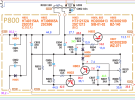
The AC voltage going into the board is 35.2V (purple). It is an international unit and the primary side of the transistor is wired for 240V per the service manual (we have around 230V in Germany).
I am unsure whether I should replace all the resistors, the Zener diodes and the remaining 2 transistors, or whether I should just put a heat sink on H802 (or do nothing at all) and call it a day. I did not check the temperature of H802 before the restoration, so it could have been like this the whole time (or slowly drifted to this situation over the years). As said, the output voltage on J808 is very stable and the unit works fine and sounds great, even for a long time (2-3 hours). However, I am unsure whether the heat might lead to a failure of H802 with potentially catastrophic damages down the line.
Any ideas or hints appreciated!
Sebastian
Hi,
I am in the process of cleaning up and recapping a Marantz 2230 that has been in the family for over 50 years. I had a relamp kit I bought in 2020 still laying around, and decided to go all-in and do a full restore a few weeks ago to make this receiver (fingers crossed) play happily for another 50 years.
Cleaning the controls helped a lot, and the rest of the restore went smoothly using a kit by Peace, Love, and Music (excellent instructions included!). I took my time with each board and tested the unit on the dim bulb tester and by playing some music after each board. I am pretty sure I did not break anything, everything works and the unit sounds amazing to my ears - I can't tell for sure, but it does seem to have gotten even better after the restore.
The only thing giving me a bit of a headache is the P800 power supply board. The restore included all the electrolytic capacitors, the two regular diodes H804 and H805 (not the Zener diodes), and H803 with a JCC2383Y transistor as included in the kit. I also cleaned the "external" transistor H801 and reapplied fresh non-conductive thermal compound. Afterwards, the output voltage was easily adjustable to 35.6V following the procedure in the service manual and stays very stable while running the unit for more than 20 minutes.
However, I noticed that H802 gets pretty hot. There's no sign of smell, smoke or any burnt components, but I can not touch it for more that a few seconds. Is that normal or could something else be amiss?
I checked and double-checked all the solder connections for cold joints or solder bridges. I tested all the transistors by measuring the diode joints and checking for shorts (in-circuit). I measured the capacitance of all the new capacitors, all are in spec. I measured all the resistors in circuit and took one leg up on R807, R808 and R809 because the measurements in-circuit were a bit off. Except for R807, which is supposed to be 3.9k and measured 4.3k, and R803 with 3,3k vs. 3.5k, all resistors are well in spec. I checked the Zener diodes in-circuit with a cheap multi-function tester (T7-H) and they were both identified correctly.
Other components on P800 are not running hot. The load resistor R018 (below the board) measures 156 Ohms and does not get overly hot.
I then measured the following voltages (blue): Most seem more or less close by their expected values (red), but the collector voltage of H802 is 2 volts higher than specified. With my limited understanding of how this circuit is supposed to work, I am assuming that H802 is handling a higher voltage drop than designed, which leads to more heat being dissipated.
The AC voltage going into the board is 35.2V (purple). It is an international unit and the primary side of the transistor is wired for 240V per the service manual (we have around 230V in Germany).
I am unsure whether I should replace all the resistors, the Zener diodes and the remaining 2 transistors, or whether I should just put a heat sink on H802 (or do nothing at all) and call it a day. I did not check the temperature of H802 before the restoration, so it could have been like this the whole time (or slowly drifted to this situation over the years). As said, the output voltage on J808 is very stable and the unit works fine and sounds great, even for a long time (2-3 hours). However, I am unsure whether the heat might lead to a failure of H802 with potentially catastrophic damages down the line.
Any ideas or hints appreciated!
Sebastian
Last edited:
 ), the precision is better as well.
