• The move to the new server is done. There are some software and database maintenance updates in process. This has us passing the hat around to help out. We appreciate any donations. Seriously, even a dollar helps. The payment page may be found here - https://www.audiokarma.org/support.html

Marantz 2230 recap & LED conversion

Perfect, thanks patfont. I'll look in the morning. Catching some zZzZz's now. :)

Edit: ahh a nichicon, that was going to be my next port of call, when I had some more time. Thank you.
 
Last edited:
Ok thats annoying. The only place I can get all those caps listed above by patfont is mouser. All are in stock apart from the 47uf 50v silmic II's. I can only get them in a quantity of 2000. Bugger that!

Cap total £2.67 (without 47uf 50v) :thmbsp:
Delivery £12 :thumbsdn:

OMG! I'm going to bed, getting late here. RANT RANT..:grumpy:

A question Pingu: Would it not be easier (and cheaper) to order from Farnell UK? They may not have the exact same caps, but you should find caps of equivalent quality from Nichicon (PW, KZ, KA, KW, FW series); Panasonic (FR, FM, FC series); United Chemicon (KZE, LXY)...etc...
 
Last edited:
Here are Farnell numbers if it saves you $$$

1890139
1848464
1848462
1900057
1823813
 
Last edited:
Hehe, many thanks guys! :thmbsp: And for all the donkey work for me! :thmbsp::thmbsp:

I just tapped those numbers into their website and...

Panasonic 22UF, 35V is min quantity of 150... edit, I must have done something wrong on their website, this is not the case...
Wima 1UF, 63V is min quantity of 10 (I could live with this)

What I was thinking was to gather all the info together for the other boards and putting one order to someone at some point. To try and save on shipping, I know I'm being frugal, but I have to be at the moment....:sigh:

either that or I'll get the caps from a couple of different places, eg hifi collective (they stock elna's) I really do want the elna silmic II caps in the signal path...:yes:

I do think I should get all the caps at once so I'm not sitting around waiting for them to arrive.

What I could do is with learning how to tell what caps are in the signal path and what aren't, so I can decide what to put where. :scratch2:
 
Last edited:
Actually, thinking about it I think I'll go through each board as it comes. I know that will make it a longer process but I can sit down and take my time, rather than being tempted to rush and ruin. Does anyone else agree? Besides I'm not in a hurry for it to be done. I have my 2215b as a good stand in at the moment. :)
 
I would just put nice caps on them amp boards it is not like there is alot.

47uf 50V example

Panasonic FC .38

Nichicon KZ .62

Elna Silmic II .80

How much $ are you saving?

I do not want to start a spitting match with any one but I can hear the difference in caps in all locations:signal coupling, power and bypass.
 
Hehe, many thanks guys! :thmbsp: And for all the donkey work for me! :thmbsp::thmbsp:

I just tapped those numbers into their website and...

Panasonic 22UF, 35V is min quantity of 150... edit, I must have done something wrong on their website, this is not the case...
Wima 1UF, 63V is min quantity of 10 (I could live with this)

What I was thinking was to gather all the info together for the other boards and putting one order to someone at some point. To try and save on shipping, I know I'm being frugal, but I have to be at the moment....:sigh:

either that or I'll get the caps from a couple of different places, eg hifi collective (they stock elna's) I really do want the elna silmic II caps in the signal path...:yes:

I do think I should get all the caps at once so I'm not sitting around waiting for them to arrive.

What I could do is with learning how to tell what caps are in the signal path and what aren't, so I can decide what to put where. :scratch2:

Signal Path on which board?
 
I also don't like that "foam block filler" look... makes those new "small" caps look even wimpier! (and yes, size does matter when you're showing off big caps...)

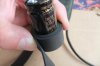
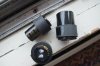
here's what I did: I got some black rubber roofing material from a friend and cut it into strips approx. 1/2" wide... then I rolled it up around the cap near the base until the proper diameter was reached, then I cut the stip and attached with a small piece of tape... then I was able to install the unit into the existing clamp, and the fit is super snug and rock solid... it's difficult to see the coils, they look "beefy", and in a way, they look like they're supposed to be there... that rubber is dense (like an inner tube) and should last nicely for decades

see PICS below

I used 6800uF for the filter, and 4700uF for the coupling caps... Nichicon KG Gold Tunes

(btw, I tried doing this first by wrapping black electrical tape around the base, however, it was very hard to wrap it on it as one neat coil, plus overnight, the tape actually moved and became completely distorted... do NOT use this method!)
 

Attachments

  • DSCF2328.jpg
    DSCF2328.jpg
    43.7 KB · Views: 197
  • DSCF2331.jpg
    DSCF2331.jpg
    57.8 KB · Views: 180
  • DSCF2531.jpg
    DSCF2531.jpg
    97.7 KB · Views: 249
Then why make the statement, you know it'll start one.:nono:

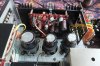
Well maybe you can help then, for example on the pic he posted of the Amp Board, which caps should he replace with his choice of "signal path caps" and where could he save $ if he wanted what are the importiant ones to get right. You seem very helpful here in the Marantz forum and I enjoy your input. So why not add what you would suggest? I only suggest what I have tried on my personal equipment and some times like to make a recommendation like others do. Just trying to be helpful.
 
Honestly, I sit down on mousers site and choose the caps based on service life and temp rating or for simplicity I'll run a cap list with part numbers that already exist. The 2270 list was all panasonic and that's what I went with and there was a noticeable sound improvement over all. Can I put my finger on what sets of caps I replaced made the best sound improvement? No. Do I care to know? No. Do I think no matter what caps are chosen there will be a sound quality improvement? Yes.

Nichicon kt are an audio grade cap at an affordable price. You can choose nichicon muse as well. I stick to film caps where space allows. Would I go to the extent of remote installing caps off of a board to see if there is a sound difference, no , however some may choose to. I'm more in it for the maintenance and repair aspect than the curiosity perspective. It's cool what you did with the 2245 and doing it for your own gear is all good in my books. I can't say I'd do that to a receiver I'm rebuilding for someone, in fact I stick with original values based on what it was built with. I don't need a unit coming back because I decided to experiment. My 1060 cap list is special, I'll be posting the recap one its started. Leestereo took 5 + hrs out of his life to design a cap list based on signal path, decoupling and low ESR within the circuit. It's not the normal rebuild I would do, even the resistors are being changed out for metal film. The entire fabric of the unit is being changed. So if you want an expert opinion of what caps should be used where, he has the reasoning. I'm starting to understand but I have a ways to go on redesign.

As an example I changed the coupling caps in my heathkit el84 tune amp today, went from old pio to orange drops. For the life of me I couldn't hear a difference, maybe I'm going deaf.
 
Last edited:
Honestly, I sit down on mousers site and choose the caps based on service life and temp rating or for simplicity I'll run a cap list with part numbers that already exist. The 2270 list was all panasonic and that's what I went with and there was a noticeable sound improvement over all. Can I put my finger on what sets of caps I replaced made the best sound improvement? No. Do I care to know? No. Do I think no matter what caps are chosen there will be a sound quality improvement? Yes.

Nichicon kt are an audio grade cap at an affordable price. You can choose nichicon muse as well. I stick to film caps where space allows. Would I go to the extent of remote installing caps off of a board to see if there is a sound difference, no , however some may choose to. I'm more in it for the maintenance and repair aspect than the curiosity perspective. It's cool what you did with the 2245 and doing it for your own gear is all good in my books. I can't say I'd do that to a receiver I'm rebuilding for someone, in fact I stick with original values based on what it was built with. I don't need a unit coming back because I decided to experiment. My 1060 cap list is special, I'll be posting the recap one its started. Leestereo took 5 + hrs out of his life to design a cap list based on signal path, decoupling and low ESR within the circuit. It's not the normal rebuild I would do, even the resistors are being changed out for metal film. The entire fabric of the unit is being changed. So if you want an expert opinion of what caps should be used where, he has the reasoning. I'm starting to understand but I have a ways to go on redesign.

Very cool can't wait to see it, if you look at the post I just put up on my 2245 thread you will see that the Preamp Board has lost the "outboard caps" and the phono board is in the process. I want it to be an install others can do with no problems down the road. And yes Leestereo knows, I have read some of his other posts. I think seeing the cap list for the 1060 will be huge, as there are many models that have similar boards inside. Really looking forward to seeing it.
 
Last edited:
Hi Guys,

Thanks for the replies. patfont please don't think you aren't helping, you are really! :thmbsp:

I'm sorry I am being really picky, the problem is I really don't want to mess this recap up, I want it to be the best I can do based upon well known knowledge here. Basically I wanted to prey on others experience to make mine really good. The problem is this receiver means quite alot to me as you know, and the pressure feels on not only to make it a nice looking recap but also a nice sounding one. Maybe I shouldn't have started with this receiver.

I just need to stop being so analytical about the whole thing. I respect all of your opinions bk, leestereo and patfont. I just find it difficult as to what information to put into process.

Like you say patfont, the additional cost would be minimal. I'm going to stop whining and get on with it.:yes:

I'm going to stick to the origional plan set and start with the power amps and get the caps from wherever I can to get me started.

What I don't want to do is piss every one off, I am sorry to be a pain. :sigh:
 
This to me is not a problem, having listened to every imaginable electrolytic cap and film capacitor installed on Marantz circuit boards I just thought I would throw in my 2 cents. I do all my choosing by ear, so there are more technical minded here that can choose based on other perimiters, which I highly respect and am indeed wishing silently that the 2 sides can work toward the same goal of advancing the current state of a Marantz rebuild. I do receive quite a bit of PM's wanting sonic ideas, and I will stick to that and not voice my opinions in the "forum" unless directly asked. I will now just sit back and enjoy.
 
Technology and your ear should always agree... If not, one or more are wrong. Or you put the parts in wrong.
 
Patfont- please don 't take it as an attack, if you believe that you can hear differences in the caps you choose then so be it, you're going with what you hear. What I was trying to point out is there are "other" factors in the circuit to use certain caps- branding aside. IMO there is too much hype as to what cap should be used where. I'd ask the question as to "why" certain caps should be used in the certain areas of the circuit- There are general purpose caps, audio caps, low esr caps, caps with less ripple than others. With that being said, maybe there is thought process associated to where it would be advantageous to use a low esr cap over and audio cap, or a general purpose cap over a low esr cap. That is what I want to understand to become better at making choices for partial restoration.
 
I actually believe that the objective (technology) and subjective (ear) sides do converge, eventually. In the late 60s, when transistors were being introduced to the consumer market, many noticed that these solid state units measured much better than their tube predecessors, but many also noticed that the tube stuff sounded better. IMHO, the conclusion isn't that one side was wrong; they were both right, the more accurate conclusions are: the ear is an excellent judge of sound and the technology of the day wasn't measuring the right parameter(s). Fast forward to the present and will are still having the same debate. As jstang stated "technology and your ear should always agree"...ideally, yes, but in some cases what we measure is inadequate (e.g., THD) and in other case it is sufficient, depending on the question, e.g., What is the residual ripple by using this size and type of capacitor in this circuit?" Both approaches have to utilized to get best out of any piece of equipment. An obvious example is the development of capacitors, the Elna Silmic II and Nichicon Muse capacitors benefited from the technology needed to develop low ESR capacitors, high ripple tolerance caps, vibration resistance caps...etc.. and their parameters are chosen and optimized for the use of these caps in the signal path use.

 
100% on the ear and tech.... It is up to the "brain" to interpret both and connect the dots correctly.....

I often and repeatedly post a URL for Walter Jung's doc....that doc a few others line up what you hear and what is happening on the tech side...

But personal taste might lead one to like one thing better than something else...and that is your choice.

However, on occasion people learn that what they are listening to and like is actually a distortion.

Nothing wrong with it..... I still enjoy a Big Mac every now and then...but I don't pretend they are a good steak....

I actually believe that the objective (technology) and subjective (ear) sides do converge, eventually. In the late 60s, when transistors were being introduced to the consumer market, many noticed that these solid state units measured much better than their tube predecessors, but many also noticed that the tube stuff sounded better. IMHO, the conclusion isn't that one side was wrong; they were both right, the more accurate conclusions are: the ear is an excellent judge of sound and the technology of the day wasn't measuring the right parameter(s). Fast forward to the present and will are still having the same debate. As jstang stated "technology and your ear should always agree"...ideally, yes, but in some cases what we measure is inadequate (e.g., THD) and in other case it is sufficient, depending on the question, e.g., What is the residual ripple by using this size and type of capacitor in this circuit?" Both approaches have to utilized to get best out of any piece of equipment. An obvious example is the development of capacitors, the Elna Silmic II and Nichicon Muse capacitors benefited from the technology needed to develop low ESR capacitors, high ripple tolerance caps, vibration resistance caps...etc.. and their parameters are chosen and optimized for the use of these caps in the signal path use.
 
...However, on occasion people learn that what they are listening to and like is actually a distortion.

Nothing wrong with it..... I still enjoy a Big Mac every now and then...but I don't pretend they are a good steak....

Very good point. It is known that even ordered harmonic distortions are interpreted by the brain as a pleasant "fuller" sound. In fact, the addition of even harmonic distortion is basically the operating basis of the Aphex Aural Exciter, a studio mixing sound enhancer that was used extensively in the 70s. This unit made tons of money for its creators, see http://en.wikipedia.org/wiki/Aphex_Systems. Similarly, in very general terms, tube amplifier designs, especially SET, have more even ordered distortions than solid state designs. Its like my Conrad Johnson tube preamp, I love its sound, but I also know that its not as accurate as my SS preamp and that's OK...sometimes I want chocolate ice cream rather than vanilla. Its a preference at a given particular time. Nevertheless, I tend to prefer a clean, neutral sound as a starting point, which I can modify (tone controls, tube rolling, speaker positioning), to an "enhanced" sound that is built-in to the circuit that can't be undone or compensated for easily.
 
I would just put nice caps on them amp boards it is not like there is alot.

47uf 50V example

Panasonic FC .38

Nichicon KZ .62

Elna Silmic II .80

How much $ are you saving?

I do not want to start a spitting match with any one but I can hear the difference in caps in all locations:signal coupling, power and bypass.

It wasn't about the cost of the caps it was more about the saving in multipul postage orders. The one order would cost £12 to post obviously more would cost many £12 to post.

But I don't want to get hung up on that. :)
 
Back
Top Bottom