• The move to the new server is done. There are some software and database maintenance updates in process. This has us passing the hat around to help out. We appreciate any donations. Seriously, even a dollar helps. The payment page may be found here - https://www.audiokarma.org/support.html

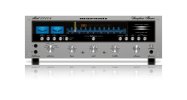
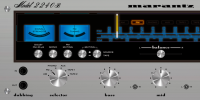
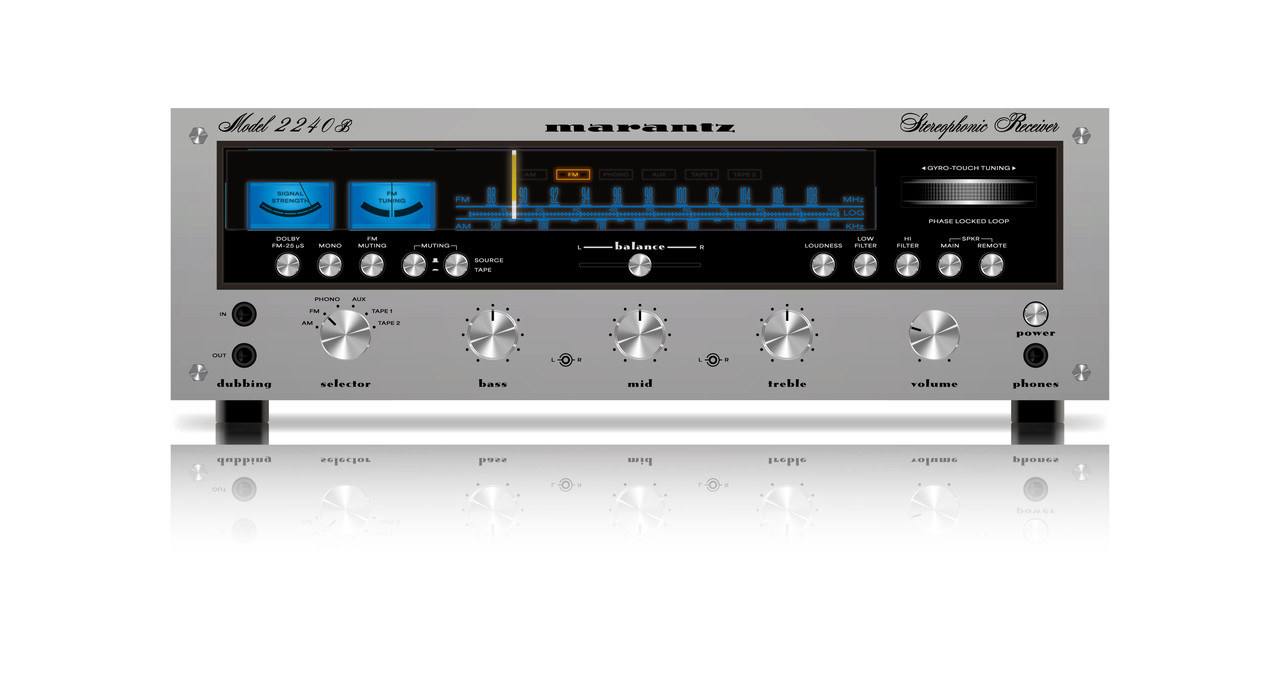
Marantz 2240B – new object of (visual) desire :-)

Heller

Active Member
Hello everybody!

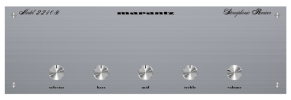
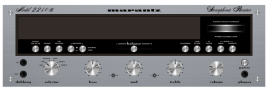
I’m about to start a visual, artistic re-creation of the Marantz 2240B front view. Could I find some support here, in terms of good high-res photos of that receiver?

The result will be following the style of my recent creations:


This will again be a private, non-commercial fun project.

Thanks a lot!
 
Register to hide this ad
Using the font »Davison Spencerian« for the script parts of the lettering seems to be a good choice. Still, the capital letters M, B, S and R need to get some extra work.

1768748797474.png
 
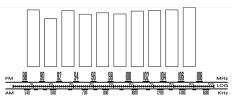
Recreating one of those FM/AM tuning scales always gives me headaches (See a b/w version of what I’ve built up so far for my 2240 B)

I don’t understand the »logic behind« the FM scale. The spacing between the given values (88, 90 … 108) makes no sense to me. Had it »analyzed« by ChatGPT: It does not seem to understand it just the same :crazy:

b-w-scale.jpg
 
Recreating one of those FM/AM tuning scales always gives me headaches (See a b/w version of what I’ve built up so far for my 2240 B)

I don’t understand the »logic behind« the FM scale. The spacing between the given values (88, 90 … 108) makes no sense to me. Had it »analyzed« by ChatGPT: It does not seem to understand it just the same :crazy:

View attachment 3682859
Google's AI does a decent job:

AI Overview


The FM radio scale (88–108 MHz) is designed to provide high-fidelity audio by using wide, 200 kHz channels within the VHF radio spectrum, preventing interference between stations
. Frequencies are centered on odd decimals (e.g., 88.1, 88.3) to allow for a 100 kHz buffer on either side, reducing overlap in the 88.0–108.0 MHz range.
Key Aspects of the FM Scale Logic:
  • Frequency Range: The 88–108 MHz band was designated by the FCC in 1945 for superior, interference-resistant, wide-band audio.
  • Channel Spacing: Each station operates within a 200 kHz channel, with a 75 kHz deviation on either side of the center frequency.
  • Odd Decimals (.1, .3, .5, .7, .9): To maximize space, the center frequencies are separated by 200 kHz, starting at 88.1 MHz. For instance, an 88.1 MHz station operates within 88.0–88.2 MHz, leaving a 100 kHz buffer for the next station starting at 88.3 MHz.
  • Methodology: Unlike AM (Amplitude Modulation) which changes power, FM (Frequency Modulation) changes the frequency of the carrier wave to encode audio, reducing noise from electrical interference.
  • Range Limitations: FM uses "line-of-sight" propagation, meaning signals are generally limited to about 50–100 miles, as they are blocked by terrain.
 
I added (strongly enlarged) bars to visualize the deviation of the different spaces within the MHz pairs. As you can easily see: the 90/92 space is the smallest, while the 106/108 space is the largest.

1769251109610.png
 
Last edited:
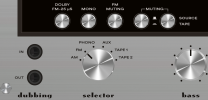
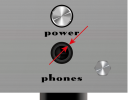
Regarding the phones/dubbing sockets – is that a gap in reality, between the metal front panel and the socket body itself?

1769497797100.png
 
I've never really looked at it that closely, but I believe it is just a gap. I'll check later tonight if you still need it.
 
I found a picture of a 2230 I've been doing a little work on and it looks like there is both a space there and a little black plastic ring. Here's as good of a picture I can make out of it.
 

Attachments

  • IMG_1648.png
    IMG_1648.png
    394.3 KB · Views: 3
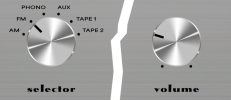
Final step was giving a slightly different angle to all those »reflection-propellers« on top of each knob or screw. Compare »selector« to »volume« here:

1769546211863.png
 
Back
Top Bottom