
• The move to the new server is done. There are some software and database maintenance updates in process. This has us passing the hat around to help out. We appreciate any donations. Seriously, even a dollar helps. The payment page may be found here - https://www.audiokarma.org/support.html

Marantz 8B help needed!

callahan1973

New Member
I purchased a Craigslist Marantz 8B recently and am in love with it so far but I recently moved and ever since I can’t get it to bias properly - even with the pots maxed out it is still maybe 25% of the way short of the mark. Those of you that are experts out here can maybe help me. I took a pic of the underside of the machine and I was wondering/praying the machine wasn’t butchered in a prior repair. I know there are a few holes in the chassis near the can on the right that were added later and I know that some caps have been replaced but I was wondering if anyone had any insight who is more experienced than I. I want to do right by this piece of history and will take it where it needs to go, won’t do the work myself, but I was wondering if anyone had advice. Thanks in advance!
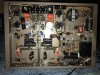
 

Attachments

  • 37C50F67-3648-45E6-9C81-AB35A51F5B7C.jpeg
    37C50F67-3648-45E6-9C81-AB35A51F5B7C.jpeg
    149.4 KB · Views: 157
Register to hide this ad
Need a schematic with voltages so you can check the different parts of the circuit as parts can drift over the years & there looks to be quite a few old caps and resistors left.

Tubes could have issues also from the move etc.
 
As this issue has emerged since the move, check that all the solder joints are still good, especially where parts have been replaced affecting the bias controls. No harm in checking tube pin connections too.
 
I can see the dreaded bumble bee caps still in the circuit which by now are now most likely electrically leaky and should be replaced along with the black Good All caps before trying to diagnose your problems as bad caps can cause the problem you describe. Also test the output tubes to be sure there aren't any problems with them.
 
The smaller front end BBs aren't much of a problem. The larger ones elsewhere, otoh, should go. The Goodalls are still in my 8 and no problem. The critical output blocking caps appear to have been replaced with orange dips. Mine still has the Goodalls there with no bias problems. Check the bias supply components.
 
I second the bumblebee replacement.

I've restored a few of these. At least two of them have had dirty / intermittent bias pots. Check to be sure that they are tracking OK with a VOM.
 
Bumblebee caps leak, though some survive better than others. The red or brown molded Good-Alls usually hold up extremely well, with very little leakage/ESR and pretty accurate ratings. That's not to say you can't replace them, but the bees are a lot worse.
 
My theory on caps that are 50+ years old is to replace them. New caps are not all that expensive compared to a failed power or output transformer that a leaky or shorted cap can cause. I've rebuilt a bunch of electronic equipment over the years and have seen failures that could have prevented if the caps had been replaced. Whenever I buy an old piece of electronic gear such as an old radio or an amplifier, I replace the caps and I do the same thing when someone brings me a piece of gear for service as I don't want to re do a repair because I tried to save a few bucks for myself or a customer. There are people that say that the sound of an amplifier changes when it's been recapped which is true, but how does anyone know what the amplifier sounded like 50 years ago when the original caps were new compared to what it sounds like now with fresh caps installed.
 
I purchased a Craigslist Marantz 8B recently and am in love with it so far but I recently moved and ever since I can’t get it to bias properly - even with the pots maxed out it is still maybe 25% of the way short of the mark. Those of you that are experts out here can maybe help me. I took a pic of the underside of the machine and I was wondering/praying the machine wasn’t butchered in a prior repair. I know there are a few holes in the chassis near the can on the right that were added later and I know that some caps have been replaced but I was wondering if anyone had any insight who is more experienced than I. I want to do right by this piece of history and will take it where it needs to go, won’t do the work myself, but I was wondering if anyone had advice. Thanks in advance!
Are you did not say what way the bias did not work. Is it to little current ( then new tubes will make
difference) . If the tubes draw to much current then proboems in the bias circuit seems present.
As for other suggestions ( B+ caps etc, wait until the bias problem is solved. )

Also, get schematics and measure voltages in the amp. Compare with the schamatics.
 
The schematics I've seen online so far do not show the voltages. Have I missed finding the right ones?
 
Last edited:
The smaller front end BBs aren't much of a problem. The larger ones elsewhere, otoh, should go. The Goodalls are still in my 8 and no problem. The critical output blocking caps appear to have been replaced with orange dips. Mine still has the Goodalls there with no bias problems. Check the bias supply components.
Do you think the Orange Drops that have been put in here are worthy replacements or should I have them replaced with something higher end? I just want to make sure I'm getting everything that I can out of it since the output transformers are (I believe and desperately hope - can anyone tell from the underside if it's likely they haven't been altered?) still original. If you or anyone else has opinions on the kinds of caps to put in here then I'm all ears (money not really an issue on that). Thanks!

Follow-up question: I assume since my experience with replacing caps is somewhat limited I should take this to someone to be serviced. Any advice near the Columbia, SC area?
 
Last edited:
The coupling caps are a matter of opinion. The orange dips are the go-to for many folks and probably as practically good as any other choice, others would be fine with Panasonic metallized polyprops. There's a group that prefer Russian milspec oily paper caps for vintage audio. Along with various tube vintage and manufacturing sources, this is a quest for certain sound signatures. If plug and play reliability is your main concern, the ODs are perfectly acceptable, as are suitable tubes from a reliable trusted supplier.
 
I second the bumblebee replacement.

I've restored a few of these. At least two of them have had dirty / intermittent bias pots. Check to be sure that they are tracking OK with a VOM.

Will do. If dirty, does DeOxit help here/where does it need to go?
 
I use the orange drop 715P or 716P as replacement caps when I do an amplifier restoration. You can use more expensive caps, but in my opinion the cost far out weighs the sonic benefits if there are any. I've used the fancy supposed high end caps and I always end up coming back to the orange drops. Save your money on the expensive caps and buy a good set of tubes. If you don't want to spend the bit of extra money on orange drops, then the Illinois MPW caps are also a good choice.
 
I agree that a proper restoration should be done on the unit. As to the specific problem at hand however, if all of the output tubes are low in terms of coming up to the required current draw, then the most probable issue will be in the B+ supply. It looks like some of the caps in this supply have been replaced. But if their quality was poor or the main filter caps just failed for some reason, that would result in notably lower B+ voltage, causing all tubes to not draw the required amount of quiescent current flow -- or be out of range for the controls to bring the tubes to the proper current level.

I hope this helps!

Dave
 
Rereading the thread, yes, elyticaps in the ps. Any elyticap that gets warm to hot is suspect. A week or leaky doubler elyticap will cause low B+.
 
I agree that a proper restoration should be done on the unit. As to the specific problem at hand however, if all of the output tubes are low in terms of coming up to the required current draw, then the most probable issue will be in the B+ supply. It looks like some of the caps in this supply have been replaced. But if their quality was poor or the main filter caps just failed for some reason, that would result in notably lower B+ voltage, causing all tubes to not draw the required amount of quiescent current flow -- or be out of range for the controls to bring the tubes to the proper current level.

I hope this helps!

Dave

Exceptionally helpful! Is the amp unsafe to run in this condition until it's corrected?
 
Back
Top Bottom