• The move to the new server is done. There are some software and database maintenance updates in process. This has us passing the hat around to help out. We appreciate any donations. Seriously, even a dollar helps. The payment page may be found here - https://www.audiokarma.org/support.html

MASTERS / SANSUI Hirano-San Ishino Lab

JimEGR

AK Subscriber
Subscriber
Not sure if this belongs here, but I don't think it would fit in better anywhere else on AK. MASTERS is a small form factor boutique Hi-Fi product line developed by the very recently deceased Mr. Hirano, owner of Ishino Lab. Mr. Hirano is a former engineer at Sansui, and developed the legendary X-Balanced circuit for Sansui. Mr. Hirano opened Ishino Lab in what looks like 1997 - his historical blog is here going back to 2007. We were all introduced to Mr. Hirano and Ishino Lab by @pete_mac in his seminal "A Sansui engineer's account of Sansui history and a continuation of Sansui's legacy" thread here.

With the recent passing of Mr, Hirano and the shuttering of Ishino Lab, I pursued some of the MASTERS product in the used market. Can you imagine? This is as close to REAL Sansui product made in the modern age. Using Sansui nomenclature, styling cues and most importantly Mr. Harino / Sansui circuitry! I hope others here were and are able to secure some of what is left out there, and share it with the rest of us here.

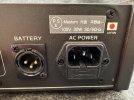
The first piece I picked up is a wild hybrid power integrated amplifier - the AU-900XG/B Custom. It is an X-Balanced 13 watt MOSFET integrated amplifier with 3 line level inputs and separable power amp. What makes this piece extremely unique is that it can be run on 100v AC and also 12v DC! At first I thought this was a portability feature, but no - it's a fidelity feature - Battery Power Sound!

Mr. Harino writes a thorough article on "Battery Power Sound" and the other specs are here.

" What is an ideal power supply?
Complete DC (no AC components (ripples) remaining.
The rectifier circuit reduces the AC components to a tiny level, but theoretically it does not become perfect DC. Batteries are perfect DC.
The amplifier circuit must instantly supply the required current.
Audio signals are discontinuous, transitional signals, so it is necessary for the circuit to have excellent instantaneous supply capability. Improving the power supply regulation rate can have a certain degree of effect.
Also, a stabilized power supply circuit can improve the first item to a certain extent, but it is sometimes pointed out during interviews that it cannot respond instantaneously.
This seems to be due to a response time problem, as it uses an NFB circuit.
Noise components (especially electromagnetic noise) must not be mixed into the current flowing into the speaker.
In recent years, with the spread of high-frequency switching devices such as converters, inverters, mobile phones, personal computers, and smartphones, the electromagnetic noise that is mixed into the power supply and radiated into the air from these devices has become very harmful. How to prevent this harmful electromagnetic noise from being emitted into the air has become an issue for audio amplifiers.
In particular, measures such as filters for electromagnetic noise mixed in from commercial power sources have been taken, but they are not conclusive.

In any case, the importance of the power supply is more important than the amplification circuit."


I've just powered it up on 100V AC and have had a listen on some moderately sensitive speakers. Definitely signatures of the later Sansui Sound. More time to listen and to build a DC power supply!
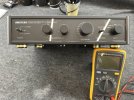
Front panel.JPG

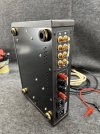
Back and bottom.JPG

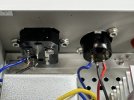
Interior.JPG
 Board.JPG

Volume pot.JPG

Shore supply exterior.JPGShore supply interior.JPG

Nob.JPG

Front glory shot.JPG


Looking right at home with all of it's ancestors!
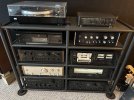
The Rack.JPG
 
Last edited:
Register to hide this ad
That is an excellent acquisition, and a rarity of some real bragging rights, no doubt. Can you tell if the knobs are original Sansui parts, or well done reproductions? And is the battery input terminal an XLR jack, or some other similar looking type? With a 12V in, you could use it in the car for some high grade Sansui sound on the road.
 
That is an excellent acquisition, and a rarity of some real bragging rights, no doubt. Can you tell if the knobs are original Sansui parts, or well done reproductions? And is the battery input terminal an XLR jack, or some other similar looking type? With a 12V in, you could use it in the car for some high grade Sansui sound on the road.

Thanks. Pretty excited about it. And to share it with the rest of the Sansui community. The last vestiges of this great brand. Hopefully some other folks here have acquired some of this gear and will post about it. Not original Sansui nobs, but definitely inspired by them. Haha yes maybe I'll get back into auto stereos. My last intentional car audio system had two Rockford Fosgate subs behind the seat of my truck - 30 years ago :).

Yes 3 pin XLR jack. I'll need to build a cable and all of the connections to a battery bank. Probably fuse it, too. Looks like two positive and one negative connection off of the battery. I have two smaller 7Ah 12V sealed batteries I will connect in parallel for 14Ah and 12V.

This is what they recommend on the product spec page. Interesting comment about people saying some batteries sound different. I'll avoid the battery sonics spiral, and stick with what I have.

Battery selection
If you want to charge your battery about once every two months, we recommend a car battery (27Ah or more).
If you want to make your battery smaller and lighter, we recommend a sealed battery of about 9-12Ah. (The sealed batteries sold at Akizuki in Akihabara are particularly reasonably priced.)
A cheap charger will suffice. It is best to charge your battery when the battery voltage drops below 11.5V.
Some users have also reported that the sound is slightly different depending on the battery. Since batteries are ionic reactions, the speed of ion transfer is theoretically supposed to be the same, but perhaps there is some reasoning that this is different in terms of audio.
 
Last edited:
Thanks. Pretty excited about it. And to share it with the rest of the Sansui community. The last vestiges of this great brand. Hopefully some other folks here have acquired some of this gear and will post about it. Not original Sansui nobs, but definitely inspired by them. Haha yes maybe I'll get back into auto stereos. My last intentional car audio system had two Rockford Fosgate subs behind the seat of my truck - 30 years ago :).

Yes 3 pin XLR jack. I'll need to build a cable and all of the connections to a battery bank. Probably fuse it, too. Looks like two positive and one negative connection off of the battery. I have two smaller 7aH 12V sealed batteries I will connect in parallel for 14aH and 12V.

This is what they recommend on the product spec page. Interesting comment about people saying some batteries sound different. I'll avoid the battery sonics spiral, and stick with what I have.

Battery selection
If you want to charge your battery about once every two months, we recommend a car battery (27Ah or more).
If you want to make your battery smaller and lighter, we recommend a sealed battery of about 9-12Ah. (The sealed batteries sold at Akizuki in Akihabara are particularly reasonably priced.)
A cheap charger will suffice. It is best to charge your battery when the battery voltage drops below 11.5V.
Some users have also reported that the sound is slightly different depending on the battery. Since batteries are ionic reactions, the speed of ion transfer is theoretically supposed to be the same, but perhaps there is some reasoning that this is different in terms of audio.
Thank you Jim ! Great topic you started !!!“Clean electricity “ is the most important for an audio amplifier.
To add on the subject, one worth to check
battery’s used in “RC” models , you can build your own package depends the requirements in power and storage .
“Kyosho” is a well know Japanese brand.
 
Showing the internals looks like it’s a prototype and not very well done at that. Look at the way they attached (glued) the bridge rectifier ( under rated) to the top of the transformer. Knockoff Alps pot, barnacle wiring you name it.
 
Yes it definitely has a "kit" look to it under the hood. Not sure if all of them were built like this or just this one. I have another one on it's way to examine, too.

What makes these interesting and special is they were built in Mr Hirano's lab, who was one of our last living connections to Sansui. I imagine this old engineer tinkering in his shop, and if you read his blog, he was still out in circulation with other audio heads comparing tweaks to their designs and gear and sound. He was committed to the art of sound until the end.

Mr. Hirano at his station -
Mr Ishino.jpg

Rough translation -

"Thank you very much for your continued patronage of Ishino Lab/Masters. This is sudden news, but our store manager passed away in January 2025. The days I have spent facing my beloved audio equipment with the support of everyone have been invaluable to me as the store manager. I'm sure he was very proud of the products he delivered with all his heart and the interactions he had with his customers. The business will cease and the workshop will be vacated at the end of February. Our website will also be closed in March. We apologize for the inconvenience, but as of today we will no longer be responding to inquiries or messages sent via the contact form.

Our entire family would like to express our sincere gratitude to all of you who have used our products for so long and who have sympathized with our manager's vision and supported us. Thank you very much for the past 28 years. - February 23, 2025 The manager's family"

 
Last edited:
Thank you Jim ! Great topic you started !!!“Clean electricity “ is the most important for an audio amplifier.
To add on the subject, one worth to check
battery’s used in “RC” models , you can build your own package depends the requirements in power and storage .
“Kyosho” is a well know Japanese brand.

Clean power! Yes. I run an Isotek power conditioner before my audio rack. And the difference is truly audible. The battery sound concept is new to me. More to be revealed there. I will check out those RC packs, too!
 
Last edited:
Yes it definitely has a "kit" look to it under the hood. Not sure if all of them were built like this or just this one. I have another one on it's way to examine, too.

What makes these interesting and special is they were built in Mr Hirano's lab, who was one of our last living connections to Sansui. I imagine this old engineer tinkering in his shop, and if you read his blog, he was still out in circulation with other audio heads comparing tweaks to their designs and gear and sound. He was committed to the art of sound until the end.

Mr. Hirano at his station -
View attachment 3445696

Rough translation -

"Thank you very much for your continued patronage of Ishino Lab/Masters. This is sudden news, but our store manager passed away in January 2025. The days I have spent facing my beloved audio equipment with the support of everyone have been invaluable to me as the store manager. I'm sure he was very proud of the products he delivered with all his heart and the interactions he had with his customers. The business will cease and the workshop will be vacated at the end of February. Our website will also be closed in March. We apologize for the inconvenience, but as of today we will no longer be responding to inquiries or messages sent via the contact form.

Our entire family would like to express our sincere gratitude to all of you who have used our products for so long and who have sympathized with our manager's vision and supported us. Thank you very much for the past 28 years. - February 23, 2025 The manager's family"

I want to know what speakers are those.
 
Was doing some reading on the Ishinolab site. Look who designed the front panel of the Masters amplifiers:
This is about the AU-Dx07X serie

"The front panel design was done by Mr. O, who has been in charge since the AU-607 (and is currently in charge of the design of Masters' key new amplifiers), and he designed a front mask that is simple yet has a calm atmosphere."
 
Showing the internals looks like it’s a prototype and not very well done at that. Look at the way they attached (glued) the bridge rectifier ( under rated) to the top of the transformer. Knockoff Alps pot, barnacle wiring you name it.

I don't disagree with the build quality in general, but do bear in mind that it was designed and made by an elderly former Sansui engineer who does know what he is doing from a design perspective - especially what matters regarding sound quality.

Aside from aesthetics, there's nothing inherently wrong with loose wiring. In fact, it can be LESS prone to noise versus running bundles of wires in parallel. However, because it's displeasing to the eye, we immediately think something is wrong with it.

If there was a sonic issue with his approaches, I suspect he would have addressed it.
 
Yeah looks like it might be a prototype to me. You can see the pinout is different for some of the transistors the board was etched for too. But handwiring! By none other than Mr Hirano.

Mr Hirano San? Isn't that a word for respect in Japanese?
 
I wonder what VR1 & VR2 were intended to be used for?

VR5 & VR6 were replaced by diodes

This is like deja vu talking about alpha circuit evolution...
 
Agreed. I think Respect is the word we are looking for here.

I wondered the same about VR1 & VR2! I'll pull the PCB and post pictures of both sides.

I would love to see us reverse engineer this amp. I also have one of the Z-Balanced amps on it's way too, which is the circuit Mr. Hirano San developed to follow the X-Balanced circuit. We can reverse engineer that one too.

Definitely spit balling here, but it would be amazing if we could crowd source develop a (non-profit) AK Hirano kit amp. The AK braintrust could pull it off, no doubt!
 
Last edited:
Was doing some reading on the Ishinolab site. Look who designed the front panel of the Masters amplifiers:
This is about the AU-Dx07X serie

"The front panel design was done by Mr. O, who has been in charge since the AU-607 (and is currently in charge of the design of Masters' key new amplifiers), and he designed a front mask that is simple yet has a calm atmosphere."

Interesting! Can you post a link to that page?
 
Last edited:
Found an interesting review of this AU-900XG/B Custom amp on Battery Power Sound on Ishino Lab. So many golden nuggets in there! And very interesting encapsulation at the end regarding the pursuit of maximum fidelity for the least amount of expenditure. More with less. It should also be noted that I think they were using high sensitivity speakers, and even reference and recommend Altec on Ishino Lab website. I can imagine these old musicians and engineers sitting around smoking cigarettes, drinking sake and basking in the sonic waves of X and Z balanced harmony from some home brew speakers using old Altec horns.

-----

Thank you for your kind support in purchasing the battery amplifier.
I am a music lover who plays the saxophone in a rural band. I have always wondered why music becomes boring as soon as it is recorded and comes out of the speaker, even though I really enjoy live sound. I had given up on this, thinking it was inevitable.

I knew that batteries were good for sound, so I was using a storage battery to power my amplifier and mixer. The sound was several levels better than commercial power and I was satisfied, but there was a buzzing sound coming from the speakers. I wondered if there was anything I could do about this sound.
Then, I found Ishino Lab's battery amplifier on the internet. It was also said to be very quiet. I thought this would be a good choice, so I ordered one.

What are your impressions after actually using it?
  • When it's in the silent mode, there's no sound at all. It's really silent. I checked the switch several times (laughs).
  • The sound is fast and natural, and the music is enjoyable.
  • The attack and volume are amazing, and it really hits the spot (laughs).
  • I think I understand what the artist intended.
  • I don't feel the speakers. The sound is not only wider but also higher pitched. It has more expressive power.
  • The live album is fun.
  • Other than that, the device is fun to operate.
I've had a lot of twists and turns, and I've tried multi-drive. I feel that the sound has definitely improved, but the adjustments are too much work and I can't enjoy the music. What's more, the cost is ridiculously high. So I've moved away from audio, but I still think that music is necessary in my life, so I've decided to enjoy music without spending too much money from now on.

Current System

MacBook Pro (wav) → Devil Sound (USB DAC) → AU900XG (amplifier) → homemade speakers A simple system for enjoying music.

Thanks to you, the system is now all battery-powered.
Simple is best. The sound is the best I've ever had. Music is fun.
Thank you so much for everything. I'm very grateful.

February 12, 2019

-----
 
Last edited:
All the hoops designers jump through to deal with filters, ripple, A/C noise, etc. Why not get pure D/C from a battery?

AC/DC
Loose from the noose
Back in Black
Number one with a bullet
I'm a power pack
 
Back
Top Bottom