So picked up an mc-602 the other day, love the amp. For now retiring the mc2300. We all know the mc-602 amp is rated at 600/600 watts. speakers are legacy focus 20/20's. When the system is dialed up and playing rather loud it will flash on the power guard lights. So is this going to damage anything, What is the real output of these amps? I really don't hear any distress in the speakers, it seems like they could take more and keep on going. The 20/20's have two inputs on them and can be run with one amp for the bass and one for the upper end, might be nice with another mc-602, one for each channel. That would knock the dust out of the rafters.


You are using an out of date browser. It may not display this or other websites correctly.
You should upgrade or use an alternative browser.
You should upgrade or use an alternative browser.
MC-602
- Thread starter DS1784
- Start date
Register to hide this ad

chuckworkb
Super Member
Power guard is protecting your speakers.

damacman
Resident Psycho
With so much clean power on tap AND power guard, those volume levels are deceiving! If you dare, walk out of the room for two minutes and then return - you'll see what I'm talking about.
As for particulars on the MC602, that stuff is so obscure it's hard to say. It's as if the MC602 was Mc's best kept secret. The amps are capable of 155 Amps/channel - the most of any stereo McIntosh amp ever made.
Occasional flashing of the Power Guard lamps just means you're having fun. I'd fathom to guess the MC602 was capable of 900wpc or even more. You'd need a dedicated 20A low impedance line to get that though.
I own MC2600s and use thrm bridged with 88dB sensitive XRT22s. Meter readings above 60W can only be described as scary - as in stand the hair up on your neck scary.
Have fun and relay as much as you can to us about your experience with this amp.
As for particulars on the MC602, that stuff is so obscure it's hard to say. It's as if the MC602 was Mc's best kept secret. The amps are capable of 155 Amps/channel - the most of any stereo McIntosh amp ever made.
Occasional flashing of the Power Guard lamps just means you're having fun. I'd fathom to guess the MC602 was capable of 900wpc or even more. You'd need a dedicated 20A low impedance line to get that though.
I own MC2600s and use thrm bridged with 88dB sensitive XRT22s. Meter readings above 60W can only be described as scary - as in stand the hair up on your neck scary.
Have fun and relay as much as you can to us about your experience with this amp.

damacman
Resident Psycho
Todd - Mc amps of this scale are in a league of their own for consumer audio. The occasional flicker of the Power Guard lamps really means very little in regards to the amps ability to play even louder should the need arise. Really what you're talking about here is an automatic compression circuit.

twiiii
Lunatic Member
What were the meters indicating when the lights were flashing? Were the meters dimming at the time? Some times when a driver is becoming non linear its impedance characteristics can change drastically demanding much more current. The Power Guard sensing that would activate to protect the amp and speaker. If your speakers can't handle the power of the amp don't push the sound any higher than of the rare flicker. If you push the amp to hard the power Guard will act like a compressor- limiter reducing the dynamic range and raising the average over all out put tremendously. There are very few speakers that can handle the continuous RMS output capability of this amp over for more than few seconds, so be ware. Your speakers are rated to 400 watts, and I doubt thats a continous rating. By the way how do you compare the quality of the two Mac amps? The real power of these amps, Mac says the peak capability is close to 950 watts for 40 milli seconds. But I would figure close to 750 to 800 watts before the PowerGuard turns on. As the speakers are exposed to long term high power levels the tolerance for high power is reduced and the acoustic out put level drops.
Last edited:
MACKIE1975
Super Member
The Power Guard LEDs should not be on at normal playing. It shall flick when there is sudden/abruptly large change in volume (dynamic). Make sure that LEDs are staying off during normal program

whoaru99
Epic Member
Todd - Mc amps of this scale are in a league of their own for consumer audio. The occasional flicker of the Power Guard lamps really means very little in regards to the amps ability to play even louder should the need arise. Really what you're talking about here is an automatic compression circuit.
I'll gladly rewrite my post if it's technically inaccurate, but McIntosh says that it detects clipping and reduces the input level accordingly.
POWER GUARD®
A waveform comparison circuit continuously monitors both input and output signals. Power Guard dynamically adjusts the input level to avoid clipping while preventing harsh sounding distortion.
My intent is not to disparage McIntosh, only to describe the basic situation at hand and why the Power Guard lights flicker/come on occasionally.
As with any clipping indicator or input-output comparitor (more or less a more sophisticated clipping indicator), an occasional flicker/flash on the odd kick drum or whatever is not a big deal. But, if it's lighting up/flickering regularly its a sign to back off the master volume a bit.

Digital music will trip power guard fast and erlyer than an anilog source. Also what is the preamp in use? That can factor in as well, this line of amps gets up there fast in output and if the preamp is already high output, well not much volume control movement is in play.

kevzep
Its all about the Music
What were the meters indicating when the lights were flashing? Were the meters dimming at the time? Some times when a driver is becoming non linear its impedance characteristics can change drastically demanding much more current. The Power Guard sensing that would activate to protect the amp and speaker. If your speakers can't handle the power of the amp don't push the sound any higher than of the rare flicker. If you push the amp to hard the power Guard will act like a compressor- limiter reducing the dynamic range and raising the average over all out put tremendously. There are very few speakers that can handle the continuous RMS output capability of this amp over for more than few seconds, so be ware. Your speakers are rated to 400 watts, and I doubt thats a continous rating. By the way how do you compare the quality of the two Mac amps? The real power of these amps, Mac says the peak capability is close to 950 watts for 40 milli seconds. But I would figure close to 750 to 800 watts before the PowerGuard turns on. As the speakers are exposed to long term high power levels the tolerance for high power is reduced and the acoustic out put level drops.
The part in bold is absolutely correct and is why it actually will get louder pushing well into the power-guard...
Its actually a form of limiting, it is not compression.
kevzep
Its all about the Music
The Power Guard LEDs should not be on at normal playing. It shall flick when there is sudden/abruptly large change in volume (dynamic). Make sure that LEDs are staying off during normal program
Depends on what your definition of normal is....
WHAT DID YOU SAY.......Depends on what your definition of normal is....


nj pheonix
Lunatic Member
I have to ask?
In a home environment, short of servicing PA duty outside, would you really listen at volume (SPL) that would require an amp that pushes past 600w rms pc nto clipping ?
Correct me if I'm wrong. Wouldn't this be in permanent hearing damage ranges?
(Even with inefficient speakers?)
In a home environment, short of servicing PA duty outside, would you really listen at volume (SPL) that would require an amp that pushes past 600w rms pc nto clipping ?
Correct me if I'm wrong. Wouldn't this be in permanent hearing damage ranges?
(Even with inefficient speakers?)
MACKIE1975
Super Member
"WHAT IS POWER GUARD"
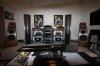
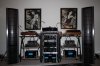
Nice system but spend sometime to tidy up the wires mess behind it
Nice system but spend sometime to tidy up the wires mess behind it
whoaru99
Epic Member
Has there been a thread here that delved into the minutiae of Power Guard? If not, that would make for a good read. Todd - read twiiii's post. He is absolutely spot on.
Back on topic - OP...?
I'm fairly sure I understand the essence of what's going on. The exact mechanism may be unique to McIntosh and perhaps even better implemented that other examples, but in net/overall effect it's not materially different than the limiters in some other amps.
As far as the OP, I guess I thought Power Guard and its mechanism/action/function was part of what the post was about?.
Last edited:
whoaru99
Epic Member
...I really don't hear any distress in the speakers, it seems like they could take more and keep on going. The 20/20's have two inputs on them and can be run with one amp for the bass and one for the upper end, might be nice with another mc-602, one for each channel. That would knock the dust out of the rafters.
Using two 602s in this form of biamp won't really deliver any material power increase to the speakers. It may sound better in some situations but it won't play any louder. If you want to push more usable power to the speakers without limiting or compression you'd need bigger amps. I don't know if the 602s can be bridged for more output.
Last edited:
OP asks:
The lights flashing indicate the amp is approaching 0.5 % distortion. In home use this distortion level comes on most often because of AC voltage sag not at the near 800 watts these amps can produce in lab conditions.
Back in the day I would visit clients with our McIntosh variac to demonstrate why they should hire a electrician to run dedicated AC lines for peak performance.
One of the few times club dance music was usefull as a test music source, follow the room lights dimming with the beat to see what all is run on your LR power circuits.
Most speaker driver manufacturers use the driver magnet structure as a heatsink to absorb the excess heat from the speaker voice coil. As the temp rises beyond certain levels these magnetic materials lose their magnetic flux, becoming less efficient and therefore having a lower output. Human nature says drive the system harder causing more heating and a vicious cycle is started. Hearing damage and driver damage soon follows.
When the red lights come on, the PG comparator circuit is engaged to lower the input signal to stay below the distortion threshold.
Lower the distortion by updating your AC wring to 20 amp circuits with 10 gauge wire and you will allow your new amp to do its best.
The lights flashing indicate the amp is approaching 0.5 % distortion. In home use this distortion level comes on most often because of AC voltage sag not at the near 800 watts these amps can produce in lab conditions.
Back in the day I would visit clients with our McIntosh variac to demonstrate why they should hire a electrician to run dedicated AC lines for peak performance.
One of the few times club dance music was usefull as a test music source, follow the room lights dimming with the beat to see what all is run on your LR power circuits.
Most speaker driver manufacturers use the driver magnet structure as a heatsink to absorb the excess heat from the speaker voice coil. As the temp rises beyond certain levels these magnetic materials lose their magnetic flux, becoming less efficient and therefore having a lower output. Human nature says drive the system harder causing more heating and a vicious cycle is started. Hearing damage and driver damage soon follows.
When the red lights come on, the PG comparator circuit is engaged to lower the input signal to stay below the distortion threshold.
Lower the distortion by updating your AC wring to 20 amp circuits with 10 gauge wire and you will allow your new amp to do its best.