• The move to the new server is done. There are some software and database maintenance updates in process. This has us passing the hat around to help out. We appreciate any donations. Seriously, even a dollar helps. The payment page may be found here - https://www.audiokarma.org/support.html

MC2505 catastrophe

Benz

Yeah Baby!
A bit dramatic I know, but my MC2505 had a major issue this morning and I'm looking for thoughts on what could be wrong. The amp has been working well for years without any problems. I've owned it for about 10 years and it underwent a major restoration in '96 (yes, almost 30 years ago). I run it through a power bar to avoid wearing out the on/off switch, and am running the speaker cables through an external passive speaker switch. When I turned on the 2505 this morning (spkrs disconnected), I heard a loud hum from the amp itself and the VU meters immediately went to max and stayed there. I turned the spkr control knob on the amp to the off position, and the hum stopped but the VU meters remained at max. I turned off the amp and it took about 5 secs for the VUs to go back to zero. I turned the amp back on briefly and the VUs went back to max. I turned everything off again and here I sit. I'm very glad that I make a habit of switching off the speakers after a listening session as I may well have fried them otherwise. They're Yamaha NS-1000M so that would have been a complete disaster.

Any thoughts on what coud be going on? I will likely take the amp to a pro but would like to get a sense of what may be happening.

Thanks in advance for any input that can be provided.
 
Register to hide this ad
Thanks for the suggestion; I might take a look myself but don't want to cause any more damage as a result of inexperience.
 
A possibility I would check is that the preamp power supply has failed and is sending hum to the amp that is then trying to amplify that. I'd check that before sending the amp for service.

You can check that without turning the amp on again if you have a DVM. If so connect the DVM to the preamp's outputs (or the amplifier-end of the interconnects) and check for AC voltage with no source playing. Any hum voltage from the preamp high enough to peg the amp's meters should show up on the DVM. If you see hum from the preamp, do further checking to see if it's coming from one of the sources.

It's probably the amp, but I'd double check.
 
A possibility I would check is that the preamp power supply has failed and is sending hum to the amp that is then trying to amplify that. I'd check that before sending the amp for service.

You can check that without turning the amp on again if you have a DVM. If so connect the DVM to the preamp's outputs (or the amplifier-end of the interconnects) and check for AC voltage with no source playing. Any hum voltage from the preamp high enough to peg the amp's meters should show up on the DVM. If you see hum from the preamp, do further checking to see if it's coming from one of the sources.

It's probably the amp, but I'd double check.
Thanks, that was easy enough to test. No AC voltage on the preamp outs, tried multiple sources. It was definitely worth checking, I hadn't thought about the preamp.
 
Was the hum and meter pegging equal in both channels? If so, that points to the power supply. What frequency is the hum? Does is sound low or like an angry bird? If you are handy with a meter you can measure for A/C on the power supply capacitors to see if there is ripple not being filtered.

Can you post photos from below and above the chassis? Have you done a visual inspection to see if there is any physical leakage from the filter caps? Were all the power supply capacitors replaced in 96? Or are some still original? There are two 9300uf filter cans and one multisection can and one 500uf can.
 
A possibility I would check is that the preamp power supply has failed and is sending hum to the amp that is then trying to amplify that. I'd check that before sending the amp for service.

You can check that without turning the amp on again if you have a DVM. If so connect the DVM to the preamp's outputs (or the amplifier-end of the interconnects) and check for AC voltage with no source playing. Any hum voltage from the preamp high enough to peg the amp's meters should show up on the DVM. If you see hum from the preamp, do further checking to see if it's coming from one of the sources.

It's probably the amp, but I'd double check.
What kind of hum from the preamp could be amplified and become audible from the amp itself (not speakers)?
 
Was the hum and meter pegging equal in both channels? If so, that points to the power supply. What frequency is the hum? Does is sound low or like an angry bird? If you are handy with a meter you can measure for A/C on the power supply capacitors to see if there is ripple not being filtered.

Can you post photos from below and above the chassis? Have you done a visual inspection to see if there is any physical leakage from the filter caps? Were all the power supply capacitors replaced in 96? Or are some still original? There are two 9300uf filter cans and one multisection can and one 500uf can.

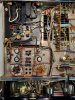
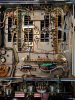
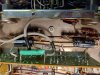
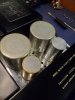
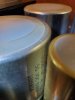
To be clear, the hum came from the amp. No speakers were connected so the audible hum can't be pinpointed to a channel, however I can confirm that both VUs were pegging equally (both at max). Hard to describe the hum as I didn't leave the amp on too long, it was quite loud, sort of like a neon tube (?). I haven't turned it back on yet so didn't measure AC on the PS caps. I've posted some photos below; there is no obvious bulging or cap leakage that I can see. I'm no expert but I think there is a mixture of new and original caps. The two 9300uf cans look original to me and one of the other two does as well. One has a gold jacket, I suspect that might have been replaced.

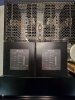
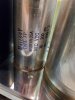
20230425_180943.jpg 20230425_180950.jpg 20230425_181014.jpg 20230425_181023.jpg
 
Those 4 silver can caps are original and appear to be manufactured in 1968. (I would guess you have an early 2505 with the bevels around the meters).

The gold color is likely an artifact of plastic aging. The plastic was probably clear when new. Just because plastic is yellow on one can doesn’t mean it’s not original. MAC used different suppliers for FP cans and the plastic used by one supplier might have aged differently. Check the date codes to be sure.

I only see 4 new caps from the 1996 repair. One on each of the driver boards (both maroon/brown color)and two (black 470uf) as part of the input circuit.

Unless the person who worked on your amp in 1996 cut open and restuffed the 4 silver filter power supply cans, they are now 55 years old. I would guess one or more of those 4 power supply cans has lost its ability to filter ripple due to age.

The MAC factory parts division sells the two 9300uf big filter cap replacements in 15000uf capacitance only. The MAC Engineering Dept has approved increasing the 2505 filter caps to 15000uf. MAC factory is the only place you can get an exact physical size replacement as they had them custom made by Cornell Dublier for the MC2505 and MA5100.

CE Manufacturing and Hayseed Hamfest sell exact replacements of the multi-can. CE has the original FP dimensions. Hayseed is shorter and shiny. The fourth silver can is a 500uf that you can replace with an under chassis electrolytic. You can bump that up to 680uf if you can’t find a 500uf. Or you could use a 470uf.

The 2505 is a superb amp and certainly worth the investment to restore the power supply. If you are handy with a soldering iron you could do the work yourself and save some dough. The two big filter cans are held in by a screw and don’t require any soldering. Very easy to replace the two big 9300uf cans.
 
Last edited:
Do you have a pair of cheap headphones you can plug in and test the amp with? Was the amp still able to play music and you had the hum sitting on top of the music? Or does the amp not pass any music and only outputs hum?

The 2505 just uses a pair of 220ohm 5w resistors to pad down the output for the headphone jack. So by listening with headphones you are essentially hearing what would otherwise be sent to the speaker outputs (unless you have an oxidized or defective speaker switch).

Did the frequency of the noise sound like this 120hz tone? If so, that could be rectified power supply ripple that isn't getting filtered adequately.

 
Last edited:
@Benz there are few more things you can visually check with the power disconnected:

1. Take off the top cover over the meter housing and post a photo here of the meter board. There are four caps on that board. These are usually two white Mallory electrolytics and two Mullard Tropical Fish striped film caps. The Fish caps don't physically age well -- the epoxy often shows cracks and burn marks like they are self-destructing.
2. Make sure there aren't any screws from the speaker terminal strip making contact with the chassis where they shouldn't
3. Do you use plastic feet under the amp? If so, make sure none of the feet screws are long enough touch anything in the underbelly of the amp.
4. De-oxit the RCA jacks. Look for any physical signs of a flakey jack ground.
5. Remove your RCA cables and test them with another receiver or piece of gear you have in the house. Make sure your RCA cables don't have a flakey or severed ground at the connector plug.
6. Inspect the speaker on/off switch and surrounding circuitry to make sure nothing is accidentally shorting it (like a screw or bolt etc).

Try and rule out the easy stuff...

Also, when was the last time you cleaned the Speaker On/Off switch with contact cleaner? Those MAC speaker switches in the 2505 and 2105 are known to become very flakey. Sometimes they fail, but usually it's just oxidation build up. I would suggest cleaning those switches if you've never done it. You can use DeOxit D5. Then very gently turn the Speaker switch back and forth twenty times. Do the same for the Power switch.
 
Last edited:
ok, a lot of great information and suggestions here Monk, can't tell you how much I appreciate it. And thanks SaturationPt for suggesting a DBT, I've read about these but never had a use for one, looks like I do now. I am no expert but do have some basic abilities in troubleshooting and simple repairs (e.g. replacing a pot). You've given me a lot to chew on and I will try some of the steps before throwing in the towel and sending the amp in the shop.

A few preliminary answers:
- 120Hz tone does sound similar to what I heard; have not tried headphones.
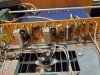
1. I added a pic of the meter board below; I can see no evidence of leakage or any burn marks.
2. speaker terminals / screws look ok, nothing out of place or touching where it shouldn't.
3. the amp is housed in the matching wood case w/panlocs so there should be no issue with long screws touching the chassis.
4. have not deoxited them yet, however hum is present even when nothing is connected to the RCA jacks.
5. cables appear good, no issues when used with other gear.
6. visually, speaker switch and circuitry looks ok. I did note however when I turned on the amp yesterday that the hum goes away when the spkr switch is turned off. VUs still peg to max.

Btw, I can confirm the amp was sold in Toronto in Nov 1968, as I have the original bill of sale and all the documentation that came with the amp when it was sold. It's a beautiful piece and I also have an equally nice, matching MX112 that was bought with it at the same time so it's definitely getting repaired. I've posted below a portion of the repair bill, it shows that the following was replaced in '96: 2 x pots; glass faceplate; 4 x transistors; 4 x diodes; 8 x caps; RCA terminals; speaker terminals; power cord.

20230426_051155.jpg

20230426_050314.jpg

20230426_050349.jpg
 
I would check the bridge rectifier diodes. I have a Mc MC2105 amps as well as other Mc solid state amplifiers over 40 years old with the original caps. I am not saying that a capacitor can not be the problem but I have repaired others with the issue I am mentioning years ago when working at EZ Teltronics in Chicago in my college years. I would and I use a variable transformer to bring up the Voltage on older equipment.
 
If your meter has a diode check you can test those power supply rectifiers with the power turned off.

Your early serial also has a diode connected to the multi-can that I don’t think the later 2505s had.

If those diodes test OK, you could then pick up an ESR meter that checks both ESR and capacitance in circuit (also with power off). ESR70 by Atlas is a good one.

These tests could help you determine if any rectifiers or filter caps are bad.

The interesting thing about your problem is that the hum is not coming from your speakers but the amp itself.

So, if I understand correctly, your speakers were not directly physically connected (instead the amp is connected to a switcher box) and the 2505 Speaker switch was on, but you had an external speaker switch box that was turned off? And your speakers were completely silent and all noise came from the amp? Is that right?

How loud was the hum coming from the amp? Could you tell specifically where the noise was coming from—for example, the power transformer or somewhere else In the amp like the meter board?

And the hum coming from the amp itself (not the speakers) stopped when you turned the Speaker switch control on the 2505 from On to Off? But both meters were still maxed out? Is that correct?
 
Last edited:
Back
Top Bottom