

You are using an out of date browser. It may not display this or other websites correctly.
You should upgrade or use an alternative browser.
You should upgrade or use an alternative browser.
McIntosh MC275 MK VI Clone
- Thread starter CohibaJoe
- Start date
nuvistordave
New Member
Alright here are the results for an MC-60 transformer; Chinese one is coming in next week.
These are similar to the MC-75; except that they lack the 3rd grid winding. Guaranteed not to be a clone tho.
- These are random wound (I dismantled a broken (shorted) transformer)
- 8-Ohm secondary inductance 204 mH (@ 100 Hz)
- Interwinding capacitance 26 nF (Pri-Sec)
- Primary Inductance (P-P) 7.5H.
- Leakage Inductance (P-P w/Secondary shorted; 1kHz) <0.5 mH
- Primary Resistance 28 Ohms P-P
I'm guessing that the above post from rustnrot is directed at me.

What do you do with a slush fund >4K...Buy a McIntosh MC275 IV Clone. Was on AliExpress last month on picking up some PCB boards, switches(testing) and came across Clones of well know gear. After IM'ing on details, I purchased Orsefon MC275 (McIntosh MC275 clone). Going over the pictures and asking many questions...$2200 and 3 weeks later we have an Amp. The circuit is based on MC275 IV.
1. 4-KT88, 3-12AX7, 4-12AT7...EH KT-88, 12AT7/12AX7 got me? LED Monitor lighting
2. Tube sockets bolted on separate metal board to prevent PCB cracking from Tube solder mounted sockets with Tube heat dissipation pipes.
2. Auto-BIAS system
3. System is monitored and Shut's Off (Relay Controlled) if Over-Volts, Clipping and Tube fails
3. Hand soldered WBT Silver
4. Gold Plated PCB Trace board
5. WIMA Films, Siemens Resistors, Nichicon, Rubycon, Philips Caps
6. XLR Balanced signal input (requires preamplifier drive)
7. RCA analog signal input (no need to drive by the preamplifier)
8. Mono output mode/stereo output mode
9. Balanced input selection/unbalanced (RCA) input selection
10. Left/Right channel volume adjustment (only for RCA analog input mode adjustment)
11. Output resistance group: 4 ohms, 8 ohms, 16 ohms
12. Gold Plated 5-way terminals
13. 1.75mm Gold Plated housing
14. Output power: stereo mono 75W / mono bridge method 150W
15. Coil 16 layers (the original Mcintosh MC275 is 12 layers) UP-OCC (single crystal oxygen-free copper) group cross winding method with the purity of single crystal oxygen-free copper 99.99%
16. Unit weight 68lbs (Yes, it is as I had to go up to 2nd floor)
Unit is running 10-12hrs per day (currently 30hrs) and I have to say...WOW. I cannot hear any "Hiss" from the tweeters and Transformer hum nothing (maybe if I had Dog hearing). After 20hrs the unit has Opened up...WIMA will need 100+hrs. I have ordered from Jim McShane a set of MC275 tubes ( 4 KT-88 Genalex Re-Issue, (3) Tung-Sol ECC803S/12AX7, (1) Genalex B759/12AX7, (4) CV4024/12AT7 Mullard NOS).
View attachment 2500243View attachment 2500249 View attachment 2500252 View attachment 2500253 View attachment 2500254 View attachment 2500255View attachment 2500257
that is pretty cool. If you don't mind how much does the amp weigh?
tks

FWIW, I recently acquired an assembled MC275 Clone. As many of you know I have been building a clone using replica parts but that's on hold for now until I finish her kitchen.
Regarding the weight and other objective data, I intend to put both the Clone and Real Mark III MC275 I own on the bench in the (hopefully) near future. Meanwhile, the weight of the Clone seems just as massive as the original.
Subjectively, I have been swapping the amps back and forth, driving each one with my RME adi-2 dac. I simply cannot tell the difference between them. They sound the same to me. They both put off the same amount of heat, which is to say, run quite cool for tube amps. I've used both the RCA and balanced inputs for both. Using the balanced inputs both amps are dead, dead quiet. The original has a the tiniest of hum in one channel with my head inside the woofer when using RCA inputs, the clone has no hum in either channel in RCA mode. As I'm sure most of you know, when using balanced inputs, the first 12AX7 is out of the circuit.
For giggles, I've swapped the bottom chassis, the tube cage, and the nameplates between the two, perfect fit every time.

68lbsthat is pretty cool. If you don't mind how much does the amp weigh?
tks
Yes, I have. I have a MC275 CE, aka Mark III. I've finally gotten some time to spend with each amp, since I have been so busy with the kitchen remodeling here. I'll post more data soon but:
1. I cannot tell the difference by listening to the amps. You might. I can't. My partner can't.
2. The clone MC275 has better square wave response, IMHO. There is very little difference so obviously some subjectivity here.
3. I ran some power tests. The MC275CE both channels driven, is 86 watts per channel. Yes, the Mark III is documented as being slightly lower power than the earlier and later models but of course still meets spec.
4. The clone MC275 tops out at an even 100 watts per channel both channels driven. Since it is a clone of the later MC275's this is not surprising.
I know the following statement will be very controversial, so here goes.
"In my opinion, the Clone MC275 is one of the best buys in tube amps today", T. Lang, circa 2023.

trainbuftony
Electron Herder
Shots fired!
Thank you for your detailed reply, really appreciate it. Sound like you guys really know your stuff when it comes to electronics, I just know what sounds good to me having played instruments in live bands over the years. Also aesthetics are important as I have recently purchased a set of Focal Kanta 3. According to specs, how do you think the clone would drive these speakers? End goal would be to run 2 I think. I have a pair of Rel subwoofers that will take the main bass load. Appreciate your help guys!Yes, I have. I have a MC275 CE, aka Mark III. I've finally gotten some time to spend with each amp, since I have been so busy with the kitchen remodeling here. I'll post more data soon but:
1. I cannot tell the difference by listening to the amps. You might. I can't. My partner can't.
2. The clone MC275 has better square wave response, IMHO. There is very little difference so obviously some subjectivity here.
3. I ran some power tests. The MC275CE both channels driven, is 86 watts per channel. Yes, the Mark III is documented as being slightly lower power than the earlier and later models but of course still meets spec.
4. The clone MC275 tops out at an even 100 watts per channel both channels driven. Since it is a clone of the later MC275's this is not surprising.
I know the following statement will be very controversial, so here goes.
"In my opinion, the Clone MC275 is one of the best buys in tube amps today", T. Lang, circa 2023.
snaimpally
New Member
It is well documented that Frank Van Alstine of Van Alstine Audio discovered that B&K ordered his preamp, copied it, and then started selling their copy branded as a B&K preamp. Van Alstine alerted several trade publications (including, I think Stereophile) and the response was that all manufacturers, to some extent, copied the circuits of other manufacturers. After that, Van Alstine started patenting circuits when he came up with something new. I think the trade publication's perspective was that the basic operation of a particular circuit (phono stage, amplifier, preamp, etc.) is well known and documented in engineering text books etc. and that manufacturers tweak those circuits and make design tradeoffs (including looking at how competitors have implemented those designs) before bringing them to market.
The whole purpose of a patent is that the inventor receives patent protection for a certain period of time (20 years) in exchange for disclosing, with enough detail, how someone can create the patented item. The idea is that by disclosing it, other can improve upon the design.
So don't get all bent out of shape over the Chinese copying designs (and that too, for which the patents have expired), because Americans have been copying each others products for years. Heck, Microsoft Excel and before it Lotus123 each started off as a copy of Visicalc (for which the inventor applied for copyright but not patent protection). You might also look into the many innovations (mouse, user interface, windows, etc.) introduced by Xerox's Star workstation, which were copied by Apple and Microsoft to create MacOS and Windows, respectively.

The circuit is less offensive than the brand identity.
snaimpally
New Member
It is well documented that Frank Van Alstine of Van Alstine Audio discovered that B&K ordered his preamp, copied it, and then started selling their copy branded as a B&K preamp. Van Alstine alerted several trade publications (including, I think Stereophile) and the response was that all manufacturers, to some extent, copied the circuits of other manufacturers. After that, Van Alstine started patenting circuits when he came up with something new. I think the trade publication's perspective was that the basic operation of a particular circuit (phono stage, amplifier, preamp, etc.) is well known and documented in engineering text books etc. and that manufacturers tweak those circuits and make design tradeoffs (including looking at how competitors have implemented those designs) before bringing them to market.
The whole purpose of a patent is that the inventor receives patent protection for a certain period of time (20 years) in exchange for disclosing, with enough detail, how someone can create the patented item. The idea is that by disclosing it, other can improve upon the design.
So don't get all bent out of shape over the Chinese copying designs (and that too, for which the patents have expired), because Americans have been copying each others products for years. Heck, Microsoft Excel and before it Lotus123 each started off as a copy of Visicalc (for which the inventor applied for copyright but not patent protection). You might also look into the many innovations (mouse, user interface, windows, etc.) introduced by Xerox's Star workstation, which were copied by Apple and Microsoft to create MacOS and Windows, respectively.
You may have read that Apple has stopped selling some of their watches (just before Christmas!) because they were found to have infringed on several patents owned by Masimo (yes, that Masimo, that recently bought Sound United, e.g., B&W, Denon, Marantz, etc.). While Apple is an innovative company, there have been instances like this where Apple has wilfully infringed (e.g., copied) another's company's innovation and refused to license it from the patent holder and instead tried to fight it in court. So its not a Chinese cultural thing - its just human nature.

"Rucycan. Accept no substitutes."
 For some reason I'm upset by knock-off caps in my knock-off amp. Solder on the board looks good. They could have bothered to clean the board after the solder work was completed. "Rucycans" are measuring in the low 620uf range. 85% of the rest of the caps are "Changxin". There is a handful of Nichion on the board. I may shotgun the electrolytics on the entire board. At the very least, the off-brand stuff. Can anyone explain the difference of changing C1 and C34 to Mundorf?


I have two factory assembled amps here and two loose main boards. They are all green boards like this one. All say Rubycon like they should, of course that doesn't mean they still aren't counterfeit.
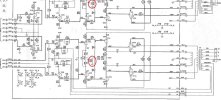
Regarding bias, yes, change R51 and R52 for trimmers. I am going to do that on one of the boards I have, but haven't done it yet. I was thinking a 200k trimmer adjusted to the middle since they are circa 100k resistors.
Regarding bias, yes, change R51 and R52 for trimmers. I am going to do that on one of the boards I have, but haven't done it yet. I was thinking a 200k trimmer adjusted to the middle since they are circa 100k resistors.
Attachments



jayvis
Addicted Member
Not sure if it's been already mentioned, but this sounds like the same thing as replica cars. The Shelby Cobra 427 immediately comes to mind. While being adored by many, replicas are usually despised by purists and collectors. Especially when someone sticks an authentic brand nameplate on one.

I'm trying to wrap my brain around the bias trimmer. I remember when I made a couple of Fender Tweed amps, I actually ditched the fixed bias-resistor for a potentiometer/resistor setup. This setup made it impossible to accidently go 0-ohm and provided a narrower, more precise adjustment range.I have two factory assembled amps here and two loose main boards. They are all green boards like this one. All say Rubycon like they should, of course that doesn't mean they still aren't counterfeit.
Regarding bias, yes, change R51 and R52 for trimmers. I am going to do that on one of the boards I have, but haven't done it yet. I was thinking a 200k trimmer adjusted to the middle since they are circa 100k resistors.