• The move to the new server is done. There are some software and database maintenance updates in process. This has us passing the hat around to help out. We appreciate any donations. Seriously, even a dollar helps. The payment page may be found here - https://www.audiokarma.org/support.html

McIntosh MC275 reissue vs vintage MAC stereo tube amps

monkboughtlunch

Super Member
Anyone compared a modern day MC275 reissue vs any of the restored vintage line up (MC275, MC240, MC225)? If so, any thoughts on how to describe the sonic signature of each? I realize the "apples to apples" comparison would be with a vintage MC275 because of the output tubes, but thought it would be interesting to understand how the "sonic signature" of the reissue also compares/contrasts with a restored vintage MC240 and MC225 as well.
 
Register to hide this ad
In response to your question, the McIntosh MC275, MC240, and MC225 sound totally different.

FWIW, my favorite is a pair of MC30s.

The MC275 and a pair of MC30s are opposite ends of the sonic spectrum. The MC30s have a “warm” sound. The MC275 sounds more like a good solid-state amp. With that said - assuming relatively sensitive speakers - all these amps are capable of excellent sound quality. IME, your ears can adjust to any of them.

IME some recordings sound better with an amp that has a “mellow” sound, some recordings sound better with a “warm” sounding amp, some recordings sound better with a more “dynamic” sounding amp, etc.

I love my MC30s for their warm, rich sound. They sound fabulous with my Snell Type CV for almost any recording. I run them direct from an Oppo UDP-95 - i.e., no pre-amp. (If you like bright high frequencies - i.e., a lot of "sparkle" or “sizzle” on top - the MC30 probably wouldn't be the first choice.) IMO, the MC30s epitomize the warm sound of tubes - and I love them for classical music that features string instruments. I think the MC30s also sound great for male voices.

OTOH, in the same system where my MC30s normally reside (living room), I run my MC275 MkV through an MX110Z - otherwise the MC275 sounds too bright for my taste. (I have the treble control on the MX110Z slightly attenuated, and the bass boosted just a little.)

In my TV room system, I run the MC225 and MC240 direct from an Oppo BDP-105 (no preamp). The MC240 sounds great on recordings that have very dramatic music (e.g., Swan Lake). On other recordings, it can be a little bright. My MC225 probably has a more balanced sound.

I believe that people have differing sensitivities to various aspects of sound. For example, it is important to me that the timbre of orchestral instruments is reproduced naturally - but I'm not sensitive to spatial imaging. IMO the question of which amp sounds best depends on your speakers, your room, what type of music you listen to, your unique sensitivities to various facets of audio quality, and which inevitable sonic imperfections are least offensive to you. In other words – for me - what equipment combination causes me to stop listening to the equipment, and causes me to “get lost in the music”. I often find that “magic occurs” when I listen to high quality (e.g., 24bit/96kHz) recordings of classical music via my MC30s and Snell Type CV. Magic also often occurs with my Scott 296 driving my Klipsch RF-7II. With that said, I could happily live with my Klipsch Palladium driven by my MC225 … or my Scott 299C …

Bottom line, it’s all about synergy between the music you like, your amp, your speakers, your room, and your ears and brain.
 
Last edited:
Out of curiosity, @robert_kc, have all of your amps been restored the same way?

The most I've heard is that there is something different in the 225, and a bit of magic in the 30s, but the 60s, 40s/240, and 75s/275 have more variation between samples than between model lines. Thus, I ascribe this to tubes and/or deviations in the restorations rather than being generalizable.

For now at least, all I can directly test is my pair of MC60s. Hopefully in future I'll be able to pick up a few others and restore them strictly the same way.
 
Out of curiosity, @robert_kc, have all of your amps been restored the same way?

The most I've heard is that there is something different in the 225, and a bit of magic in the 30s, but the 60s, 40s/240, and 75s/275 have more variation between samples than between model lines. Thus, I ascribe this to tubes and/or deviations in the restorations rather than being generalizable.

For now at least, all I can directly test is my pair of MC60s. Hopefully in future I'll be able to pick up a few others and restore them strictly the same way.

Excellent point re state of restoration. All of my vintage amps have been fully electronically restored, but by different technicians. I agree that the state of restoration affects that sound quality of an amp (e.g., which coupling caps were used). And, tubes matter. And synergy with speakers matters. Each of my amps was placed in a system based on synergy with the speakers and room. Then, each amp was "tube rolled" for that system - based on my ears.

Here's my current systems:

Living room: Stereo speakers are Snell Type CV. Subwoofer: Klipsch P-312W. The source components are Oppo BDP-95 (with USB hard drive containing high-res FLAC recordings), and Dual 1249 with Stanton 681EE. Amps include a pair of McIntosh MC30s, Scott 296, McIntosh MX110 / McIntosh MC275, a pair of Pilot HF-56 mono receivers, an NAD pre-amp and Acurus A250 power-amp for movies, and a McIntosh 2155 driving JBL L830s in the kitchen / dining room. A patch panel (banana plugs) allows me to connect the speakers to whichever amp I want, and a Niles AXP-1 RCA selector switch connects the Oppo to the amp. Chromecast Audio for internet radio and Spotify Premium.

TV room: Stereo speakers are Klipsch Palladium P-37F. Subwoofer: Klipsch P-312W. The source is an Oppo BDP-105 (with USB hard drive containing high-res FLAC recordings). The amps are Scott 399, McIntosh MC225, Kenwood KR-9050, Fisher 800B, Fisher X-1000, Scott 299C, McIntosh MC240, and an NAD C375BEE. The tube amps are for music. The solid-state amps are for movies. A patch panel (banana plugs) allows me to connect the speakers to whichever amp I want, and Niles AXP-1 RCA selector switches connect the Oppo to the amp. Chromecast Audio for internet radio and Spotify Premium.

Office: Stereo speakers are JBL L880. Sources: Oppo DV-980H SACD/CD/DVD, and my Windows 10 laptop with Music Streamer II DAC. Amps: Fisher 500C, Scott 299B, Altec 353A, and an NAD D 3020 for general internet use (and summertime). Banana jacks allow me to connect the speakers to whichever amp I want, and a Niles AXP-1 RCA selector switch connects the Oppo to the amp.

Basement: Front, center, and left speakers are Klipsch RF-7 II. A single rear speaker is a Klipsch RF-7. Subwoofers: SVS SB16-Ultra, Klipsch R-115SW. Source: Oppo UDP-205 (with USB hard drive containing high-res FLAC recordings). Amps: Scott 272, Inspire “Fire Bottle” SE Stereo Tube Amplifier HO, Scott 222C, McIntosh MX110Z tuner/preamp, Fisher KX-200, Scott 296, Pilot SA-260, Scott LK150. A patch panel allows me to connect the speakers to whichever amp I want, and F/F RCA cables enable me to connect an amp to the Oppo, and a power amp to the MX110Z. Chromecast Audio for internet radio and Spotify Premium.

Bedroom: The speaker is a single Klipsch WF-35. Source is an older CD player. Fisher TA 500 (AM/FM mono receiver). Chromecast Audio for internet radio and Spotify Premium.
 
...
The MC275 and a pair of MC30s are opposite ends of the sonic spectrum. The MC30s have a “warm” sound. The MC275 sounds more like a good solid-state amp. With that said - assuming relatively sensitive speakers - all these amps are capable of excellent sound quality. IME, your ears can adjust to any of them.

IME some recordings sound better with an amp that has a “mellow” sound, some recordings sound better with a “warm” sounding amp, some recordings sound better with a more “dynamic” sounding amp, etc.

I love my MC30s for their warm, rich sound. They sound fabulous with my Snell Type CV for almost any recording. I run them direct from an Oppo UDP-205 - i.e., no pre-amp. (If you like bright high frequencies - i.e., a lot of "sparkle" or “sizzle” on top - the MC30 probably wouldn't be the first choice.) IMO, the MC30s epitomize the warm sound of tubes - and I love them for classical music that features string instruments. I think the MC30s also sound great for male voices.

OTOH, in the same system where my MC30s normally reside (living room), I run my MC275 MkV through an MX110Z - otherwise the MC275 sounds too bright for my taste. (I have the treble control on the MX110Z slightly attenuated, and the bass boosted just a little.)

In my TV room system, I run the MC225 and MC240 direct from an Oppo BDP-105 (no preamp). The MC240 sounds great on recordings that have very dramatic music (e.g., Swan Lake). On other recordings, it can be a little bright. My MC225 probably has a more balanced sound.

I believe that people have differing sensitivities to various aspects of sound. For example, it is important to me that the timbre of orchestral instruments is reproduced naturally - but I'm not sensitive to spatial imaging. IMO the question of which amp sounds best depends on your speakers, your room, what type of music you listen to, your unique sensitivities to various facets of audio quality, and which inevitable sonic imperfections are least offensive to you. In other words – for me - what equipment combination causes me to stop listening to the equipment, and causes me to “get lost in the music”. I often find that “magic occurs” when I listen to high quality (e.g., 24bit/96kHz) recordings of classical music via my MC30s and Snell Type CV. Magic also often occurs with my Scott 296 driving my Klipsch RF-7II. With that said, I could happily live with my Klipsch Palladium driven by my MC225 … or my Scott 299C …

Bottom line, it’s all about synergy between the music you like, your amp, your speakers, your room, and your ears and brain.

It's no coincidence you speak of the MC30, HH Scott 296 and 299C in such glowing terms, pun intended. All of them have tube rectifiers which separates them from solid state rectified tube amps such as the MC275. I have to agree, the MC275 sounds too much like a solid state amp which sort of defeats the purpose of choosing tubes. I've had my restored MC-60's sat side by side with my (ex) MC-275V and preferred the 60's by a mile. The 60's sounds organic and brings life to vocals in a way the 275V cannot. In addition to my 60's, I own a 275G so I am still faithful.
 
I would say the new mc275s are very flat and neutral which is the way mac build most of their equipment and what people like about mac.

If you want color go for a older amp.
 
At the top of this section is a piece written by FranK Gow, Gordon's son about the differences in the 275's. I thru V, I think. The mellowest of the Mac amps in my experience was the MC-30 and 60. The little 225 isn't the brightest or the mellowest, but does something special you have to hear. 240' and 40's were just not all there being a little to forward and zippy some times. I preferred my 275's bi-amping my Concert Grands, even over the 2100's and 2200's. But undoubtedly the best amp with the smoothest most accurate sound was the MC3500/350. Even at just 2 watt levels it out performed everything else Mac ever made up to that point. I'd even put a pair up against a 2300. The 7200 was the first SS amp i really liked. Tight bass and sweet highs the previous SS amps couldn't match. Even the 3500 couldn't compare. But if some one would give me four 3500's today in top form, I wouldn't hesitate to use them for music. I'd keep two channels of my 207 to power the super tweeters, however.

Where does the MK VI fit in all this, well the top octave seen to be better than the older units, the tones are purer and the area between 100 and 500 hz is more realistic with some speakers than SS units. I think the bass is cleaner more to todays tastes. Of course the higher the internal impedance of an amplifier, the more its influenced by the speaker load. And I think there is an improvement in that respect with the MK VI. I really liked the way older 275's in Mono pushed XR-7s and XRT 22. Not super loud but it was great sound.
 
Last edited:
The mellowest of the Mac amps in my experience was the MC-30 and 60. The little 225 isn't the brightest or the mellowest, but does something special you have to hear. 240' and 40's were just not all there being a little to forward and zippy some times.

Does mellow mean rolled off highs?

What does forward and zippy mean?
 
The earlier versions will have a fatter bottom end with with less grip/control over the bass drivers. The top end will be more relaxed, with makes them a good match for Klipsch horn loaded speakers.
 
I prefer the MC30 and MC225 amps and have used on a wide range of speakers - most not the very high efficiency types - always great results

Perhaps because they are paid for and the price of newer Mc tubes?

Don't think so but ???????
 
The MC225 has the simplest topogy of the unity coupled amps, the back end of the MA230 is much simpler but not unity coupled topology. The early MC30 and MC60 amps had relatively soft tube rectifiers, the silicon rectified amps had stiffer supplies with chokes instead of resistors.
 
I'm not sure that's true (Maybe by generation?)
60s have dual rectifiers which should be more than adequate for pretty much any load they'd likely see. (they made spec back in the day driving a preamp from the same supply) Also , IIRC they have choke supplies.
I was always a bit curious how different an MC 60 and an MC 75 sounded. My belief is that, blind folded everything else being even you'd be hard pressed to tell them apart.
I've never had the opportunity (I likely never will) so that's an educated guess based on the 2 designs.
 
Corrected, the MC60 has ps choke. The dual rectifiers help with dynamic ps voltage sag on heavy demand with half the seies resistance of one. I suspect the amp could meet spec with one removed.
 
I forgot who,
Someone on here was going on about modding their mc60s to SS rectification.
If I wasn't flush with a surplus of 5U4s I might consider it.
It's one of those if it ain't broke.....
Scenarios.
Sorry about the sidetrack
 
Adding my .02 after 5 years since I've been an owner of MC30's, MC225 and MC240 now for a several months and have been able to compare. Of course, this thread started with a post asking about the 275, and I have not heard that amp. But figured the thread is far enough out, and relevant to some part of the thread to comment.

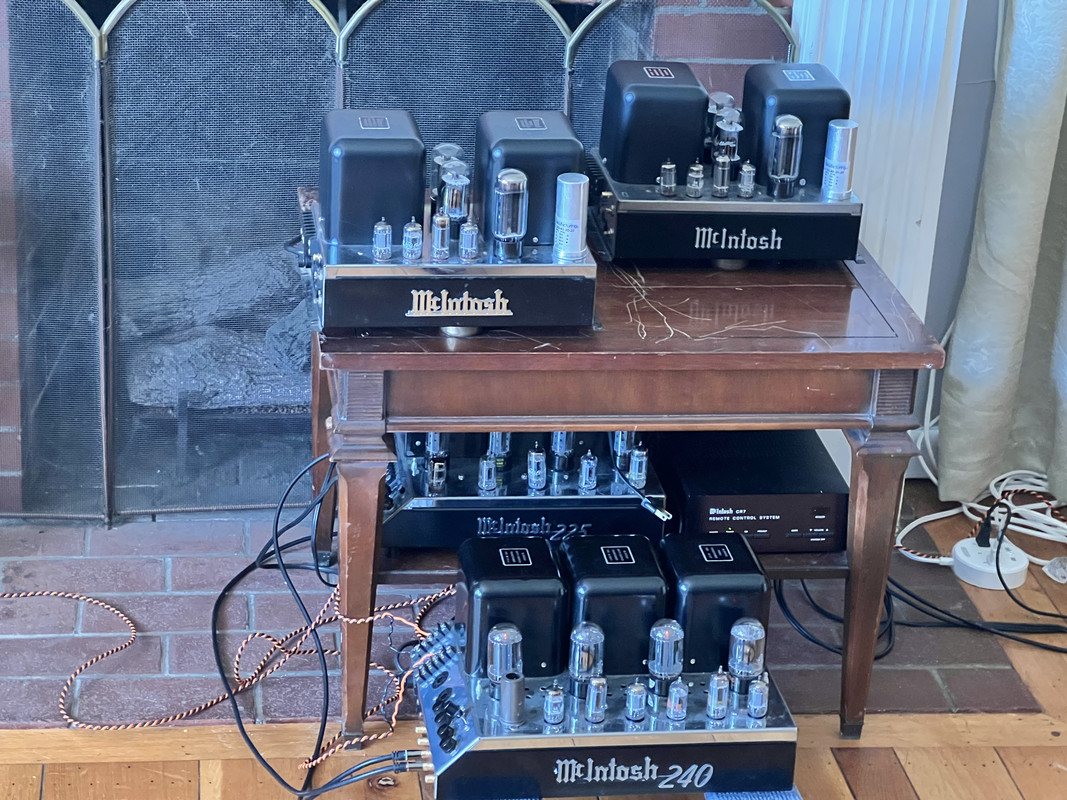
To begin with, as long as all are properly restored electrically, I honestly don't know how anybody could say anything negative about any of them. I could easily live with any of them. They are all incredibly fun and while there are some small differences that I can pick out, very similar. Listening through either Klipsch La Scala's, Cornwalls, KLH Model Six's, or even Allison One's, the 240 is wonderful. Quite muscular but not at all solid state sounding. I also own a restored MC2120, and that is solid state sounding. It's an older Mc, so it's still quite warm and easy to listen to, but the 240 is more holographic and it's mid range is terrific. Powerful enough to not only get super loud on the most efficient speakers and provide a very big bottom end to the notoriously(with some) bass shy La Scala's, but in a smaller room could drive a relatively inefficient acoustic suspension Allison One's with authority. No problem.

The 225 is the most delicate of them. Yet, on my La Scala's, it can get very loud and offer a more then reasonable bottom end. A little more colorful then the 240, but honestly it mostly sounds to me like it's younger sibling. Great mids and highs.

The MC30's offer the best mids of all of them, I suppose due to tube rectification. It's the most romantic tube sounding also. Very warm sounding but not overly so, at least to me. Drives the La Scala's with great authority, and can rock when asked.

I think the 240 was the most surprising of the 3. I've read so many things that indicated it was not as good as the 30's, or 225, lacked that tube goodness that they offered, etc. I haven't found that at all to be the case. While it is the most muscular, it most definitely is a vintage tube amp, and therefore super sweet. Like I said, I just don't know how anybody could hear something different, but then it's all very subjective.

D36-EB121-12-FE-43-B0-A65-D-7-F14-F09-E7-CCC.jpg
 
I compared impeccably restored vintage 240 and vintage 275 amps, as well as the 275 V, to the 275 VI (on stock vintage Klipschorns). There are very distinct sonic differences among those amps on those speakers. These differences were not subtle; and everyone—we (and the employees at Audio Classics who came in for a listen)—wholeheartedly agreed. (I can’t speak to the 225.) Here’s briefly what I remember: Compared to the 275 VI, the 240 was considerably darker, with wobblier bass and softer transitions and less distinctions between bass, midrange, and treble; it was also less dynamic. The vintage 275, though warm, was preferable to the 240 but not as forward or dynamic as the 275 VI, and it had less control of the bass, which wasn’t as low or tight as the 275 V or 275 VI. The 275 V, though great, also had slightly less deep bass and tautness—less slam than the 275 VI. I greatly preferred and purchased the 275 VI. Obviously, these amps perform differently with different speakers. The 240 or 225 might be the clear winner in another system. It’s not the horse, per se, but the relationship between horse and cart that matters. Since then, I’ve rolled the 275 VI’s stock 88s for Gold Lions.
 
Obviously, these amps perform differently with different speakers. The 240 or 225 might be the clear winner in another system.

I agree that the same amp can present completely different given the gear that it's teamed up, speakers being a huge part of the equation. But additionally, IMO, it comes down to what the parameters are to be a "clear winner". One person might hear wobbly bass and soft transitions as a negative, while somebody else might hear it as the amp's musicality and soul, while clear dynamics, bass tightness and forwardness might come across to some at sterile, or solid state like. I know I really enjoy my 77 La Scala's with the original crossovers and caps after having compared them to new one's, while other's claim high improvement changing out old for new. I like older, moving magnet phono cartridges, and conical one's at that. Other's swear by moving coil. Which one is "better"? I think we all know the answer to that.
 
Adding my .02 after 5 years since I've been an owner of MC30's, MC225 and MC240 now for a several months and have been able to compare. Of course, this thread started with a post asking about the 275, and I have not heard that amp. But figured the thread is far enough out, and relevant to some part of the thread to comment.

To begin with, as long as all are properly restored electrically, I honestly don't know how anybody could say anything negative about any of them. I could easily live with any of them. They are all incredibly fun and while there are some small differences that I can pick out, very similar. Listening through either Klipsch La Scala's, Cornwalls, KLH Model Six's, or even Allison One's, the 240 is wonderful. Quite muscular but not at all solid state sounding. I also own a restored MC2120, and that is solid state sounding. It's an older Mc, so it's still quite warm and easy to listen to, but the 240 is more holographic and it's mid range is terrific. Powerful enough to not only get super loud on the most efficient speakers and provide a very big bottom end to the notoriously(with some) bass shy La Scala's, but in a smaller room could drive a relatively inefficient acoustic suspension Allison One's with authority. No problem.

The 225 is the most delicate of them. Yet, on my La Scala's, it can get very loud and offer a more then reasonable bottom end. A little more colorful then the 240, but honestly it mostly sounds to me like it's younger sibling. Great mids and highs.

The MC30's offer the best mids of all of them, I suppose due to tube rectification. It's the most romantic tube sounding also. Very warm sounding but not overly so, at least to me. Drives the La Scala's with great authority, and can rock when asked.

I think the 240 was the most surprising of the 3. I've read so many things that indicated it was not as good as the 30's, or 225, lacked that tube goodness that they offered, etc. I haven't found that at all to be the case. While it is the most muscular, it most definitely is a vintage tube amp, and therefore super sweet. Like I said, I just don't know how anybody could hear something different, but then it's all very subjective.

D36-EB121-12-FE-43-B0-A65-D-7-F14-F09-E7-CCC.jpg
Do I detect some 60s on the horizon for you?
 
Back
Top Bottom