• Please note that Audiokarma will be offline briefly for updates early on Monday morning, September 28th.

McIntosh Mc60 restoration advice...how far to go

The only problems I've ever had with a few things being powder coated is it can be kind of thick? I had to carefully ream out some holes in some rims so the studs on the hub would fit through. Small bo

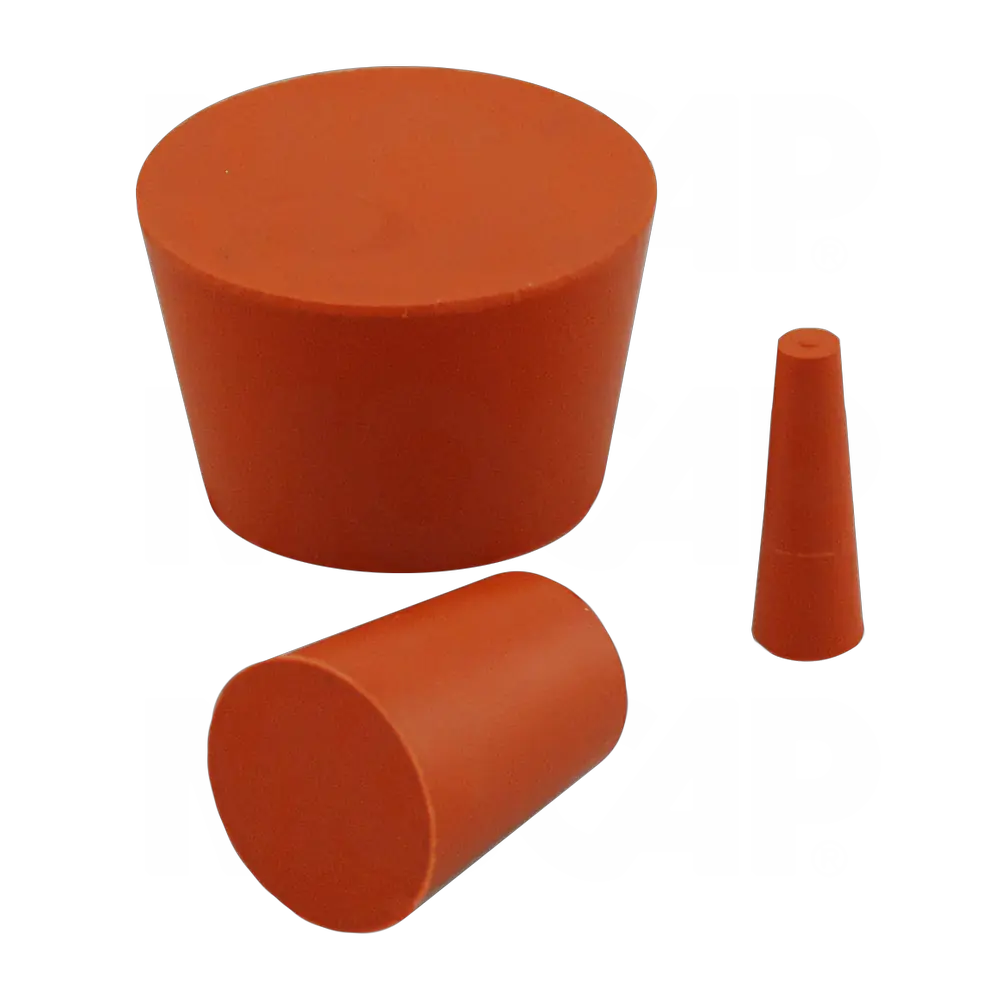
Ask your shop to mask the holes before paint, or if you do your own powder coating, you can order some silicone masking plugs. Amazon sells kits for small money.

I used to use these guys. Not cheap, but top-drawer products for everyday industrial use;

 
Ask your shop to mask the holes before paint, or if you do your own powder coating, you can order some silicone masking plugs. Amazon sells kits for small money.

I used to use these guys. Not cheap, but top-drawer products for everyday industrial use;

Heck, those could work for painting as well as long as you don't get the paint too thick. I'll have to get me some. Thanks for the post. :thumbsup:
 
Heck, those could work for painting as well as long as you don't get the paint too thick. I'll have to get me some. Thanks for the post. :thumbsup:

The whole trick to the silicone plugs is that the powder does not adhere to them while coating, as they are non-conductive, reducing wicking around the edge.
Take that, you electrostatic monkey!

Also, insert them from the side of the item such that the tapered side of the plug emerges on the visible side of the item being coated. Only use the minimum insertion force necessary to hold the plug in place to prevent bulging on the good side. This will reduce paint thickening around the opening, and reduce the possibility of damaging the paint around the opening when removing the plug. Best practice to remove the plug is using a twisting/pulling motion. Nice part is that even after baking powder, or liquid paint drying, the coating never really sticks to the plugs.

Small "oopsies'' are unavoidable, but there are many special tools (I use Shaviv deburring tools with a bunch of different cutting heads) available for really professional touch-ups.

Cheers,
Art
 
The whole trick to the silicone plugs is that the powder does not adhere to them while coating, as they are non-conductive, reducing wicking around the edge.
Take that, you electrostatic monkey!

Also, insert them from the side of the item such that the tapered side of the plug emerges on the visible side of the item being coated. Only use the minimum insertion force necessary to hold the plug in place to prevent bulging on the good side. This will reduce paint thickening around the opening, and reduce the possibility of damaging the paint around the opening when removing the plug. Best practice to remove the plug is using a twisting/pulling motion. Nice part is that even after baking powder, or liquid paint drying, the coating never really sticks to the plugs.

Small "oopsies'' are unavoidable, but there are many special tools (I use Shaviv deburring tools with a bunch of different cutting heads) available for really professional touch-ups.

Cheers,
Art
Also with this chassis coating considered, one has to keep in mind there are original chassis ground points at the 2 FP can capacitor mounting riveted mounting flange holes and also grounding to the output tube socket mounting flange holes to chassis connections, plus probably other chassis grounding points like the input RCA jack, unless one wishes to strap together all the normal chassis circuit grounds with decent gage buss wire connections.
Unstable noisy operation could result, if not addressed.
 
Clearly today, 70 years later we have better instrumentation, better components, we can completely redesign the amplifiers and improve them but I have to wonder why you wouldn’t just start with fresh iron and design your own instead of overpaying for a vintage amplifier that is worth more to collectors than its objective performance will justify in the audio market.

McIntosh clearly did have plenty of film caps available at the time, these amps are full of black Sprague film caps. However if you open enough of them you will find that the capacitors vary from amplifier to amplifier, where you might find a lot of “bumblebee” caps in one, none in another, ... of the same model amplifier. It appears that McIntosh didn’t feel that there was enough (or any?) difference between the two types in most of the circuitry to specify. We have found that we can make the metal film thinner, the insulating / electrolytic layers thinner through our modern processes but I see more failures of ten-year-old capacitors than I do in these old beasts. I can pull capacitors out of a 1970s Sansui or 1960s McIntosh, and find them to still test in-spec (by RIAA standards anyway) and we have new product going out the door that I need to RMA within a couple of years, ... much of the capacitor “improvement” has been in miniaturizing components and maximizing profits.

Modify to your heart’s content, it’s only a hobby. The only real heartburn I have when people make general comments regarding changing the type of component, it’s not a “one size fits all” answer. In some cases it can make an improvement, in others it can degrade performance or introduce instability. Even after designing and prototyping ad-naseum, we still test to destruct many examples of new designs to determine whether any further changes are necessary before production, there almost always are as even good theory only goes so far. For the advanced hobbyist or Engineer, modifications make sense. For the average guy wanting to restore his amplifiers however there’s a lot more to consider than whether a film cap is “better” than an EL cap.

 
Ask your shop to mask the holes before paint, or if you do your own powder coating, you can order some silicone masking plugs.
I install those myself before taking work to the powder coat shop. Alternately, holes can be drilled prior to PC, then threaded afterward.

Jack
 
Also with this chassis coating considered, one has to keep in mind there are original chassis ground points at the 2 FP can capacitor mounting riveted mounting flange holes and also grounding to the output tube socket mounting flange holes to chassis connections, plus probably other chassis grounding points like the input RCA jack, unless one wishes to strap together all the normal chassis circuit grounds with decent gage buss wire connections.
Unstable noisy operation could result, if not addressed.

Agreed. I usually mask the interior of the chassis to prevent overspray in order to retain conductivity, if I'm staying original.

Personally, I prefer to use the more orthodox ground-buss technique as opposed to the easier "it grounds wherever it mounts" style. As a bonus, proper ground layout will usually provide quieter operation and enhanced reliability. Ask anybody who has encountered a Fisher receiver with a bit of chassis corrosion that doesn't have the later daisy-chain between ground points.. yikes, what a pain.
 
The chrome powder coat I've seen was easily distinguishable from real chrome. I would move all the major parts to a new, unblemished SS chassis rather than do that. Some of the PC colors are excellent, but then it's less of a restoration and more of a "restomod."

Trying to save parts with leads crimped onto tube socket lugs and terminal strips is a major PITA. I won't do it unless a component is irreplaceable. Matter of fact, this is one advantage to replacing the tube sockets. Just rip everything out - including the attached resistors and caps - and toss it all.

Jack
Hi Jack, I see what you mean about the chrome vs simulated chrome powder coat... The from what i now see PC looks great until the mandatory clear goes on... then it really becomes more of a grey... I haven't yet had a chance to see it in person but based on your feedback, if i do go PC I'm thinking of colors (Copper orange might look cool)... or just go the new chassis route. These are never going to be perfect, which is honestly why I was interested in them...Serial numbers aside, having ones on the rough side puts a little less guilt on playing with them a bit and seeing what can be done.
 
I think that there is some truth to the thought that changing components can alter the sound. Changing from an old carbon-comp resistor to a new carbon-comp resistor shouldn’t change anything but maybe from carbon-comp to film (different delta-T) has the potential to change, ... something? Same with changing from electrolytic to film, etc. it has the potential to make something different.

There are many people who claim that changing every cap to film will make it better, ... which begs the question why McIntosh Engineers who had plenty of access to film caps (and used many of them) didn’t do that if there were improvements to be had (the answer is obvious: it didn’t improve anything).

It’s your amp, if you want to change the type of cap and/or resistor it likely won’t hurt anything, just don’t expect some magical improvement because the capacitors have an expensive name on the side. I stick with high-quality commercial resistors and capacitors as nobody will ever open my amplifiers to see if there are fancy names on the caps. Good enough for McIntosh is a pretty good endorsement.
Thanks for the great advice! I'm just starting to get into them a bit today so I should know what I'm up against here in a bit. I would like to see what the original coupling caps sound like (it they turn out to all measure good... if they don't into a parts bag they go and new caps go in. Even if they are good I'm thinking swapping in a few different caps might be an interesting listening test to see how much real difference they make. Granted my ears, speakers and source all would play into any perceived changes... still might be fun to put in some orange drops and compare them... doubt I would want to go too wild though.
 
Agreed. I usually mask the interior of the chassis to prevent overspray in order to retain conductivity, if I'm staying original.

Personally, I prefer to use the more orthodox ground-buss technique as opposed to the easier "it grounds wherever it mounts" style. As a bonus, proper ground layout will usually provide quieter operation and enhanced reliability. Ask anybody who has encountered a Fisher receiver with a bit of chassis corrosion that doesn't have the later daisy-chain between ground points.. yikes, what a pain.
I hear what you say on the ground buss route... I hit similar to what you did with your Fisher on an old 340B Scott... chased and chased the issue.. turned out to be a corroded rivet on a cap that was out of mt sight... swapped out the rivet and all was well.
 
Ask your shop to mask the holes before paint, or if you do your own powder coating, you can order some silicone masking plugs. Amazon sells kits for small money.

I used to use these guys. Not cheap, but top-drawer products for everyday industrial use;

Thanks for the tip! Now that you all have mentioned it .. it never crossed my mind about the thickness of the Powder Coat affecting the holes in the chassis... if I end up going this route I would have never thought about it... ugh what a potential disaster that would have been... I can see me now with newly painted chassis trying to sand down the inside of each socket, rivet and screw hole....
 
Clearly today, 70 years later we have better instrumentation, better components, we can completely redesign the amplifiers and improve them but I have to wonder why you wouldn’t just start with fresh iron and design your own instead of overpaying for a vintage amplifier that is worth more to collectors than its objective performance will justify in the audio market.

McIntosh clearly did have plenty of film caps available at the time, these amps are full of black Sprague film caps. However if you open enough of them you will find that the capacitors vary from amplifier to amplifier, where you might find a lot of “bumblebee” caps in one, none in another, ... of the same model amplifier. It appears that McIntosh didn’t feel that there was enough (or any?) difference between the two types in most of the circuitry to specify. We have found that we can make the metal film thinner, the insulating / electrolytic layers thinner through our modern processes but I see more failures of ten-year-old capacitors than I do in these old beasts. I can pull capacitors out of a 1970s Sansui or 1960s McIntosh, and find them to still test in-spec (by RIAA standards anyway) and we have new product going out the door that I need to RMA within a couple of years, ... much of the capacitor “improvement” has been in miniaturizing components and maximizing profits.

Modify to your heart’s content, it’s only a hobby. The only real heartburn I have when people make general comments regarding changing the type of component, it’s not a “one size fits all” answer. In some cases it can make an improvement, in others it can degrade performance or introduce instability. Even after designing and prototyping ad-naseum, we still test to destruct many examples of new designs to determine whether any further changes are necessary before production, there almost always are as even good theory only goes so far. For the advanced hobbyist or Engineer, modifications make sense. For the average guy wanting to restore his amplifiers however there’s a lot more to consider than whether a film cap is “better” than an EL cap.
I think this will be a fun project... I'll do some experimenting just to see what happens when I swap different components, but I'll probably not go too far out there unless I have to. You brought up an interesting point about the caps varying through out the run... I remember seeing somewhere an article from back in the day where someone at McIntosh mentioned that the brand of tubes didn't affect the sound so don't worry about it... I wish I had the link still. I think most everyone would disagree with that now days? At least to me and my ears there can be a LOT of difference. So I'm wondering if the same thought process back then was also their approach to caps... as long as they meet their specs "they all sound the same" so maintaining specific mfg's was not anything they cared about.
 
There was an OG from McIntosh on the McIntosh forum some years back who told that they all met the spec, if McIntosh happened to buy the “black beauty” caps one week and the “bumblebee” caps the next, that’s what went in those less-critical locations.

On vintage Guitar forums, the bumblebee caps are highly regarded for their sound, on audio forums not so much.

I replaced the black beauty coupling caps in my MC240 with K40 PIO caps on a recommendation from a McIntosh guru, and thought it turned my amp into a soggy-sounding amp. To each his own on that one.

Tube rolling is much easier than cap rolling, thats certain.
 
I replaced the black beauty coupling caps in my MC240 with K40 PIO caps on a recommendation from a McIntosh guru, and thought it turned my amp into a soggy-sounding amp.
Perhaps because the dielectric absorption of PIO is so bad. Ditto for the Bumblebees, which I believe are mylar.
I would like to see what the original coupling caps sound like
If you replace them with polypropylene, they won't sound like anything. :)

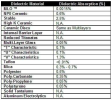
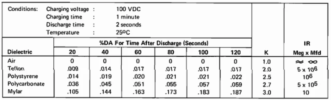
Here are two charts showing properties of common capacitors. PIO isn't on the lists (most companies no longer make them), but several white papers online indicate they are worse even than electrolytic in this regard. The most practical coupling cap dielectric now in terms of cost, size and availability is polypropylene. All the needed values are available at companies like Digikey and Mouser. There simply isn't a good reason to spend more for hi-fi.

Screen Shot 2024-11-02 at 9.15.03 PM.png

Screen Shot 2024-11-02 at 9.14.38 PM.png

Jack
 
I hear what you say on the ground buss route... I hit similar to what you did with your Fisher on an old 340B Scott... chased and chased the issue.. turned out to be a corroded rivet on a cap that was out of mt sight... swapped out the rivet and all was well.

Ha, now there's a coincidence, I also have a 340B (one of my favourite receivers, along with my 400) that had similar problems.
Aluminum does not play well with most other metals when it comes to ground points between dissimilar metals. The oxide layer on the aluminum is not great for conductivity even with fresh metal.

My thoughts on your MC60;

I wouldn't do any cosmetic work, other than a good cleaning and applying some form of preservative to stop further degradation. But, that's just me. I appreciate survivors.
Solvol Autosol or Nevr-Dull are particularly well-suited products. Work great on chrome and aluminum, and leave behind a protective coating. Be careful around the lettering. I've been using these on vintage motorcycles and my own Mac's and Dynaco's for a very long time. Wonderful stuff!

As for the electronics, I would do nothing less than a complete restoration/resurrection. Whatever perceived magic the original parts may have provided, like Elvis, left the building long ago. These are phenomenally good sounding and reliable units, and are keepers. Frankly, from a sonic perspective, there is nothing left worth saving, other than the transformers. I have been looking for a pair of MC60's for many decades, and have yet to find anything affordable that wasn't totally trashed. I may be a bit jealous....
 
Okay, first of all, not all caps are in positions that “affect the sound” at all. Second, dielectric absorption is not the only characteristic that a capacitor has as changing ESR can change the circuit slightly. Third, and to me the most puzzling, if you’re really after the most linear and uncolored sound, a tube amplifier is not the place to be. Tube amplifiers impart their own sound, their own characteristics, one of the reasons that “tube rolling” exists, as do the components designed into the circuit including PIO and EL caps, as well as film caps in many places throughout the circuitry from the factory.

If you are primarily interested in the most accurate amplifier then why would you start with a 70-year old design and amplifier and hardware, and not start right out with a new design using the latest technology?

I keep reading how people claim they’re updating the circuit, with technology that was available 70 years ago when the amplifier was built, and it’ll magically become a modern design. Tube amplifiers have tubes.

The biggest change to produce a more accurate amplifier in an MC60 would be to dump the rectifier tube(s) and re-design the DC supplies with solid-state so that the power supply isn’t weak at the knees, ... but then we don’t want to do that because there’s something magical about that voltage dip that compresses the music, ... such contradictions.

If you want to change the amplifier’s sound, go for it. If you want a modern tube amplifier, make more changes than just cap-swaps. If you want an amplifier that sounds like 1960, that’s what you have. Hey it’s a hobby, and you don’t need to be an Engineer to order parts from Digikey, solder them in, and claim you have made massive improvements.
 
Last edited:
I keep coming back to two-ish ways these can be treated. New chassis, and to heck wid the serial numbers( but with the two chassis on a shelf, there is proof they were brothers for the purist). Second, keep 'em with the OE chassis for basically purposes of re-sale. The originals are good, but IME, not worth it as such for a personalized, top shelf system. I have parted ways with a bunch of them, including a stock re-build Cit.ii. The E-Linear W6m cleaned their collective clocks. Either way, a solid rebuild, and I've no reason to suspect a new chassis( SS preferably) would be a poor choice.

I suggest building them so you're happy. If not, is wasted effort and $$...but with a non-trivial bit of education(priceless!!!! ).

Douglas
 
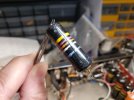
One of my MC30's had this:
20210616_104841.jpg

You could also try Boeshield on the chassis after cleaning. It's a metal preservative that I believe is wax based. I put it on the top of my table saw several years ago and still clean and smooth. Boeing developed it originally to use on plane parts. You can buy it direct or from Amazon.
 
if you’re really after the most linear and uncolored sound, a tube amplifier is not the place to be.
Your experience is clearly different than most of us here. I moved back to tubes after five decades of pursuing solid state. Everything from Ampzilla to Mark Levinson, Lux and the usual assortment of Sansui, Pioneer and other Japanese peasants. It's exactly for reasons of uncolored sound that I finally discarded my last SS amp in favor of a $20 Harman Kardon garage find. I'll never go back.

Jack
 
Back
Top Bottom