• The move to the new server is done. There are some software and database maintenance updates in process. This has us passing the hat around to help out. We appreciate any donations. Seriously, even a dollar helps. The payment page may be found here - https://www.audiokarma.org/support.html

McIntosh Mc60 restoration advice...how far to go

I keep coming back to two-ish ways these can be treated. New chassis, and to heck wid the serial numbers( but with the two chassis on a shelf, there is proof they were brothers for the purist). Second, keep 'em with the OE chassis for basically purposes of re-sale. The originals are good, but IME, not worth it as such for a personalized, top shelf system. I have parted ways with a bunch of them, including a stock re-build Cit.ii. The E-Linear W6m cleaned their collective clocks. Either way, a solid rebuild, and I've no reason to suspect a new chassis( SS preferably) would be a poor choice.

I suggest building them so you're happy. If not, is wasted effort and $$...but with a non-trivial bit of education(priceless!!!! ).

Douglas
Thanks Douglas! Everyone has been so great on here with all the options and ways they would approach this. I've gotten a lot of terrific ideas and I'm really starting to map out my plan both cosmetics and chassis wise... a lot of what excited me about these particular amps was to your point of the education (fun) of digging into them. If they were in a better state I think I would be more hesitant in stripping them down and playing with them. But in their current condition they give me the opportunity to have some fun and put what I'm learning here into practice :)
 
One of my MC30's had this:
View attachment 3335996

You could also try Boeshield on the chassis after cleaning. It's a metal preservative that I believe is wax based. I put it on the top of my table saw several years ago and still clean and smooth. Boeing developed it originally to use on plane parts. You can buy it direct or from Amazon.
Thanks and Wow! I'm hoping that is not the normal way the bumblebees fail... one more reason to yank them!
I think there is hope with the one chassis in maybe getting it cleaned up decent enough (maybe) so I'll check out Boeshield and maybe give it a shot.. :)
 
Ha, now there's a coincidence, I also have a 340B (one of my favourite receivers, along with my 400) that had similar problems.
Aluminum does not play well with most other metals when it comes to ground points between dissimilar metals. The oxide layer on the aluminum is not great for conductivity even with fresh metal.

My thoughts on your MC60;

I wouldn't do any cosmetic work, other than a good cleaning and applying some form of preservative to stop further degradation. But, that's just me. I appreciate survivors.
Solvol Autosol or Nevr-Dull are particularly well-suited products. Work great on chrome and aluminum, and leave behind a protective coating. Be careful around the lettering. I've been using these on vintage motorcycles and my own Mac's and Dynaco's for a very long time. Wonderful stuff!

As for the electronics, I would do nothing less than a complete restoration/resurrection. Whatever perceived magic the original parts may have provided, like Elvis, left the building long ago. These are phenomenally good sounding and reliable units, and are keepers. Frankly, from a sonic perspective, there is nothing left worth saving, other than the transformers. I have been looking for a pair of MC60's for many decades, and have yet to find anything affordable that wasn't totally trashed. I may be a bit jealous....

Yea I REALLY like the 340B... its a great receiver... this one I got from my neighbor years ago and he had it sitting in his basement for years before ... a rebuilt power supply and a few coupling caps later it sounds great. I'm guessing back in the day Scott figured the Aluminum chassis would last forever and not rust... not realizing what you mentioned.. the issue with the dissimilar metals rearing their head. But then again I doubt they really thought that almost 60 years later people would still be using them ;)

I did get a chance to dig into the Mc60's a bit over the weekend... brought them up on the variac (not to full voltage though)... Surprise #1 they both came up (so iron is all good..Whew!) Surprise #2... no hummm...so the PS electrolytic's are hanging in there (at least enough for me to test)... and (Non) Surprise #3 the bumblebees are leaking. (But the black beauties checked fine for value and leakage)... so looks like these guys are getting a well needed full on restoration.
 
Perhaps because the dielectric absorption of PIO is so bad. Ditto for the Bumblebees, which I believe are mylar.

If you replace them with polypropylene, they won't sound like anything. :)

Here are two charts showing properties of common capacitors. PIO isn't on the lists (most companies no longer make them), but several white papers online indicate they are worse even than electrolytic in this regard. The most practical coupling cap dielectric now in terms of cost, size and availability is polypropylene. All the needed values are available at companies like Digikey and Mouser. There simply isn't a good reason to spend more for hi-fi.

View attachment 3335634

View attachment 3335635

Jack

There was an OG from McIntosh on the McIntosh forum some years back who told that they all met the spec, if McIntosh happened to buy the “black beauty” caps one week and the “bumblebee” caps the next, that’s what went in those less-critical locations.

On vintage Guitar forums, the bumblebee caps are highly regarded for their sound, on audio forums not so much.

I replaced the black beauty coupling caps in my MC240 with K40 PIO caps on a recommendation from a McIntosh guru, and thought it turned my amp into a soggy-sounding amp. To each his own on that one.

Tube rolling is much easier than cap rolling, thats certain.
Wow I thought it was just me... I tried K40 in my C20 because I had a couple leaky bumblebees in there... the K40's lasted about 60 mins before I threw the C20 back on the bench and yanked them out.... I know they probably sound nice in certain amps... but my C20 was not particularly liking them... soundstage collapsed, muddy. Maybe if I had the patience to let them break in over days it might be different (given the praise these seem to get I suspect they would have come around some)...
 
I did get a chance to dig into the Mc60's a bit over the weekend...
Sounds like progress! About the PS caps, my Citation V also powered up fine on a Variac when I first acquired it a couple years ago. However, the main caps were apparently almost completely dried out. There was no hum, but the problem showed up immediately with low frequency signals. Sine waves were very distorted, even at relatively low power levels, and I have to assume that I would have seen the entire B+ line being modulated by the outputs if I had put a scope on it. This all cleared up after the caps were replaced. Have fun with those Macs!

Jack
 
The pic that @nerdorama showed is a great example of why bumblebee's fail. Unfortunately, they aren't always this obvious.
Many times, they have lost integrity around the leads, which is not easily visible. Moisture gets in, and regardless of dielectric type, leakage results.

The Black Beauty caps don't seem to suffer this type of failure, and seem to exhibit a far lower failure rate than most other caps from the era.
 
The cracked case is what happened to all of the bumble bee caps in my Philco TV. I've run across them in other things with various amounts of split going on. They are pretty much always leaky to some degree. Never bothered to dissect one to figure out the dielectric, once its cracked open and electrically bad it doesn't exactly matter anymore. If it was film, it would likely be mylar though. In modern terms thats metalized polyester. Mylar is just the DuPont brand for a metalized polyester film.

The black beauty caps I've run into seem to depend on the specific type. I forget the fine points but I want to say there are two series, one is PIO, the other might be a di-film. I replaced a bunch of the PIO ones in an old National shortwave for my boss, they were actually leaking oil out of them. Never tested them electrically, any component that is actively dripping liquid out of it needs to go away. I think that may have been the red or orange print ones, the other series I think uses yellow print?
 
Mylar is just the DuPont brand for a metalized polyester film.
Thank you for mentioning that, I don't recall if I have ever looked it up. Polyester is about 10X worse for DA than polypropylene, so that puts everything together.

Jack
 
I've found the solid aluminium type caps make good replacements for tantalum caps, and are rated better than similar electrolytics.

I don't believe Solid Aluminum caps have been manufactured for a long time now. Aluminum-Polymer is available, but they don't remotely spec on par with Tantalum's.
 
i've seen dozens of tantalum caps fail leaky and shorted over the years. I won't use them.

Jack
 
I don't believe Solid Aluminum caps have been manufactured for a long time now. Aluminum-Polymer is available, but they don't remotely spec on par with Tantalum's.
That's the ones, I'm still a bit of a noob (nothing more dangerous than a little knowledge) I usually just check esr, size is often my biggest concern, but after checking, tantalums have way better dcl ratings, which is why I assume their so popular?
 
That's the ones, I'm still a bit of a noob (nothing more dangerous than a little knowledge) I usually just check esr, size is often my biggest concern, but after checking, tantalums have way better dcl ratings, which is why I assume their so popular?

Noob or not, you had it right; the solid aluminum caps were really good, especially for long life and low leakage. But they were quite expensive and often in limited supply.

In high gain or very sensitive circuits, leakage=noise, which was why Tantalum caps were very popular, as higher µF film caps were huge in size and price, and were generally limited to lower values, and low-leakage electrolytics weren't all that common at one time.
 
I keep coming back to two-ish ways these can be treated. New chassis, and to heck wid the serial numbers( but with the two chassis on a shelf, there is proof they were brothers for the purist). Second, keep 'em with the OE chassis for basically purposes of re-sale. The originals are good, but IME, not worth it as such for a personalized, top shelf system. I have parted ways with a bunch of them, including a stock re-build Cit.ii. The E-Linear W6m cleaned their collective clocks. Either way, a solid rebuild, and I've no reason to suspect a new chassis( SS preferably) would be a poor choice.

I suggest building them so you're happy. If not, is wasted effort and $$...but with a non-trivial bit of education(priceless!!!! ).

Douglas
Personally I never worry about resale. If I don't intend on keeping and using piece of equipment it get the basic restore and off it goes. The rest gets personalized to my liking. Even a few pieces of equipment I've done this to still sold fast when I decided to let them go. I didn't take any of a, or very little hit wise on the price.
i've seen dozens of tantalum caps fail leaky and shorted over the years. I won't use them.

Jack
I ran into a row of them cracked in a SS preamp.
 
Always replaces all the capacitors, especially the ones in the power supply. The black caps with the colored striped had a lot of drifting after 15 years or so. Davie O'brien replaced the ones I needed for free at Mcintosh Amplifier clinic back in the late 60's. OUT put tubes should be matched pairs as there is so much variation today. Its one reason I gave up on tubes a long time ago in the 70's.. maybe to soon is what I feel now. I should have waited another 10 years.
 
I ran into a row of them cracked in a SS preamp.

I've found tantalum caps to be extremely intolerant of any sort of exceeding their ratings. Slight over-voltage, ka-pow! Miserable things, and expensive to replace like for like now. Low leak electrolytic or film is usually a better sub now.
 
Always replaces all the capacitors, especially the ones in the power supply. The black caps with the colored striped had a lot of drifting after 15 years or so. Davie O'brien replaced the ones I needed for free at Mcintosh Amplifier clinic back in the late 60's. OUT put tubes should be matched pairs as there is so much variation today. Its one reason I gave up on tubes a long time ago in the 70's.. maybe to soon is what I feel now. I should have waited another 10 years.
This brings up a critical mod(IMO), converting the amps from fixed, fixed bias to adjustable fixed bias. This through adjusting the cathode follower grid. A pot to get rid of the fixed voltage divider in other words.

Douglas
 
and wire it so if the pot fails, it goes full or more negative rather than to nothing.

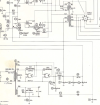
Relevant part of the schematic

1730818335086.png

Sub R22 with a 100k resistor in series with a 50k pot. Approx mid travel will be stock values. If the pot goes open or if the wiper lifts, you get extra negative voltage to the cathode follower which will shut down the output stage rather than letting it run away and kill output tubes.
 
Since the negative rail diode is probably Selenium, and replacing it with something like a pair of UF4007's in series( for PIV ratings ) will make the rail mo' negative so there is more to mess with( R35 value increase ).

Douglas
 
Always replaces all the capacitors, especially the ones in the power supply. The black caps with the colored striped had a lot of drifting after 15 years or so. Davie O'brien replaced the ones I needed for free at Mcintosh Amplifier clinic back in the late 60's. OUT put tubes should be matched pairs as there is so much variation today. Its one reason I gave up on tubes a long time ago in the 70's.. maybe to soon is what I feel now. I should have waited another 10 years.
Thanks!! I've ordered the replacements for the bumblebees and electrolytic's so they should be showing up here in the next few days. Hoping that these will be a good start to getting these electrically back on their feet. Once I get them in I'll look to bring them back up on the variac and check voltages. I figure then I''ll have a much better picture for next steps :)
 
Back
Top Bottom