• The move to the new server is done. There are some software and database maintenance updates in process. This has us passing the hat around to help out. We appreciate any donations. Seriously, even a dollar helps. The payment page may be found here - https://www.audiokarma.org/support.html

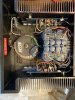
Melted inductor & blown capacitors AR9LS

Kraco_Lover

New Member
Hello AKers
About 5 years ago I acquired a pair of AR9LS. I sourced new capacitors and resistors and updated the crossovers using the old inductors. In the last listening session involving home brew and elevated listening levels, an issue related to one of the speakers became apparent.
Upon inspection of that speaker it was found that one of the inductors was melted and 2 of the capacitors wired in parallel were burst. I managed to find a crossover for sale, replaced the inductor and put in new capacitors.
Since the new capacitors were not the same brand as the ones I was replacing I decided to replace those same capacitors in the other speaker. Much to my disappointment those same 2 capacitors were blown and the same inductor melted in the other speaker.
My question to you all is what likely caused this? Did the capacitors fail causing the inductors to melt or vice versa? These were powered by an Adcom 5500, could the amplifier be a likely cause?
I attached a couple pictures although they are likely of little help. Thank you all in advance for your input!
 

Attachments

  • CAE82F21-9C1B-4F42-A312-E8584875911E.jpeg
    CAE82F21-9C1B-4F42-A312-E8584875911E.jpeg
    169.3 KB · Views: 69
  • ADD7BAAC-6968-4795-BEBC-8C8E341B9106.jpeg
    ADD7BAAC-6968-4795-BEBC-8C8E341B9106.jpeg
    165.8 KB · Views: 68
Register to hide this ad
My guess would be serious oscillation caused by clipping the amp. Inductors are low pass fliters, so get hot when a lot of high frequency (50kHz is common) signal is being blocked. Ditto for the caps.

Could also simply be driving far too much wattage through the speakers. Be glad the crossover fried and not the voice coils.
 
Unless the crossover components were somehow mis-wired? If you have a shunt capacitor for example, it is usually fitted after an inductor, or if not has a resistor in series with it. If it was connected directly across the speaker terminals, it could fail.

Lee.
 
Did the amp suffer an output stage failure, placing supply voltage at the speaker?
Had to have happened. I have never seen an inductor on a speaker melt. I have however seen a voice coil ejected from a speaker, burning. Phase Linear 700 could do that.
 
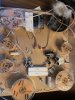
The crossover over pic shows old, original caps. Catastrophic failure of old caps when overdriving is not that uncommon. It happens, that is why many recommend recapping old speakers. Those crossovers should have been recapped a while ago.

As for the melted coil, the pic does not clearly show any melted or burnt coil. Which coil is melted? Have you tested it for continuity and inductance? Don't confuse the hot glue for melted plastic. Well, actually it is melted plastic, but it is supposed to be melted and then hardened.

The coil wire looks good and not discolored. The spools have a bit of hot glue on them to hold the wire in place as it exits the spool. The one spool in the lower right corner has a wavy portion like it may have gotten hot and softened. If that is the extent of the melting, it is likely from driving the speaker beyond its rating/capability, causing the coil to heat up. Also, based on the age of the caps, they have likely drifted, which could shift the crossover point, making the driver carry more bandwidth than intended, which could cause coil heating.
 
The crossover over pic shows old, original caps. Catastrophic failure of old caps when overdriving is not that uncommon. It happens, that is why many recommend recapping old speakers. Those crossovers should have been recapped a while ago.

Those are Erse Audio caps, and so probably not original. That crossover board doesn't look original either. Not sure how the AR9LS model is, but an AR9LSi crossover should look like this :

index.php


And if it's restored the correct way, should look something like this :

index.php


I have a whole thread on these speakers, you can check it out here :

https://audiokarma.org/forums/index.php?threads/acoustic-research-ar9lsi-restoration.528158/

Lee.
 
If it was an amp rail voltage failure I'd expect the voice coil to roast long before the inductor. V.C. wire is a whole lot thinner. Cap shouldn't care so long as it was rated at sufficient voltage.

I once roasted a pair of JBL woofers with a Phase Linear. Not an amp failure, but I knocked cable off and got full 360 watts of 60hz hum into 85 watt rated speakers. The voice coils deformed and locked the woofers up but didn't actually burn the coil open. The fuse in the amp popped before that happened. The crossovers were and still are just fine. Based on that I'd expect something truly nasty would have had to happen with the amp to melt an inductor and blow a cap if it was anything DC - audio range and you'd know it. Ultrasonic oscillation could though.
 
Thank you all for your replies. Lee sonic is correct, those are Erse audio caps I used when I recapped the speakers after I purchased them some years ago. And if memory serves they were the AR9ls and I added the option to run the signal through 2 resistors (not pictured) to have the option of the LS or LSI sound. I suppose it is possible I wired something incorrectly which might explain the same failures in each crossover. However I’m guessing there would have been hundreds of hours listening time before noticing a problem.
The 5500 had, at times, been driven to the point where it’s warning lights would illuminate on particularly bass heavy portions of songs, although this was not the norm. The amp was not being driven to these levels the evening the failure was noticed. When this issue became apparent, it was noticed in only one channel, although the same failures happened in both crossovers so I suppose it is possible the failure could have happened a prior date or dates. There are younger adults with access to the system so I haven’t been present every listening session but they are primarily used by the Mrs. and I.

These speakers served me well for a number of years and memories have certainly been made in front of them. The uncertainty of the cause of the issue is frankly, a bummer. My plan is to source inductors and triple check that I have things wired correctly.
I haven’t been able to find 2 of the exact value inductor as of yet. Without having inductors custom made, how close is good enough? These appear to be 3.8mh. I’m not 100% sure on the gauge yet but think it’s 20. I might order a tool to more precisely measure unless someone happens to know.
Thank you all.
 
You can always order one thats slightly higher and un-wind a few turns of wire to get it down where you need. Its just a coil of wire on a plastic bobbin, the more turns of wire, the higher the inductance.
 
Could just be a bad set of capacitors. Pretty early for failure, but if there was something defective about them when installed, that would explain the simultaneous failures.

And one of the "young adults" may have turned the volume all the way up to see "what would happen" and not report that behavior -- it's not like I didn't do anything like that when I was young.....

The inductors are fine unless the insulation is burned off the windings. If there are no shorts they will work as intended.
 
Sorry for the poor picture quality of the original post. Attached is a better photo of the inductor at issue. My gut tells me a replacement would be prudent.
 

Attachments

  • 2ABEAF70-AFC7-4727-996F-2E978C488AA1.jpeg
    2ABEAF70-AFC7-4727-996F-2E978C488AA1.jpeg
    125.3 KB · Views: 31
it got hot, but it may still be fine. Plastic lets go a lot quicker than wire and insulation does. An LCR meter to confirm the inductance wouldn't be a terrible thing. If you do want to replace it and can't find an exact match, you'll need one in order to tweak the replacement to the correct value anyway.
 
Sorry for the poor picture quality of the original post. Attached is a better photo of the inductor at issue. My gut tells me a replacement would be prudent.
Unless it's shorted, I'd imagine that it's going to match the inductor in the other speaker better than any replacement will.
 
Search eBay for MK168, and buy yourself one of those multi-testers. I have used these to measure inductance, and re-wind inductors to get the values I desire. You can check your inductance on the "melted" coil versus the non-melted one in the other speaker.
 
Back
Top Bottom