• The move to the new server is done. There are some software and database maintenance updates in process. This has us passing the hat around to help out. We appreciate any donations. Seriously, even a dollar helps. The payment page may be found here - https://www.audiokarma.org/support.html

Minimus 7 Loudspeakers - Measurements

Minimus damping the cabinet?

Regarding the Minimus 7 , here’s a highly untechnical question. What effect would lining the inside of the cabinet with anti-vibration material have ? Somehow it seems like it would have a similar effect of creating more “mass” or “density” to the cabinet correct? Would that be a benefit? Just a thought.
 
Adding mass simply shifts the resonant frequency of the wall panels and this may or may not be good depending on the goals. You want to add resistive dissipative loss so that any resonance is highly damped and dies down fast. This of course assumes that there is a problem.

The box does ring, however I don't think it is a serious issue.

I would probably use a thin layer of damping material if I was asked to find a solution. Something like this:
http://www.parts-express.com/pe/showdetl.cfm?Partnumber=268-030

Thin is important because we don't have much enclosure volume to work with. I would probably use a moderately thick layer of glue to glue in the fiberglass damping and let the glue act as the wall damping as another alternative.
I suggested how to stuff the box here:
http://www.audiokarma.org/forums/showpost.php?p=2357327&postcount=98
 
My thoughts? We're good +/- 20° in all directions with this design. Close enough for the Zilchster.

I worked with the stock inductor at your suggestion, Pete, and I believe it was a good one. In the context of an economical upgrade, it certainly makes sense if it can yield an acceptable result, which, in my view, it does.

In the course of working through this, there were several occasions on which I was tempted to take a different approach, and that is still possible, certainly, but after checking just a few more things here, I'm done. If nothing else, it comprises a solid foundation for the exploration of alternative options. I devoted my entire holidays to this project; I may come back to it and do more later, but I have no desire or inclination to make Minimus 7 my life's work at this point.... ;)

I agree that this is a good enough fix and far better than the original. I've not finalized my pair and I might just wind down the original if I decide to go that route. I'm probably going to order a pair of the tweeters from Apex Jr. and see how those work before finishing them.
 
Seems you're reading into my comments. I have nothing against local stores or long life synthetic products. I don't know why but the synthetic products have not tested well so far, show me one that works and will last 50 years at reasonable cost and I'll use it.

I've tested many poly fills and none are as good as fiberglass. Similar situation.

The thickness of the felt at the link you provided is not stated, what is the thickness? I'd be looking for 1/4" sometimes 1/2" or 3/4" which is only available from industrial supply houses as far as I know.

It's about 3/32" - and positively exquisite for damping planar dipoles.

All sorts of crazy thicknesses of felt are available in the form of saddle pads. Up to and occasionally over an inch. It's not what you'd call fluffy, though.

As for the afore-mentioned study that compares 1 synthetic product with 1 mostly natural product, I would wager that a cursory inspection would find easily described visual and tactile quality cues in both of them - such as the general density, the fineness of the fibers, how uniform the matting is, and how much resistance it has to air when you try to blow through it.
 
Loose Ends:

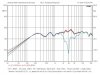
PZ-2.1 performance is virtually identical using either the stock inductor or the PE Jantzen 0.4 mH 20 Ga., Green and Red, respectively.

Inverse tweeter phase connection reveals the acoustic crossover to be at 3120 Hz, and the acoustic phase center to be on the woofer axis. Down at least 20 dB, the filter summation is excellent, Cyan.

The frequency response there is essentially the same as on the tweeter axis, Violet:

attachment.php

I agree that this is a good enough fix and far better than the original. I've not finalized my pair and I might just wind down the original if I decide to go that route. I'm probably going to order a pair of the tweeters from Apex Jr. and see how those work before finishing them.
You're certainly welcome to document your future work and findings in this thread, Pete; it seems we have compiled somewhat of a Minimus 7 reference resource here.... :thmbsp:
 

Attachments

  • Loose Ends.jpg
    Loose Ends.jpg
    52.4 KB · Views: 1,597
I devoted my entire holidays to this project; I may come back to it and do more later, but I have no desire or inclination to make Minimus 7 my life's work at this point.... ;)

At the risk of pandering, thanks for taking it this far Zilch. While I have no idea how much time it takes for you to do what it is you do, I know your efforts are appreciated by many. :thmbsp:

BTW, I spent my entire holidays reading about this project (and enjoyed it immensely). :D
 
KUDOS TO ZILCH :banana: :banana: :banana: (aka Mr. Minimus 7)

Thanks for ALL the effort and time spent on this project.

This is ONE reason I registered and regularly attend AudioKarma. :thmbsp:

Good folks with great experience and superb knowledge. :D

I have learned so much in just this thread alone. I'm going to eventually get some speaker testing tools so that I can become more proficient in building and modifying speakers. :scratch2:

Again a BIG thanks!!!!
 
The captions on the polars for the 3rd graph down do not seem correct, is there an extra there? This was intended to be +/- 20 deg I take it?

Positive degrees are up above the tweeter?
These would be green in the second +/- 10 deg plot, and yellow in the third +/- 20 deg plots where it can be seen that the ~3.8 K peak is eliminated. It becomes a dip in the 20 deg curve near the BBC dip range, so listening 10 to 20 deg off axis and flipping the speaker allows the listener to hear the BBC dip versus slightly boosted in that range.
 
]Mr. Minimus

I've got an email here that says it'll take care of that.:thmbsp:

What's up next, Z? Give me enough warning to find one or 2 and I'll try to play along instead of playing darts in the dark.

Ray
 
Clarification of Polars:

The captions on the polars for the 3rd graph down do not seem correct, is there an extra there? This was intended to be +/- 20 deg I take it?
Yes, they're all shown in the next graph down, but I separated vertical +/- 10° vs. +/- 20° also so they could be more clearly seen.

Positive degrees are up above the tweeter?

These would be green in the second +/- 10 deg plot, and yellow in the third +/- 20 deg plots where it can be seen that the ~3.8 K peak is eliminated. It becomes a dip in the 20 deg curve near the BBC dip range, so listening 10 to 20 deg off axis and flipping the speaker allows the listener to hear the BBC dip versus slightly boosted in that range.
Yes. As you suggested, I consider +10° to be the optimum listening axis, the green curve, even though the true axis aligns with the woofer. Anywhere in line with the speaker provides a bit more "brightness," which some may prefer. It's only a difference of 1 or 2 dB, but is audible, and provides a nice bit of versatility according to listening tastes and preferences.... :thmbsp:


What's up next, Z? Give me enough warning to find one or 2 and I'll try to play along instead of playing darts in the dark.
Your participation at any level is always welcome, Ray, and your contributions appreciated.

[Even the dumb ones. ;) ]

I've got several E'Wave option investigations on deck presently, using different horns, drivers, and waveguides, and I still have to get back on my Large Advents with the 8" square waveguides. The Bauhausler's Advent mod tutorial granted me a bit of breathing room to explore KLH-17 and Minimus 7 here, but I want to get back and finish up my own approach to Advents. Nested interrupts clearly appear to be the modus operandi.

For now, parts are on order to do the final mods on these Minimus 7s, and since they belong to Wiredbecker, I'll be encouraging him to do the actual work on some of them; there are four in total, and we need to see how well this design performs on the different versions we presently have here....
 
So, things to do:

1- Buy a pair or two '7's
2- Buy the PZ-2.1 stuff
3- enjoy the sound.

Question for Zilch:

I assume you did all the testing with the crossover parts outside the cabinets. Would installing them internally affect the sound greatly or a minor amount?
 
Question for Zilch:

I assume you did all the testing with the crossover parts outside the cabinets. Would installing them internally affect the sound greatly or a minor amount?
The crossover components consume cabinet volume, which raises Fc, its tuning. The impact is primarily at the lowest frequencies, and though we've long since concluded that Minimus 7s require augmentation with a subwoofer, I'm hoping that any existing bass response lost as a consequence of installing more components inside will be recovered via changing the interior damping material to fiberglass in lieu of the current polyester.... :dunno:
 
The crossover components consume cabinet volume, which raises Fc, its tuning. The impact is primarily at the lowest frequencies, and though we've long since concluded that Minimus 7s require augmentation with a subwoofer, I'm hoping that any existing bass response lost as a consequence of installing more components inside will be recovered via changing the interior damping material to fiberglass in lieu of the current polyester.... :dunno:

Or build the crossover in a external project box.
 
Hmm. Unless I'm reading the graph totally whacked, it's a teensy-bit smoother in the response from 100 Hz and lower, not alot of difference between stuffed and empty.
 
Back
Top Bottom