• The move to the new server is done. There are some software and database maintenance updates in process. This has us passing the hat around to help out. We appreciate any donations. Seriously, even a dollar helps. The payment page may be found here - https://www.audiokarma.org/support.html

More speaker cable "stuff"- the Silversmith Audio Fidelium Loudspeaker cables.

Way cool! Thumpers?


I was kidding. Your natural accent is you. Nothing wrong with that.


Thanks for the tip. Our motivation was to see the eastern cliffs, but the big rocks were along the way.

Wishing you well with the treatments...
No. Honda 500 four with rear sets, ace bars and a Piper FM racing frame.
 
"Skin effect in radio frequency" is just so beautiful I will print this out and hang it on my wall.

Do you know why systems sometimes sound better after a cable "change"? Removed oxidation. Nuff said.
 
Excuse me I didn't think it was out of place to support what I quoted from you. For your testing to mean much it would also have to include all different types of conductors. If you know anyone that has spent 2 months every day listening to and confirming different types do sound different let me know. Measurements aside I still think people need to listen to different types. Then one could use your measurements to support what they heard.

actually, it must be the other way around.

Ears and brains lie a lot to you.
Test equipment does not.

And yes, you can measure EVERYTHING you can hear...
 
Wow. I wonder, how a manufacturer can dare to offer a cable with such a high resistance as a loudspeaker cable.

Greetings from Munich!

Manfred / lini
Hubris, or lack of true understanding?
I can just imagine. Someone with a passing knowledge of EM reading up on skin effect, seeing the crude equations and thinking that they understand the consequences then implementing a "solution".
Next, doing a listening test and declaring- "this sounds great"- without actually measuring anything, or even understanding the consequences of their choices, and going to market targeting audiophiles whose only window into what is or is not acceptable is an unfortunate, but in many ways unavoidable (I've been there myself) trust in reviews.
 
ampmogcabspeakerbothends.png

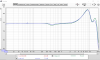
Just a reminder of what the performance is of my usual home made Mogami 2921 cable for comparison. Blue is amp output, green is the speaker terminals.
Note the c. 100mdB dip in the 300Hz-1kHz region. This is subjectively inaudible as far as just a frequency deviation from the flat baseline is concerned.
 
Last edited:
(...) but in many ways unavoidable (I've been there myself) trust in reviews.

Not sure, whether that's inevitable.

Personally I already quit reading our usual audio magazines over here quite a long time ago, when these wouldn't provide enough measurement results anymore (but rather either none at all or merely the most basic ones...). Because I've got ears and an individual taste myself, so that listening tests performed by reviewers, whose tastes I don't know, to me are of secondary interest at best. Whereas what I don't have, is decent, expensive measurement equipment. Hence it's measurement results, that I'd foremost need to be provided by those mags - so if I don't get these anymore, I can rather save the money for those mags and spend it on accessories and music instead.

Greetings from Munich!

Manfred / lini

 
Not sure, whether that's inevitable.

Personally I already quit reading our usual audio magazines over here quite a long time ago, when these wouldn't provide enough measurement results anymore (but rather either none at all or merely the most basic ones...). Because I've got ears and an individual taste myself, so that listening tests performed by reviewers, whose tastes I don't know, to me are of secondary interest at best. Whereas what I don't have, is decent, expensive measurement equipment. Hence it's measurement results, that I'd foremost need to be provided by those mags - so if I don't get these anymore, I can rather save the money for those mags and spend it on accessories and music instead.

Greetings from Munich!

Manfred / lini
Well, you can be sure that I'll provide appropriate measurements within the limitations of the equipment that I have, which is actually pretty good, and that well informed opinion will accompany them. ;)
About the only thing I lack is the ability to conveniently/automatically make off axis measurements of loudspeaker responses, and that isn't going to happen any time soon.
I can make the measurements the old-fashioned way- basically with a nail and string defining a 1m arc from the center of the loudspeaker, using REW and a calibrated mic, and one of these days I'm going to do that on the ESL11As, just for fun...
 
Thanks for doing the research and sharing it with AK!

Am I correct in saying the difference would be far more pronounced if both charts were using the same scale?

Fidelium Chart: (scale 70.0 - 83.53 => 13.53db)
Mogami 2921 Chart: (scale 76.0 to 78.3 => 2.3db)
 
Last edited:
Thanks for doing the research and sharing it with AK!

index.php

index.php


The top plot has a range of 2.4dB, the bottom c. 14dB.
The top and bottom use the same power amp and speakers- dual mono Benchmark AHB2s and ML ESL11As. The cable impedance is very small in the top plot, so the amp is seeing the essentially unvarnished load of the electrostatic loudspeakers and behaves accordingly- even though the variation in output is very small indeed until the frequency is close to 20kHz.
In the bottom plot the cable resistance is high so the amp output is even flatter than in the top, but the cable impedance "interacts" with the speaker to make the frequency response look terrible.
Clearly cables don't make a difference:)
In the top plot by the way, the HF difference between the two curves is due to the cable skin effect.
In the bottom plot there is no skin effect, but it's still crappy.
 
Last edited:
View attachment 2629361

Just a reminder of what the performance is of my usual home made Mogam1 2921 cable for comparison. Blue is amp output, green is the speaker terminals.
Note the c. 100mdB dip in the 300Hz-1kHz region. This is subjectively inaudible as far as just a frequency deviation from the flat baseline is concerned.

IMO that is as it should be if one truly wants accuracy and resolution without added coloration from their cables.

The small ~100mdB dip in the 300Hz-1kHz region in the Mogami looks to be a whopping ~2.6dB in the Fideliums!
Obviously, the visual differences would have been even more dramatic if you had been able to use the same SPL increments on both graphs.

Even that larger visible (but inaudible) 0.10dB deviation at ~16kHz in the Mogami graph would barely be visible if you used the same SPL scale as you did in the Fidelium graph further showing how much more these Fideliums alter the signal in your system (and not in a good way). The Mogami deviated by about 0.10dB @ 16kHz, whereas the Fideliums by ~10dB!! @ 16kHz.

Definitely not the definition of Fidelity.
 
Too late. Perhaps you should remove them again.

I edited to delete the graphs but leave the information about the difference in scales.

The measured difference would have far more impact if it was possible overlay the Mogami graph onto the Fidelium chart. It currently looks like the Mogami is hugely impacting the output of the amp, but not in the Fidelium, when in fact the Mogami curve is just heavily exaggerated by the much finer scale. Not sure how easy that is to do that overlay however.
 
I didn't go into this with the intention of comparing a bunch of cables. The Fidelium just sort of happened as a friend bought them. The original measurements occurred to illustrate that skin effect is real, can be calculated, measured and simulated, even with extremely short cables with multiple conductor paths, and it will scale from there.
The measurement techniques are slightly different as I haven't set up a specific set of conditions to do this and the tool I used is limited to reporting SPL- which is meaningless in this case.
Nevertheless, the dB differences are valid, and it only takes a moment's thought to do the conversion.
 
Last edited:
IMO that is as it should be if one truly wants accuracy and resolution without added coloration from their cables.

The small ~100mdB dip in the 300Hz-1kHz region in the Mogami looks to be a whopping ~2.6dB in the Fideliums!
Obviously, the visual differences would have been even more dramatic if you had been able to use the same SPL increments on both graphs.

Even that larger visible (but inaudible) 0.10dB deviation at ~16kHz in the Mogami graph would barely be visible if you used the same SPL scale as you did in the Fidelium graph further showing how much more these Fideliums alter the signal in your system (and not in a good way). The Mogami deviated by about 0.10dB @ 16kHz, whereas the Fideliums by ~10dB!! @ 16kHz.

Definitely not the definition of Fidelity.
If I wanted frequency response modifications for my system, I'm pretty sure that I wouldn't think that the process of selecting a cable in an essentially random ad hoc way would be the way I would choose to do it.
Still, each to their own.
 
Thanks for doing the research and sharing it with AK!

Am I correct in saying the difference would be far more pronounced if both charts were using the same scale?

Fidelium Chart: (scale 70.0 - 83.53 => 13.53db)
Mogami 2921 Chart: (scale 76.0 to 78.3 => 2.3db)
Yes.
 
If I wanted frequency response modifications for my system, I'm pretty sure that I wouldn't think that the process of selecting a cable in an essentially random ad hoc way would be the way I would choose to do it.
Still, each to their own.

Yes, but what if you could do that random frequency modification for only $1500? :):)
 
Back
Top Bottom