MuseChaser
Super Member
Random bits of toilet paper in one's ears could do so, virtually free of charge!Yes, but what if you could do that random frequency modification for only $1500?
"Charmin....for the ....cleanest..... sound ever!"


Random bits of toilet paper in one's ears could do so, virtually free of charge!Yes, but what if you could do that random frequency modification for only $1500?

If I wanted frequency response modifications for my system, I'm pretty sure that I wouldn't think that the process of selecting a cable in an essentially random ad hoc way would be the way I would choose to do it.
Still, each to their own.
Random bits of toilet paper in one's ears could do so, virtually free of charge!
"Charmin....for the ....cleanest..... sound ever!"
Good point...that would make it sound like shi....oh, never mind....Dare I suggest that you are neglecting the "skin effects" of having bits of said Charmin in your ear?

Remember, the response will be different for each speaker depending on its impedance/frequency curve.Agreed 100%
Then of course there is always going to be the guy that puts these Fideliums in a system exactly as yours and then waxes poetic about the new found bloom and richness these cables gave him.
Continuing that thought, it would seem possible, then, that a given cable, with (ahem) unusual qualities like this one, used with a given amp and given speaker COULD actually yield a flatter frequency response overall of the impedance/frequency response curves of the speaker were unusual to start with. However, if that were the case, wouldn't the design of the speaker be suspect?Remember, the response will be different for each speaker depending on its impedance/frequency curve.
You could measure the speaker impedances in advance and determine how the response would change. It won't necessarily be a rolling off at HF. It could be almost anything.
Remember, the response will be different for each speaker depending on its impedance/frequency curve.
You could measure the speaker impedances in advance and determine how the response would change. It won't necessarily be a rolling off at HF. It could be almost anything.
Yes. It could, theoretically. Speakers often show irregularities in gain at crossover points where the impedance often fluctuates. I can certainly speculate that the impedance and gain could be locally going in opposite directions so that the cable would compensate, however such speculation would most likely be specious.Continuing that thought, it would seem possible, then, that a given cable, with (ahem) unusual qualities like this one, used with a given amp and given speaker COULD actually yield a flatter frequency response overall of the impedance/frequency response curves of the speaker were unusual to start with. However, if that were the case, wouldn't the design of the speaker be suspect?

You have a good handle on wires and have an educated understanding of the fact that different wires sometimes sound different, so I have a question. I have a piece of gear that has a class A line level output. The output is a bit higher (300 ohms) than most modern line level device outputs (most seem to be 100 ohms or less). I've noticed that the "sonic" signatures of various interconnects seem to be magnified with this particular piece of gear. Does the higher output impedance somehow influence the "sound" of the cables used to connect it to my pre-amp? My pre-amp inputs are are 30kohm as I assume that may be important for your answer as well?I'm not going to comment too much on the paper. The math presented seems like a direct copy from EE early undergraduate courses on electromagnetism and can be found on line.
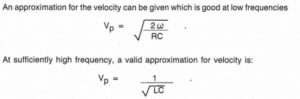
The conclusions essentially are that due to conduction/skin effect issues the audio signal propagates through the cable at a speed which is a fraction- in the order of 10%- of the speed of sound.
Thus, transmission line effects are important, as is the microstructure of the conductor, which cause internal reflections "muddying" the sound.
This justifies all of the choices that were made in the design of his cables.
Yes, they would be important if his conclusions were indeed true- i.e. the speed of sound is c. 340m/s, so the waveform would propagate at 34m/s and the 10 ft (3m) cables would be a half wavelength at c. 5Hz! It would also mean that the delay would be in the order of 100ms, not 1us!
He is correct that the two conductors- the one from the amp to the speaker and the return one from the speaker to the amp- do form a transmission line. What he gets wrong is the frequency scale at which this becomes important.
Clearly the author didn't learn about the Poynting vector and the transfer of energy in a conductor/transmission line- which essentially means that the energy is transferred in the EM fields and not within the conductor itself- and hence is governed by the permeability and permittivity of the dielectric between the two "plates" of the cables. They generally teach that in 4th year EE and graduate level Physics in the US. Thus, the "energy" propagates at c. 50% of the speed of light or in the order of 5 million times faster than he states.
That made all of his conclusions concerning dispersion and reflections and the effect of imperfections/dislocations in the conductor entirely spurious.
Continuing that thought, it would seem possible, then, that a given cable, with (ahem) unusual qualities like this one, used with a given amp and given speaker COULD actually yield a flatter frequency response overall of the impedance/frequency response curves of the speaker were unusual to start with. However, if that were the case, wouldn't the design of the speaker be suspect?
 . Not a game I’m interested in playing.
The two sides do agree- at least in my case-and I'm not going to go over my "audiophile/technical resume" to support it.If only the two sides could agree and understand that you need both listening and measurements to be successful, there has to be a balance as with everything in life . It’s not all or nothing.
Audiofreak71
I cannot answer that. Possibly the distortion levels increase substantially into more capacitive loads, possibly the stage becomes unstable, etc. etc. There are a number of possibilities and you have not provided sufficient information to make a valid observation.You have a good handle on wires and have an educated understanding of the fact that different wires sometimes sound different, so I have a question. I have a piece of gear that has a class A line level output. The output is a bit higher (300 ohms) than most modern line level device outputs (most seem to be 100 ohms or less). I've noticed that the "sonic" signatures of various interconnects seem to be magnified with this particular piece of gear. Does the higher output impedance somehow influence the "sound" of the cables used to connect it to my pre-amp? My pre-amp inputs are are 30kohm as I assume that may be important for your answer as well?
Frankly I don't understand the subjectivists objection to exposing something like this that is inherently flawed, nor their willingness to just throw out hard won psycho acoustic results.
You should be happy. I've shown- conclusively- that cables CAN matter, and that skin effect CAN matter, if not for the bogus reasons that are often stated.
OK, thanksI cannot answer that. Possibly the distortion levels increase substantially into more capacitive loads, possibly the stage becomes unstable, etc. etc. There are a number of possibilities and you have not provided sufficient information to make a valid observation.

Manfred,Not sure, whether that's inevitable.
Personally I already quit reading our usual audio magazines over here quite a long time ago, when these wouldn't provide enough measurement results anymore (but rather either none at all or merely the most basic ones...). Because I've got ears and an individual taste myself, so that listening tests performed by reviewers, whose tastes I don't know, to me are of secondary interest at best. Whereas what I don't have, is decent, expensive measurement equipment. Hence it's measurement results, that I'd foremost need to be provided by those mags - so if I don't get these anymore, I can rather save the money for those mags and spend it on accessories and music instead.
Greetings from Munich!
Manfred / lini
Manfred,
the times of "HiFi Stereophonie" with Karl Breh and Arndt Klingelnberg and their colleagues are long gone. It is significant that "Bild-Zeitung" - like magazines like "Audio" and "Stereoplay" simply sold better here. It´s a shame!