• Check out the Annual AK Secret Santa exchange Program, signup before November 23rd in the AK Charities & Christmas forum!

Muffsy phono stage hum problem

IIRC there's a ground strap, but the boards are mounted via sliding into little channels in the extruded aluminum enclosure. Friction fit, no screws.

I'm also wondering if the voltage from the transformer isn't a little high, which can cause a "buzzing" in the regulating circuit. The OP did describe the noise as sort of a "buzz" and "hum" both. It always helps to hear the actual noise. A "buzz" can indicate AC noise, as opposed to a grounding "hum" issue.
 
Drop a flat aluminum length (a meter stick or something) through a gap between 2 magnets, and the rate of speed which it passes will be noticeably affected by the magnetic field.
Yes that is true, but it happens because when a conductor such as aluminium or copper or whatever passes through a magnetic field a current is induced in the conductor and the current creates its own magnetic field which opposes the original field. The conductor doesn't have to be ferromagnetic for that to happen (as far as I know).
 
I saw it on the website, and yes, that neat little enclosure would be the way to go, and use the wall wart. That's how I would do it anyways. I believe the OP's intent was to use an enclosure to match his existing equipment. There's nothing wrong with that at all. Customizing is my way of thinking. lol! I am sure the hum issue can be sorted out, it's just a matter of finding the cause and correcting it. There is no reason it can't be made to work. I am wondering though, how are the boards mounted in the "made for it" enclosure? Do any of the boards utilize mounting screws/studs for directly grounding them to the chassis? The OP has the boards isolated, and "grounded" through the cables at the end of the chain. I am thinking that may be at least part of the issue, and not so much the proximity of the transformer.
The boards are mounted on a plastic piece of board. I did not use screw thinking that that it may cause ground loop. I have very shallow knowledge on electronics, my knowledge is just to soldered the parts and assemble. Yes you are absolutely right, I have made my enclosure to match my other equipments. I also love designing my own DIY equipment, some pictures attached.
 

Attachments

  • received_2826391880718291.jpeg
    received_2826391880718291.jpeg
    26 KB · Views: 19
  • IMG_20190904_081729.jpg
    IMG_20190904_081729.jpg
    28.9 KB · Views: 20
I'm also wondering if the voltage from the transformer isn't a little high, which can cause a "buzzing" in the regulating circuit. The OP did describe the noise as sort of a "buzz" and "hum" both. It always helps to hear the actual noise. A "buzz" can indicate AC noise, as opposed to a grounding "hum" issue.
I have checked the voltage, it is exactly 15 volt. And it has a buzz noise , more prominent on one of the channels (left for now). But, there is no buzz or hum when I connect my turntable with my old receiver.
 
The boards are mounted on a plastic piece of board. I did not use screw thinking that that it may cause ground loop. I have very shallow knowledge on electronics, my knowledge is just to soldered the parts and assemble. Yes you are absolutely right, I have made my enclosure to match my other equipments. I also love designing my own DIY equipment, some pictures attached.

They look really nice!
 
I have checked the voltage, it is exactly 15 volt. And it has a buzz noise , more prominent on one of the channels (left for now). But, there is no buzz or hum when I connect my turntable with my old receiver.

OK, we're not worried about the turntable. At this point it seems the buzz is coming from within the muffsy "unit". Meaning within the chassis enclosure, and not necessarily from the boards themselves individually. Ideally you want what is referred to as a "star" ground system. That is where every "ground", from every board, or connector is wired individually to one single ground point. A ground "loop" is a difference in the potential between ground points. When you have a "loop", you create an "antenna" that has current running through it which will pick up noises along the way. The way yours is wired, the "ground" has potential differences between each connection with varying amounts of current between points. The "loop" is then terminated to one point, the chassis ground stud. That "stud" will become the "star" center point. Separate your output RCA grounds from the RCA input grounds. Just cut the yellow ground wire between the input and output RCA to separate them so the yellow wire should be separate now. Attach it (yellow wire) to the center (ground) terminal coming out of the power supply board. That will put the power supply ground in the center of the "star" to chassis ground. Hopefully that will eliminate any possible ground "loop" and at least make the "buzz" mostly disappear. Perhaps someone else can help to be sure the loop has been eliminated.
 
I've already told the OP twice to do that but it seems to have been dismissed.

Also, the term "ground" for RCA negatives is rather misleading in my opinion since they don't need to be connected to ground at all for there to be no hum.

I had that in my post... "Separate the RCA "ground" (or rather negative)"... But when I rewrote it for the 3rd time I forgot to put it back in.. By then I was rather tired of editing so I left it be. :biggrin: However since the terminal(s) on the board are labeled "GND", it seems less confusing.
 
Yes, it can all get a bit confusing - not surprising considering that it's more complicated than people often realise and the terminology is ambiguous. The variable that's outside of the OP's control is the track routing on the PCB, which may or may not be optimal. However, since other people have used the same boards and been satisfied I suppose we should assume that's ok.

One thing which may be worth trying is to physically remove the mains transformer from the case. Certainly the wiring could be tidied up. Where two wires are carrying AC they should be twisted together, and there's no point in having the wires from the transformer secondary going to the audio board and then being linked through to the psu board - why not just go straight to the psu board? In fact, why are there two boards anyway? Why not just have everything on one board?
 
The boards are probably two pieces because Skrodahl utilizes the power board to run multiple different circuits he sells.

I'd kind of like to try putting the PSU board in a different case entirely and running a DIN cable for DC over to the preamp case. I could fit two preamps and two PSUs in two of the 'standard' cases and have preamps for two tonearms in a really neat package. :)
 
Also, a lot of people run this preamp and it's progenitor the CNC on battery power, in which case the PSU board is unnecessary.

That'd actually be a good test. Power it up on a couple of 9v batteries and see if the hum goes away. Would confirm it's definitely coming from the AC power somehow.
 
Any updates?
I have separated the RCA ground from output and input, but no improvement. meanwhile I have messed up with another project, that is Soekris DAM 1021 r2r DAC. Completed it , but giving very low volume output. However I have contacted the vendor, he is communicating to solve the issue. I'll update once I get a solution. regards
 
I am in contact with the vendor, there must be something wrong with my setup, I am being given the guidelines to check, it is probably a "grounding" issue. I'll update as I nake some time and fix it. Thanks to all for your kind suggestion, best regards
 
Suggestion from vendor as follows:
"would like for you to see if there's a short between the mains ground and signal ground. Set your multimeter to ohms/resistance and measure between these two points (just to be 100% sure the problem doesn't lie there):

mail


Next, I'd like you to focus on three fairly simple things:

  • Make sure that your signal cables (between the turntable and the Muffsy) is shielded
    (7 out of 10 hum problems are solved by replacing the cable with a KNOWN shielded cable)
  • Check the grounding between the RCA connectors, one of them does not look like it's connected at all:

mail


  • Move the AC power connection to the PSU board:

mail


1. I get both buzz and hum.
2. It is more prominent on the left channel, but it is there in both sides.
3. Hum increases when I touch any metal on TT, it decreases when I touch both Phono and TT. It also decreases when I spin the platter or turn on TT motor.


All these three point to grounding problems. Especially the fact that the hum decreases when you touch both the TT and the Muffsy.

Noise on TD160 is nothing new though, you'd might want to check out this thread on Audiokarma:
https://audiokarma.org/forums/index.php?threads/thorens-td160-hum.771434/ "

Now I am workung on this.
 
Pictures seem to be missing, so here's a summary of actions taken and tips given.

First of all, I'd be happy to give you a refund or a new kit. Just let me know in our email thread.

  • There is less hum when you touch both the turntable and the phono pre, this indicates grounding problems.

  • Make absolutely sure that you have a shielded signal cable between the turntable and the phono pre.

  • TD160 grounding problems are quite common. Make sure that there is a ground connection through the signal cable, or patch up a separate ground cable as described here (don't do both, that'll probably create another loop):
    https://audiokarma.org/forums/index.php?threads/thorens-td160-hum.771434/

  • Check that the mains earth isn't shorted to signal ground, using your multimeter:

    48763639363_11794d8f00_z.jpg


  • The ground cable may actually not be soldered to one of the RCA ground lugs:

    48763639318_d43c42bd26_z.jpg


  • It seems like you have quite a few cold joints, and cables just soldered on top of the PCB instead of through the holes. Heat up the soldering pen and touch up any grey blobs of solder.

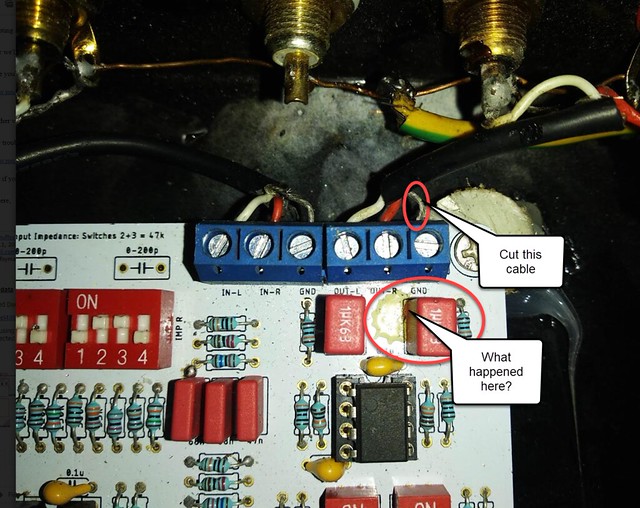
  • Cut the GND connection to the signal out connector, and check the output capacitor that seems broken w/leakage:*

    48763671753_60fd3ae22b_z.jpg


  • There's no need to run the AC input voltage through the phono preamp board. Connect it directly to the power supply instead:

    48763639338_a33d5bd2f9_z.jpg
 
Back
Top Bottom