• The move to the new server is done. There are some software and database maintenance updates in process. This has us passing the hat around to help out. We appreciate any donations. Seriously, even a dollar helps. The payment page may be found here - https://www.audiokarma.org/support.html

Multi room audio system, XLR balanced cables

aabottom

Swing
Anybody run XLR balanced cables for a single source multi-room 2 channel audio system? I’m looking for advice on a music distribution systems. If there are big advantages for using wireless, some sort of optical links, or other methods, I will consider those options.

I guess I’m hard core ol’ school. I know there are other options (wireless, and optical links perhaps), but I already have at least 5 amp/receivers and 5 sets of speakers. I just want to hook them up to the same music source so I can walk room to room with the same sound.

PS: I’ve looked at some of the other multi room sound threads, but I have not found one that addresses XLR balanced line systems. I will continue to read those threads.

aabottom requirements
- 5 room stereo music broadcasting
- cable lengths are about 20, 20, 40, 40, and 50 feet
- Walk room to room with the same sound.
- Options to play alternate sources in some rooms
- HiFi, low noise, audio distribution
- Control room sound volume from within the room
- Accepting suggestions for other possible requirements

Here’s a sketch of a possible 5 room stereo system using XLR balanced cables. By my initial estimate, I can do this for about $600.

Multi-room audio XLR balanced 5x2 stereo: 5 rooms with 2 ch stereo.
Room 0 [Multiple music sources]=> 2 ch RCA cables> [Main Receiver]=> 2 ch RCA unbalanced cables> =[RCA to XLR box]=> 2 ch XLR balanced cables> =[XLR 8 channel splitter]=> 4 sets of 2ch XLR cables to 4 rooms>
2 ch XLR cables> =[XLR to RCA box]=> 2 ch RCA cables room 1> Amp room 1> speakers 1
2 ch XLR cables> =[XLR to RCA box]=> 2 ch RCA cables room 2> Amp room 2> speakers 2
2 ch XLR cables> =[XLR to RCA box]=> 2 ch RCA cables room 3> Amp room 3> speakers 3
2 ch XLR cables> =[XLR to RCA box]=> 2 ch RCA cables room 4> Amp room 4> speakers 4

What I need list
Item Qty Description Potential unit to buy
1 1 =[RCA to XLR box]= [1]
2 1 =[XLR 8 channel splitter]= [2]
3 4 =[XLR to RCA box]= [1]
4 12 XLR balanced cables, various lengths [3]

What I have list:
Item Qty Description
5 lots multiple source players: turntables, CD players, cassette decks, FM, ect.
6 5 amplifier or receiver
7 5 pairs of stereo speakers
8 5 pairs of stereo speaker wires

[1] Rolls MB15b Promatch 2-Way Stereo Converter
https://www.bhphotovideo.com/c/product/217366-REG/Rolls_MB15B_MB15b_Promatch_2_Way_Stereo.html

[2] Behringer DS2800 2-Input/8-Output Distribution Splitter for Commercial Applications
https://www.bhphotovideo.com/c/prod...0_2_input_8_output_distribution_splitter.html

[3] Kopul Premium Performance 3000 Series XLR M to XLR F Microphone Cable - 50' (15.2 m), White
https://www.bhphotovideo.com/c/product/995746-REG/kopul_m3050_w_premium_cable_xlr_m_to.html
 
Last edited:
Register to hide this ad
Reserved for future use.
1. First edit of above.
- cable lengths are about 20, 20, 40, 40, and 50 feet
 
Last edited:
Well aabottom, you can go that route, but I achieved all that you desire by using Cat 5/6(balanced by design) cabling utilizing line level passive HQ baluns(ruler flat from 15hertz to 20 KHz.) manufactured by etslan.com.

I did all this in 2010 after researching on the web to update my existing distribution A/V feeds, and my main rack in my living room has all my music/audio + 4 separate different video sources(OPPO UDP-203, laptop, Mac MCD 7007, Mac laserdisc player, and JVC Super-Video machine), whose audio outputs can be sent, if selected, via a Mac preamp`s(record out(won`t work with variable main output/s) preamp to a 1X8 HQ ETS active distribution to six different rooms with no better or worse SQ than the room`s system`s quality can provide from the main rack`s source.

Zero hum in the audio in any room`s audio system, and since some of my house`s 6 rooms gear has grounded power connection, and before I went this Cat.5/6 route, I had to ground lift those stereos, which I was not comfortable doing to avoid ground loops and the resultant low level hum present in any audio fed from the living room`s rack.

And I really like that no matter where in my house I go, with the exception of my 2 bathrooms(though I could have !), I hear my digital wav. music all day.

My method will be more expensive than yours, but with Cat.5.6/7 Cabling installed, I can easily change out to whatever type signal baluns needed for the future, since my Cat cable installation was swept certified to nearly 600MHz, I doubt that my needs will out grow it`s bandwidth in my life time..
A additional, but very important purchase, was needed in my case, was the HQ surge/spike protection devices for all Cat. cable sends at both ends, as I live in the upper end of lightning alley of FL. and all that 1000`s of feet Cat cabling in the attic is a very effective pathway for lightning`s powerful destructive EMP..

FWIW. This my thoughts & suggestion/recommendation, and after over 8 years of use, I would not change a device/method.

Good luck with whatever method you choose, Sir..

Kind regards, OKB
 
Well aabottom, you can go that route, but I achieved all that you desire by using Cat 5/6(balanced by design) cabling utilizing line level passive HQ baluns(ruler flat from 15hertz to 20 KHz.) manufactured by etslan.com.

I did all this in 2010 after researching on the web to update my existing distribution A/V feeds, and my main rack in my living room has all my music/audio + 4 separate different video sources(OPPO UDP-203, laptop, Mac MCD 7007, Mac laserdisc player, and JVC Super-Video machine), whose audio outputs can be sent, if selected, via a Mac preamp`s(record out(won`t work with variable main output/s) preamp to a 1X8 HQ ETS active distribution to six different rooms with no better or worse SQ than the room`s system`s quality can provide from the main rack`s source.

Zero hum in the audio in any room`s audio system, and since some of my house`s 6 rooms gear has grounded power connection, and before I went this Cat.5/6 route, I had to ground lift those stereos, which I was not comfortable doing to avoid ground loops and the resultant low level hum present in any audio fed from the living room`s rack.

And I really like that no matter where in my house I go, with the exception of my 2 bathrooms(though I could have !), I hear my digital wav. music all day.

My method will be more expensive than yours, but with Cat.5.6/7 Cabling installed, I can easily change out to whatever type signal baluns needed for the future, since my Cat cable installation was swept certified to nearly 600MHz, I doubt that my needs will out grow it`s bandwidth in my life time..
A additional, but very important purchase, was needed in my case, was the HQ surge/spike protection devices for all Cat. cable sends at both ends, as I live in the upper end of lightning alley of FL. and all that 1000`s of feet Cat cabling in the attic is a very effective pathway for lightning`s powerful destructive EMP..

FWIW. This my thoughts & suggestion/recommendation, and after over 8 years of use, I would not change a device/method.

Good luck with whatever method you choose, Sir..

Kind regards, OKB
Thanks for timely response Bill. I've read some of your responses from other AK XLR / balanced cable threads. I'm still digesting the info at etslan.com. I'm not much of a video man, but future growth to that may be palatable. A few question if you may.

1. So you go from audio RCA to etslan balun to CAT5 to etslan balun to audio RCA cable? No XLR are required?
2. Do you have a design/ build thread on your A/V distribution system?
3. Is your system totally passive?
4. Some specific model numbers from etslan.com would help sort through the mass of info there, thanks.

I'm still in the requirements and design phase. I have no commitment to hardware except my stable of amps, receivers, speakers, and source players.
 
Thanks for timely response Bill. I've read some of your responses from other AK XLR / balanced cable threads. I'm still digesting the info at etslan.com. I'm not much of a video man, but future growth to that may be palatable. A few question if you may.

1. So you go from audio RCA to etslan balun to CAT5 to etslan balun to audio RCA cable? No XLR are required?
2. Do you have a design/ build thread on your A/V distribution system?
3. Is your system totally passive?
4. Some specific model numbers from etslan.com would help sort through the mass of info there, thanks.

I'm still in the requirements and design phase. I have no commitment to hardware except my stable of amps, receivers, speakers, and source players.

Ok aabottom, # 1I chose their "active" audio Ethernet 1X8 splitter for back of my rack`s limited mounting space and less regular IC cable clutter .
What is done is you have a passive balun to convert your L/R audio feed to Ethernet, then a short Ethernet jumper that then plugs into the 1X8 RJ-45 active audio specific splitter`s input which has 8 RJ45 ouput jacks which you plug your Cat cables that go to each room.
At that end a passive Ethernet balun is plugged into the Cat cable, and then your ICs connect to the line input of whatever audio gear you wish to send a signal to.
If ETS didn't have this active 1X8 balun splitter, the same results could have been achieved, but would require a HQ grade "active" L/R 1X by whatever regular RCA audio splitter and a passive balun for each send, and RCA ICs for each balun to the non Ethernet splitter, thus increasing the complexity and clutter at the sending end.

The end point rooms balun/RCA IC`s would be the same either way, 5 rooms equals 10 passive baluns, using ETS`s audio specific 1X8 Ethernet active splitter is a better more practical solution using only one input passive balun and however many endpoint passive to convert back to RCA for connection to your remote room`s gear.
No XLR needed, unless you wish to go that route, as they have XLR balun systems(splitter/baluns) too.

More to follow
 
(Well, looks like Bill types a little faster than I do. Dang.)

Also keep in mind that balanced doesn't always require a bevy of XLR connectors. Many modern (pro) balanced distribution amps have screw terminal connections on removable sockets. If you're considering CAT5, which is unshielded, then dispensing with the 3" of shield offered by actual XLR connectors is no biggie. (Not that you'd use XLR with CAT5, necessarily...) If everything is terminated with XLR, that's around 40 individual connectors, at several bucks each -- so nominally $200. Some of them will be in equipment you would buy, rather than individual. And the baluns aren't free, either. Cable almost is, though -- in fact, I've got a partial reel of CAT5 I'd give you, if you were nearby.

A balanced DA could give you level adjustments (with proper selection) but that's also available locally in each room by your design. Ultimately, you just want a split that doesn't cause hum/ground loop problems, and doesn't excessively load down whatever's driving the system. The Ethernet system mentioned above is probably pretty cost-effective, so I'd start there and see if it meets your needs. If not, you're not out much.
 
Thanks for timely response Bill. I've read some of your responses from other AK XLR / balanced cable threads. I'm still digesting the info at etslan.com. I'm not much of a video man, but future growth to that may be palatable. A few question if you may.

1. So you go from audio RCA to etslan balun to CAT5 to etslan balun to audio RCA cable? No XLR are required?
2. Do you have a design/ build thread on your A/V distribution system?
3. Is your system totally passive?
4. Some specific model numbers from etslan.com would help sort through the mass of info there, thanks.

I'm still in the requirements and design phase. I have no commitment to hardware except my stable of amps, receivers, speakers, and source players.

Answer # 2: No I don`t have a thread/post about my Cat.5/6 A/V distribution setup/configuration, just suggestions of what I`ve done here.
This is the most detailed effort so far, primarily because, being I`m partially paralyzed and type with my pointer finger, as you might suspect, can/is tiresome for long winded descriptions of detail.

I studied a MCM cat. every morning in the bathroom for the good portion of 2009, and started thinking about doing the Cat 5/6 and looking into a A/V distribution upgrade, and looking up various products/cable on line, and sat down in the afternoon sipping a beer(you know, old school "drinking & thinking") figuring out how many Cat.-6 RJ-45 punch down jacks of different colors, wall plates, Ethernet jumpers and what length, and color for 4 separate type video signal feeds, and a separate audio feed with it`s different color jacks, separate old work mounting boxes, jumpers, etc.

I knew of nobody who had done anything like this, so I had to figure it out on my own.
I paid my A/V dealer to run/pull my suppled 5 1000ft rolls/reels of excellent performance Belden Media Twist Ethernet cable, mount the boxes, wall plates, and jacks as I provided all materials.
Then I paid another specialized structured wiring company to do a sweep certification proof of performance test on all circuits with his $ 5,000.00 Fluke structured wiring Certifier.
My choice of Ethernet cable was primarily for best high bandwidth video performance, so using the same cable for audio was a zero concern as I knew my audio quality would not be compromised.

Audio is active send, and passive at the end points.

The Component(RGB), S-Video, composite video are passive baluns at both ends, but have to have a active multi signal type 500 Mhz bandwidth 1X6 splitter by Calrad(no longer made) to fed the send/source baluns.
The HDMI, SVGA sends and receivers require active 1X8 splitters and convertors/translators at the end points, otherwise, it would require 2 Cat cables per signal, so I chose a company called Atlona for that route.
IMG_0313.JPG IMG_0314.JPG
 
Last edited:
Or an audio D.A. (Distribution amp), using RCAs. I use a 1X5 audio D.A , tape out from preamp to D.A. In.
Distributes whatever tape out source I have chosen to the D.A., which distributes line level signal to 5 amps.
Don’t know the name of the D.A, it is a commercial unit.
 
Or an audio D.A. (Distribution amp), using RCAs. I use a 1X5 audio D.A , tape out from preamp to D.A. In.
Distributes whatever tape out source I have chosen to the D.A., which distributes line level signal to 5 amps.
Don’t know the name of the D.A, it is a commercial unit.

Yes, I went that route in 1995, to 4 rooms from my master rack, but had ground loop issues, hence my hum free pure A/V signal Cat 6 distribution method in 2010.
 
Thanks for timely response Bill. I've read some of your responses from other AK XLR / balanced cable threads. I'm still digesting the info at etslan.com. I'm not much of a video man, but future growth to that may be palatable. A few question if you may.

1. So you go from audio RCA to etslan balun to CAT5 to etslan balun to audio RCA cable? No XLR are required?
2. Do you have a design/ build thread on your A/V distribution system?
3. Is your system totally passive?
4. Some specific model numbers from etslan.com would help sort through the mass of info there, thanks.

I'm still in the requirements and design phase. I have no commitment to hardware except my stable of amps, receivers, speakers, and source players.

Ok aabottom, here are the pdf`s of the ETS`s Cat 6 audio products I have been using since 2010, the PA 700 I USE FOR THE AUDIO SPECIFIC AUDIO CAT distribution.
The second pdf is the passive audio baluns PA 807 that I use at each room, and to pre-convert the unbalanced audio RCA feed to the PA 700.
They offer suggested connections/configurations in the pdfs below.

It ain`t cheap, but I know it (their products)work/s perfectly and is high quality, cause I`m a SQ demanding ass hole, and so is my B-I-L(we`re both highly regarded ex FOH sound men.

Good luck on whatever method/configuration that you choose.

Kind regards, OKB
 

Attachments

Ok aabottom, # 1I chose their "active" audio Ethernet 1X8 splitter for back of my rack`s limited mounting space and less regular IC cable clutter .
What is done is you have a passive balun to convert your L/R audio feed to Ethernet, then a short Ethernet jumper that then plugs into the 1X8 RJ-45 active audio specific splitter`s input which has 8 RJ45 ouput jacks which you plug your Cat cables that go to each room.
At that end a passive Ethernet balun is plugged into the Cat cable, and then your ICs connect to the line input of whatever audio gear you wish to send a signal to.
If ETS didn't have this active 1X8 balun splitter, the same results could have been achieved, but would require a HQ grade "active" L/R 1X by whatever regular RCA audio splitter and a passive balun for each send, and RCA ICs for each balun to the non Ethernet splitter, thus increasing the complexity and clutter at the sending end.

The end point rooms balun/RCA IC`s would be the same either way, 5 rooms equals 10 passive baluns, using ETS`s audio specific 1X8 Ethernet active splitter is a better more practical solution using only one input passive balun and however many endpoint passive to convert back to RCA for connection to your remote room`s gear.
No XLR needed, unless you wish to go that route, as they have XLR balun systems(splitter/baluns) too.

More to follow
Bill:

Thanks for the additional info. I’m beginning to understand your system and the etslan gear. Their audio Ethernet splitter is about 6 times more expenensive than the Behringer DS2800 2x4 XLR balanaced audio splitter. The etslan audio/ video Ethernet splitter is about 8 times more expenensive. I haven’t totally discounted it yet. But my need to split 1 A/ V channel into 8 channels is likely very slim.

My XLR system above, like yours, has only 1 set of 2 baluns on the input end and 4 sets of 2 baluns on each output end the 4 rooms. I see the advantages of that. 1) Fewer baluns at the input end. 2) I can locate the 2x4 active splitter a good distance from the amp/ receiver source, if I desire.
 
(Well, looks like Bill types a little faster than I do. Dang.)

Also keep in mind that balanced doesn't always require a bevy of XLR connectors. Many modern (pro) balanced distribution amps have screw terminal connections on removable sockets. If you're considering CAT5, which is unshielded, then dispensing with the 3" of shield offered by actual XLR connectors is no biggie. (Not that you'd use XLR with CAT5, necessarily...) If everything is terminated with XLR, that's around 40 individual connectors, at several bucks each -- so nominally $200. Some of them will be in equipment you would buy, rather than individual. And the baluns aren't free, either. Cable almost is, though -- in fact, I've got a partial reel of CAT5 I'd give you, if you were nearby.

A balanced DA could give you level adjustments (with proper selection) but that's also available locally in each room by your design. Ultimately, you just want a split that doesn't cause hum/ground loop problems, and doesn't excessively load down whatever's driving the system. The Ethernet system mentioned above is probably pretty cost-effective, so I'd start there and see if it meets your needs. If not, you're not out much.
Thanks for your reply Chip. Yes, I realize I don’t have to use XLR, but the 2x4 splitter I found uses them. Plus I can get 50 ft XLR cables with connectors at each end for $19 in most any color I want.

I’m only doing 5 rooms: source room + 4 remote rooms, so that’s only 10 XLR cables (only 20 XLR connectors).
 
Answer # 2: No I don`t have a thread/post about my Cat.5/6 A/V distribution setup/configuration, just suggestions of what I`ve done here.
This is the most detailed effort so far, primarily because, being I`m partially paralyzed and type with my pointer finger, as you might suspect, can/is tiresome for long winded descriptions of detail.

I studied a MCM cat. every morning in the bathroom for the good portion of 2009, and started thinking about doing the Cat 5/6 and looking into a A/V distribution upgrade, and looking up various products/cable on line, and sat down in the afternoon sipping a beer(you know, old school "drinking & thinking") figuring out how many Cat.-6 RJ-45 punch down jacks of different colors, wall plates, Ethernet jumpers and what length, and color for 4 separate type video signal feeds, and a separate audio feed with it`s different color jacks, separate old work mounting boxes, jumpers, etc.

I knew of nobody who had done anything like this, so I had to figure it out on my own.
I paid my A/V dealer to run/pull my suppled 5 1000ft rolls/reels of excellent performance Belden Media Twist Ethernet cable, mount the boxes, wall plates, and jacks as I provided all materials.
Then I paid another specialized structured wiring company to do a sweep certification proof of performance test on all circuits with his $ 5,000.00 Fluke structured wiring Certifier.
My choice of Ethernet cable was primarily for best high bandwidth video performance, so using the same cable for audio was a zero concern as I knew my audio quality would not be compromised.

Audio is active send, and passive at the end points.

The Component(RGB), S-Video, composite video are passive baluns at both ends, but have to have a active multi signal type 500 Mhz bandwidth 1X6 splitter by Calrad(no longer made) to fed the send/source baluns.
The HDMI, SVGA sends and receivers require active 1X8 splitters and convertors/translators at the end points, otherwise, it would require 2 Cat cables per signal, so I chose a company called Atlona for that route.
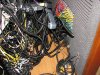
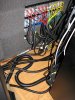
View attachment 1210061 View attachment 1210062
Wow, look at all them wires! Thanks for your history on your design flow.
 
Or an audio D.A. (Distribution amp), using RCAs. I use a 1X5 audio D.A , tape out from preamp to D.A. In.
Distributes whatever tape out source I have chosen to the D.A., which distributes line level signal to 5 amps.
Don’t know the name of the D.A, it is a commercial unit.
For reasons Bill mentioned, I prefer not to use a RCA distribution amp- requires more RCA cables and baluns, and leads to potential ground loop & noise issues.
 
Ok aabottom, here are the pdf`s of the ETS`s Cat 6 audio products I have been using since 2010, the PA 700 I USE FOR THE AUDIO SPECIFIC AUDIO CAT distribution.
The second pdf is the passive audio baluns PA 807 that I use at each room, and to pre-convert the unbalanced audio RCA feed to the PA 700.
They offer suggested connections/configurations in the pdfs below.

It ain`t cheap, but I know it (their products)work/s perfectly and is high quality, cause I`m a SQ demanding ass hole, and so is my B-I-L(we`re both highly regarded ex FOH sound men.

Good luck on whatever method/configuration that you choose.

Kind regards, OKB
I can see the growth potential of the ETS Cat 6 system. But, for audio only I’m not sure if the sound quality would be any better than the Behringer DS2800 XLR balanced system.

On that note, I tried to find the audio specs on the Behringer DS2800, but no luck. I downloaded their “User Manual” from their website, but it has no specs like frequency response, line level in & out limits, noise limits, etc. The “User Manual” is largely an 8 page advertisement.

It’s back to the bathroom catalogs and beer thinking to determine what I really want.


Thanks all.
 
Last edited:
Wow, look at all them wires! Thanks for your history on your design flow.
Yeah, it`s a snake farm !!
Those rectangular silver boxes that you see with the different colored Ethernet cables plugged in are my High bandwidth Ethernet surge/spike protectors all custom mounted to a anodized aluminum 1/8" thick 12X24" plate for common point grounding via a 8 gage rope wire to (4) 8` ground rods driven in the ground under the A/V rack`s floor(before the concrete was poured to fill a unused existing planter) all bonded together with solid # 8 gage copper underneath, and that ground system is bonded to the 20 amp breakered 12 gage 120 v feed to the master rack`s power feed.
 
I can see the growth potential of the ETS Cat 6 system. But, for audio only I’m not sure if the sound quality would be any better than the Behringer DS2800 XLR balanced system.

On that note, I tried to find the audio specs on the Behringer DS2800, but no luck. I downloaded their “User Manual” from their website, but it has no specs like frequency response, line level in & out limits, noise limits, etc. The “User Manual” is largely an 8 page advertisement.

It’s back to the bathroom catalogs and beer thinking to determine what I really want.


Thanks all.

I don`t know what the noise and distortion specs are on my ETS distribution configuration, and I have HQ test equipment to measure it, but the several room`s stereos that are considered very high quality, have not revealed any reason to run the tests as no hum, channel separation concerns or abnormal hiss have given me reason to. No pops or clicks heard in any of the 5 rooms stereo`s when any electrical device turns on or off, unlike my original Belden RG 58 stranded center coax stereo pairs to the same rooms fed by a Niles ADA-6 HQ 1X6 Audio distribution amp years ago(circa 1995~ 2010)
No RF/EMI is present either.

Cat. 5/67 cables are 110 ohm balanced by design and can carry 4 analog signals in any, or opposite direction with little concern for crosstalk if the levels are kept around line level, and mine are unshielded.

Good luck on your quest aabottom
 
Back
Top Bottom