mstap42
Active Member
Some background and a word of thanks...
A while back, I asked y'all for thoughts on some Magnavox console drivers. (See the thread Advice on Magnavox console speakers ... )
Everyone who responded offered something interesting and encouraging. The bottom line was these are good speakers. Worth keeping. Better than the little bit of cash I could get for them. Plus, I can do something pretty easily, starting from scratch and learning as I go with help from AKers.
How true that is, and how grateful I am for all the help and encouragement.
As I write, I'm listening to Pat Metheny Offramp on my new OBs. Earlier this evening, I auditioned Peter Gabriel, Holly Cole Trio, Kate Rusby, Dire Straits, Shannon Curfman, and Rickie Lee Jones.
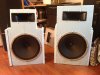
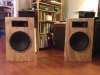
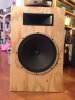
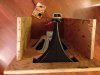
My teenage sons like them. Even my wife does...as long as the music isn't jazz. She's being very patient about the optics--these prototypes are raggedy-looking.
But the sound is really, really nice. All I can say is thanks!
Design and rationale...
Goals: Cheap. Fast. And did I mention cheap?
Baffle material: 1" Styrofoam sheeting
Fasteners: zip ties
Configuration: One OB and one H-frame (I'm already forming opinions on those. More about that below.)
Crossover: 2nd order Linkwitz-Riley @ 3,000 Hz.
Cost: Less than $40
Drivers: Gift from a friend's basement cleanout
Sheeting: Dumpster dive
Fasteners: Zip ties, $3.00
XO components: $30 - PE buyouts, including shipping
Crimp disconnects $3.00
Wire (red, black), stranded, 20 AWG: On hand
Plywood mounting blocks: On hand
Hot glue: Two sticks, one on hand. Bought a bunch more for $6.
Rationale
Baffles: Easy to build and reconfigure
Configuration: OB can quickly become U-frame. H-frame can become U-frame or OB.
Crossover frequency:
I thought on this quite a while, taking into account the advice and comments in the earlier thread. Plus some, in a new thread, that got vaporized a couple of weekends ago when AK was down a couple of weekends ago.
Stretch goal, but can't afford it: 3-way, active XO, tri-amp. I can't afford active, nor at the moment the bandpass components. (That would double the XO outlay, leaving aside the need to buy some mids. I have some 6-1/2" mid/bass that might work, but they're much less efficient than the horn and alnico woofer.)
I considered 800 Hz. But then there are the limitations of the horns. So iI looked at 2,000 Hz or above. The woofers are OK at least to there. And the horns don't honk too badly at that point.
Having decided on 2,000 Hz as the minimum, I measured the DC resistance on the drivers. Horns - 12 Ohm nominal, 13.2 actual. Woofers - 4 Ohm nominal, 3.8 actual. (Lucky me!. The LF XO components for 8-Ohm would have cost a good bit more.)
2nd order was a given. Butterworth or Linkwitz-Riley? Butterworth was cheaper, but crossing above 2,000 Hz -- the higher end of the woofers' range and near the lower end of the horns' audibly pleasing range -- I decided to spend a little more for the L-W for its flatter curve at the XO point. No point calling attention to the weaknesses of the design any more than necessary.
All that remained was to shop for components. I thought of DIY -- unwinding motor coils -- for the inductors. I got 15 yards out of an old vacuum cleaner motor. Not enough.
Luckily, PE has some buyout inductors. Ferrite core. Cheap cheap cheap. Ferrite core -- another compromise, especially for the high pass filter.
Optimal crossover point given budget and available parts from PE: What XO point would give me inductor values AND poly cap values close to those available? To get this, I mapped the component values for every 500 Hz from 2,000 to 4,500. Then I crosswalked those to the PE availability.
Happily, the L-W values matched up better than the Butterworth values. At 3,000 Hz, I could pair inductors in series for L1 and L2 and caps in parallel for C2 to get within 0.02 of all calculated values. (Realizing that not all calculators figure things the same way.) No worries, with 5% tolerance caps and something like 10% on the inductors.
Sound? Sweet, detailed highs. A little forward, but not annoying. No ringing. Maybe a little "round" in the mids, but my tone controls compensate well enough. Bass? As predicted, the H-frame extends the bass. But off-axis is important because my room isn't large. I will end up chopping the front off and coverting to U-baffle.
Sorry no pics, but I will post some. Stay tuned!
Pics added ...
A while back, I asked y'all for thoughts on some Magnavox console drivers. (See the thread Advice on Magnavox console speakers ... )
Everyone who responded offered something interesting and encouraging. The bottom line was these are good speakers. Worth keeping. Better than the little bit of cash I could get for them. Plus, I can do something pretty easily, starting from scratch and learning as I go with help from AKers.
How true that is, and how grateful I am for all the help and encouragement.
As I write, I'm listening to Pat Metheny Offramp on my new OBs. Earlier this evening, I auditioned Peter Gabriel, Holly Cole Trio, Kate Rusby, Dire Straits, Shannon Curfman, and Rickie Lee Jones.
My teenage sons like them. Even my wife does...as long as the music isn't jazz. She's being very patient about the optics--these prototypes are raggedy-looking.
But the sound is really, really nice. All I can say is thanks!
Design and rationale...
Goals: Cheap. Fast. And did I mention cheap?
Baffle material: 1" Styrofoam sheeting
Fasteners: zip ties
Configuration: One OB and one H-frame (I'm already forming opinions on those. More about that below.)
Crossover: 2nd order Linkwitz-Riley @ 3,000 Hz.
Cost: Less than $40
Drivers: Gift from a friend's basement cleanout
Sheeting: Dumpster dive
Fasteners: Zip ties, $3.00
XO components: $30 - PE buyouts, including shipping
Crimp disconnects $3.00
Wire (red, black), stranded, 20 AWG: On hand
Plywood mounting blocks: On hand
Hot glue: Two sticks, one on hand. Bought a bunch more for $6.
Rationale
Baffles: Easy to build and reconfigure
Configuration: OB can quickly become U-frame. H-frame can become U-frame or OB.
Crossover frequency:
I thought on this quite a while, taking into account the advice and comments in the earlier thread. Plus some, in a new thread, that got vaporized a couple of weekends ago when AK was down a couple of weekends ago.
Stretch goal, but can't afford it: 3-way, active XO, tri-amp. I can't afford active, nor at the moment the bandpass components. (That would double the XO outlay, leaving aside the need to buy some mids. I have some 6-1/2" mid/bass that might work, but they're much less efficient than the horn and alnico woofer.)
I considered 800 Hz. But then there are the limitations of the horns. So iI looked at 2,000 Hz or above. The woofers are OK at least to there. And the horns don't honk too badly at that point.
Having decided on 2,000 Hz as the minimum, I measured the DC resistance on the drivers. Horns - 12 Ohm nominal, 13.2 actual. Woofers - 4 Ohm nominal, 3.8 actual. (Lucky me!. The LF XO components for 8-Ohm would have cost a good bit more.)
2nd order was a given. Butterworth or Linkwitz-Riley? Butterworth was cheaper, but crossing above 2,000 Hz -- the higher end of the woofers' range and near the lower end of the horns' audibly pleasing range -- I decided to spend a little more for the L-W for its flatter curve at the XO point. No point calling attention to the weaknesses of the design any more than necessary.
All that remained was to shop for components. I thought of DIY -- unwinding motor coils -- for the inductors. I got 15 yards out of an old vacuum cleaner motor. Not enough.
Luckily, PE has some buyout inductors. Ferrite core. Cheap cheap cheap. Ferrite core -- another compromise, especially for the high pass filter.
Optimal crossover point given budget and available parts from PE: What XO point would give me inductor values AND poly cap values close to those available? To get this, I mapped the component values for every 500 Hz from 2,000 to 4,500. Then I crosswalked those to the PE availability.
Happily, the L-W values matched up better than the Butterworth values. At 3,000 Hz, I could pair inductors in series for L1 and L2 and caps in parallel for C2 to get within 0.02 of all calculated values. (Realizing that not all calculators figure things the same way.) No worries, with 5% tolerance caps and something like 10% on the inductors.
Sound? Sweet, detailed highs. A little forward, but not annoying. No ringing. Maybe a little "round" in the mids, but my tone controls compensate well enough. Bass? As predicted, the H-frame extends the bass. But off-axis is important because my room isn't large. I will end up chopping the front off and coverting to U-baffle.
Sorry no pics, but I will post some. Stay tuned!
Pics added ...
Attachments
![IMG_4938[1].JPG](/forums/data/attachments/572/572197-f3532b983a3f4b7b0e5bd380f6f935c1.jpg?hash=81MrmDo_S3)
![IMG_4939[1].JPG](/forums/data/attachments/572/572198-99dad0cccc57302cdb59b2fc0a0e98fc.jpg?hash=mdrQzMxXMC)
![IMG_4940[1].JPG](/forums/data/attachments/572/572200-594cece0f9e537da684b0e0fb030815c.jpg?hash=WUzs4PnlN9)
Last edited: