• Please note that Audiokarma will be offline briefly for updates early on Monday morning, September 28th.

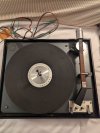
My Garrard Lab 80 Obsession

Set the arm for zero balance point. Parallel to platter. Move the arm gently by using gentle pushes toward the spindle. See if it stops abruptly anywhere in its horizontal motion.

Then increase the arm counterweight so the stylus is just barely above the platter, and try again.

I suspect you have arm friction, either the pivot bearings, or under the chassis, since your auto functions aren’t working correctly.
Thanks for the advise.
I did as you suggested and I'm not feeling/seeing and rough spots, however, the arm is not as loose as those on my other turntables. This one travels a few inches and stops unless I give it a solid shove.
"Arm friction" is a good way to describe what seems to be happening. What would the next step be regarding pivot bearings or some clues on what to look for underneath? (I beleive I mentioned that I have some of the auto mechanism pulled out right now)
 
This has an exploded view of the arm, I think lever # 83 is what holds the arm in place. If you mess with this, hold the arm down before touching the set screw on #83 or the arm will fall out and all those bearings will vanish. What I'd check first is that its not set together so tightly that it binds. My arm will lift up just the slightest bit at the back. If yours has no movement at all it may be the issue.
 

Attachments

I checked and that screw is very tight (won't budge) - It appears that this screw is meant to be tight (?) my arm doesn't move much (if at all) when I try lifting it from the back (I assume you meant to try lifting part #5?) Nothing seems to be binding - any chance this could be a product of wrong/poorly aligned cartridge or head shell?
 
The screw is what holds that lever in position so it should not be loose, but if the lever is pushed against the base of the arm it may be causing it to not move correctly.

There is no cartridge alignment on these. It won't cause arm friction problems, and it won't cause the auto functions to not work.

Moving a few inches and stopping unless you give it a shove is definitely not normal and what I'd consider binding. Either the arm moves freely or it does not.
 
I understand - wasn't thinking that cartridge alignment might cause friction, but possibly the tracking issue.
If the lever is creating undue friction on the arm base (presumably #86 resides inside the arm base tube of #82) - is there a way for me to determine this beyond loosening the screw? I'm wary of losing the bearings - so want to be sure I understand correctly that I should push down on the arm from above (#5) to keep the bearings in place if I loosen the set screw on #83?
 
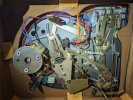
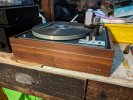
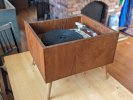
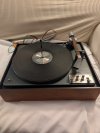
I have one more for my collection. My collection of Lab 80s that need to be restored but I will never have time to do it. This one makes three. It looks really clean. Even underneath. Someone may have serviced this in the not so distant past. I haven't been able to test it yet because it has no power cord. I am also including pictures of the 4hf I recently acquired just for fun.

PXL_20240403_023026188.MP.jpgPXL_20240403_023213418.jpgPXL_20240403_023451061.MP.jpgPXL_20240324_140502664.PORTRAIT.jpgPXL_20240324_140247788.jpg
 
Converting a Lab 80 to auto single play like an 80 Mk II

The main functional difference between the Garrard Lab 80 of 1964 and its successor model, the 80 Mk II of 1966 is that the 80 Mk II will automatically play a single record using the short, single-play spindle. The Lab 80 will not.

For a long time, I've been curious about converting a Garrard Lab 80 so that it would function like the 80 Mk II, while retaining the chaste, understated appearance of the original Lab 80, which I prefer.

With the introduction of the 80 Mk II, Garrard issued a revision to the original Lab 80 service manual, with additional operating instructions, part numbers and a bottom-side illustration covering the 80 Mk II. This revised manual has not yet been made available at Vinyl Engine or other online sources. One might think that the revised manual would indicate how to change one to the other, but although there were many part numbers that changed, not all of the changes were functional, to permit automatic single play. Some involved cosmetics such as the "turret" for the tonearm, the tonearm shaft itself, the platter mat and centre trim disc, and the control panel with its fluted tab controls. And as it turned out, some 80 Mk II parts with new part numbers were actually no different from their Lab 80 counterparts. Why different part numbers? I don't know.

I set out to convert a Lab 80 to automatic single record play. Starting with my own Garrard Lab 80 and a pile of parts from an 80 Mk II whose chassis was damaged beyond repair, it turned out that only four parts in the original Lab 80 had to be replaced with 80 Mark II parts, and what may be surprising is that the lever connected to the AUTO tab control is not one of them! There were a few additional parts from the 80 Mk II that had to be installed to implement the change.

Refer to the two photos of the undersides of a Lab 80 and an 80 Mk II. In the Lab 80 photo, the four parts that have to be changed are indicated with RED lines. In the 80 Mk II photo they are also indicated with RED lines and identified by the same names. 80 Mark II parts that must be ADDED are indicated with YELLOW lines and identified by name (the Reject Pawl, Pivot Pin and Circlip were already installed on the Manual Link).

Two critical parts are the Spring for Switch-Off Link and the Spring for Auxiliary Lever. It turns out that the strength of these two springs is important. Too strong a Spring for Switch-Off Link or too strong a Spring for Auxiliary Lever, and the "converted" unit will behave just like a standard, original Lab 80. If one had the original springs, this would be no problem but in my case, although I had a pile of parts consisting of all the levers underneath an 80 Mk II, I did not have the springs, which I had to wind myself.

The finished product performs just as desired. Pulling the AUTO tab starts the unit; the AUTO tab latches while the tonearm lifts, moves over the record to the proper diameter as set by the record size selector, and sets down. The AUTO tab then retracts automatically to a midway position. At the end of a record, the automatic mechanism lifts the tonearm off the record, returns it to its rest, and sets it down; and the unit shuts off.

I know this is a 12 year old post, but I'm interested in doing this. I just started fixing a lab 80 and I love the sound. I don't have a stacker spindle and I like the idea of converting it to automatic with the single play spindle. My question is, if I use the mk i parts that I replaced in the mk ii, will the mk ii still function like a manual turntable? Or basically, will the mk ii not function at all?
 
Currently working on a Lab 80, and the idler tire won't turn the platter in auto mode--manual is fine. I've stripped down, cleaned, and re-lubed nearly the entire mechanism, with the exception of the tonearm and the auto trip (this will come later, since I don't see it playing a role here). I've also tried sanding the glaze off of the tire, but no luck.

Now if I give the arm that holds the idler shaft a little press during the auto sequence, the platter will spin, the tonearm move in, record drop, etc. So I'm left with thinking either the idler simply doesn't have enough grip or perhaps the spring that pulls the tire into contact with the pulley and platter has long some strength. I can certainly try shortening said spring, but I'm leery about doing that without knowing that others have had the same experience and found this to solve it. Thoughts?
 
I had a similar issue where the auto functions wouldn't work. Someone told me to put rosin on the idler wheel to make it stickier. If the auto functions work then, it means you need a new or refurbished idler wheel. I didn't have any rosin, so I used honey and it did the trick. I sent my idler wheel in to get refurbished and now everything works great
 
As a test, you can use some thread to catch a few spring turns and tie them up, to effectively shorten the spring. Easy to remove and should not damage the spring.
 
I dissolved some rosin in isopropyl and then lightly brushed it around the edge of the idler tire. The table now works as in should in auto mode, so time to get the tire rebuilt. Thanks for the tip, @kbuch8586
 
I dissolved some rosin in isopropyl and then lightly brushed it around the edge of the idler tire. The table now works as in should in auto mode, so time to get the tire rebuilt. Thanks for the tip, @kbuch8586
Hmmm, there is a manufacturer in Canada who produces brand new idlers for Lab 80 or Zero 100 and some other turntables. I bought a few of these and they work perfectly and look very good too.
 
I would guess Audiovault, a Canadian shop making idler wheels looking nice enough. I haven't tried any myself yet, but have only seen positive reports about them.
 
I would guess Audiovault, a Canadian shop making idler wheels looking nice enough. I haven't tried any myself yet, but have only seen positive reports about them.
I have ordered 3 sets of idlers from them 2 for my Garrard Lab 80 and 1 for my Zero 100. All work well.
 
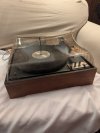
This little beauty came home with me today. I responded to the seller as soon as I saw it yesterday and did the three hour round trip today. This makes four lab 80's and one 4HF for me. This is the first one with the dust cover. Has a pickering v15 installed. I need more space.
 

Attachments

  • PXL_20250708_022446367.jpg
    PXL_20250708_022446367.jpg
    110.6 KB · Views: 21
  • PXL_20250708_022430616.jpg
    PXL_20250708_022430616.jpg
    120.6 KB · Views: 21
  • PXL_20250708_022405775.MP.jpg
    PXL_20250708_022405775.MP.jpg
    102.3 KB · Views: 21
Who here has the cake top cover? I have one that's in decent condition, but it was really yellow. I tried sanding, but it didn't help at all and now there are scuff marks. I bought buffing compound with 2 or 3 different grits and will try again and take my time. Has anyone done this with good results????
 
Its so thin that I think you'll have a very hard time polishing it. I have one but its split like many of them are.
 
Back
Top Bottom