• The move to the new server is done. There are some software and database maintenance updates in process. This has us passing the hat around to help out. We appreciate any donations. Seriously, even a dollar helps. The payment page may be found here - https://www.audiokarma.org/support.html

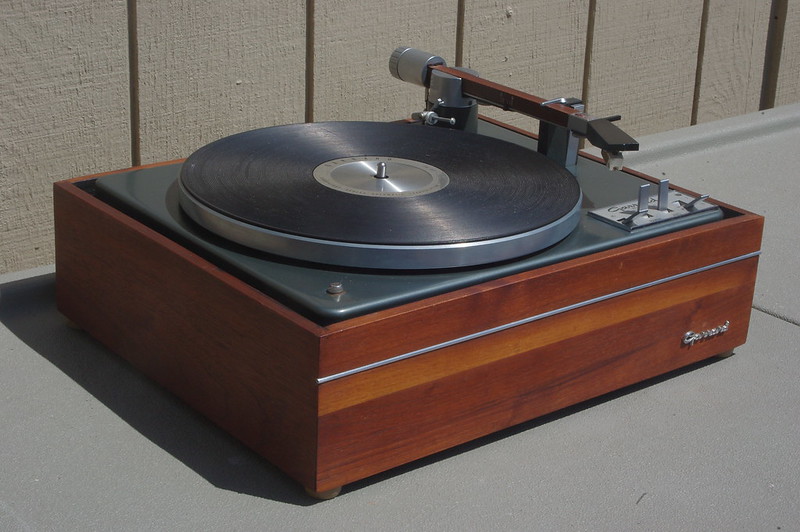
My Garrard Lab 80 Obsession

I got my LAB 80 at an antique shop and it was obviously VERY lightly used.
I noticed a slight wobble in the pitch after having it for a year (not sure what took me so long to notice it...maybe it wasn't always there??). It is more noticable on the last track on a record side.

I verified the speed hiccup with a stroboscope. It appears to be once every revolution. The marks on the scope slightly drift backwards (I could live with that, if it was constant) but once a rev, they jump back as if something is rubbing.

Here is the situation:

- I have the spindle oiled with light sewing machine oil,
- I thought it was a warped platter, so I bought a second platter for cheap to test...nope...still hiccups.
- The inner rim surface (where idler contacts) was cleaned with alcohol.
- The main bearing is in excellent shape and properly assembled (i.e. the upper and lower thrust plates are where they should be, the balls are in place and the plastic bearing housing is flawless.
- The idler wheel shows no signs of cracking or hazing and I have rejuvenated it and filed off the outer surface to expose new rubber. It also gets up to speed in about 2 seconds, so that tells me the wheel is acceptable. (not that I suspect an idler wheel or motor problem because the hiccup is once per platter revolution)

I really dig this turntable. My PL-41 is in storage because I prefer the LAB 80 with Shure M91E as my daily driver. I'm just bothered knowing that the hiccup is there...I'm sure you all understand.

Any suggestions would be appreciated.

Thanks,

JD

Make sure the arm thingy the idler sits on and everything associated with allows the idler to move freely and completely when the functions and speed selectors are manipulated. Free them up with a bit of light machine oil if necessary.
 
Once per revolution sounds like some issue with the platter bearing, or possibly the auto-cycle gear is trying to catch on a high tooth every revolution. Make sure the "gap" in the cycle cam is centered against the gear on the platter and its not fetching up or something like that.


leepal: could be the idler, but it may also be the mechanism is trying to engage and its all gummed up. Does the platter turn freely? If it does and the idler won't run it up to speed, its probably done for. You may try sanding the edge to rejuvinate it but sometimes they just get too far gone to work and you have to have the idler re-rubbered. Oh, there is also a spring in there that pulls the idler between the motor and platter. If thats off, or if the arm the idler sits on is seized up and not pivoting properly, you'll get no traction.
 
leepal: could be the idler, but it may also be the mechanism is trying to engage and its all gummed up. Does the platter turn freely? If it does and the idler won't run it up to speed, its probably done for. You may try sanding the edge to rejuvinate it but sometimes they just get too far gone to work and you have to have the idler re-rubbered. Oh, there is also a spring in there that pulls the idler between the motor and platter. If thats off, or if the arm the idler sits on is seized up and not pivoting properly, you'll get no traction.


I tried sanding the edge of the idler but it didn't help. The arm the idler sits on moves around ok. The spring, I wondered if was that and tried a different spring which was tenser but that didn't make a difference. The platter does turn freely. Think it must be the idler.
 
Yeah, sounds like it. Does the idler feel hard on the edge? Mine is, and it does what you describe. Mine will run the platter OK in manual mode but as soon as the changer mechanism kicks in, it stalls. I sanded the edge, and it glazed up almost immediately. One album side and I can barely dent the edge of the idler with my fingernail. Time to send it off to the re-tread man.
 
7223770272_ee77884fb4_c.jpg


At one time I had three Garrard Lab 80s simultaneously, if I count the Lab 80 Mark II I gave to my parents to replace their old Webcor record changer. But gradually they all drifted away...as I mentioned in one of my first posts to this board, I sold my last one for really silly money. But the itch to own a Lab 80 never went away.

Now, I've got one again. Bought it for a lot less than "really silly money."

Essentially it worked as received, both manually and as a changer with the tall spindle. But it got a thorough mechanical going-over and relubrication, anyway. Now, it works a LOT better!

The Lab 80's final test was in the audio system. It sounded good, with the strong sense of pitch stability that is the hallmark of a good idler-drive turntable. It is also very quiet; rumble is low enough that it is lost in record noise. This one's a keeper, unless someone offers me really silly money for it.
 
I keep seeing the MK1 version, and I think I like it a bit better than my MKII. Its not the arm, but the switch panel mostly, and the stock plinth seems nicer on the MK1. My MKII box doesn't have the Garrard script for example, and it doesn't have the "belt".
 
My esthetic preference is also for the original Lab 80. The control panel of the Mk II got shiny chrome and black, and the tab controls became shiny and fluted; to my eye not as "classic" as the satin-finished control panel and plain tabs on the original.

I DO like the automatic play of a single record on the Mk II. The original Lab 80 only had manual play of a single record with the short spindle...intentionally. Their feeling was that automatic single record play with the short spindle could be dangerous; with a Lab 80 playing in AUTO mode you should not pick up the arm manually and put it back on its rest; the mechanism won't permit it without your overriding a spring that pulls the arm back to the setdown position, whether it be 12", 10" or 7". If the user picks up the tonearm by hand and does not have a FIRM grip on the finger lift, the arm could spring back and if this occurs the stylus would hit and damage the record, or itself, or both. This was characteristic of the Lab 80 mechanism, derived directly from that of the Type A and RC88/98. There is no such restriction on picking up the tonearm in MANUAL mode. But competitors Dual and Miracord both had automatic single record play, so Garrard had no choice but to follow suit in the Mark II, although the risk of record/stylus damage was still there. Lesson: Don't be impatient; even though it takes longer, USE THE CUEING DEVICE. Or better yet, hit the AUTO tab and let the machine shut itself off.

As for the Lab 80 with the "hiccup" once per revolution: If the auto trip operating lever is too close to the center hub during play of the record, the opposing magnets on the hub and in the operating lever will create a "drag" on platter motion, once per revolution. When retracted, the operating lever "bumps" against an eccentric which can be adjusted by loosening the screw that holds it. Try giving it a bit of extra "space" from the center hub.
 
Last edited:
Great info. I'm always learning new info on this thread. Now I know why the original Lab didn't have auto with the short spindle. I always wondered why. Thanks!
 
I got my LAB 80 at an antique shop and it was obviously VERY lightly used.
I noticed a slight wobble in the pitch after having it for a year (not sure what took me so long to notice it...maybe it wasn't always there??). It is more noticable on the last track on a record side.

I verified the speed hiccup with a stroboscope. It appears to be once every revolution. The marks on the scope slightly drift backwards (I could live with that, if it was constant) but once a rev, they jump back as if something is rubbing.

Here is the situation:

- I have the spindle oiled with light sewing machine oil,
- I thought it was a warped platter, so I bought a second platter for cheap to test...nope...still hiccups.
- The inner rim surface (where idler contacts) was cleaned with alcohol.
- The main bearing is in excellent shape and properly assembled (i.e. the upper and lower thrust plates are where they should be, the balls are in place and the plastic bearing housing is flawless.
- The idler wheel shows no signs of cracking or hazing and I have rejuvenated it and filed off the outer surface to expose new rubber. It also gets up to speed in about 2 seconds, so that tells me the wheel is acceptable. (not that I suspect an idler wheel or motor problem because the hiccup is once per platter revolution)

I really dig this turntable. My PL-41 is in storage because I prefer the LAB 80 with Shure M91E as my daily driver. I'm just bothered knowing that the hiccup is there...I'm sure you all understand.

Any suggestions would be appreciated.

Thanks,

JD

Um, I hate to admit this, but the relief of landing on a solution prompts me.

I discovered that the turntable (and consequently the platter) was not balanced at all. I had put the Lab 80 away, and got to wondering if I had neglected to balance it. Maybe there was some binding going on? Sure enough. After checking the balance on the platter, the speed is spot on, and maybe a hair fast, but almost undetectable.
I had read and understood the necessity of balancing a TT, but no article ever gave a reason why. I guess I figured it was to eliminate any forces on the stylus.

Anyway, I'm really sorry to waste everyone's time with an amature mistake, but maybe this will help other owners avoid the same mistake.
 

Yep, that was mine soon after I brought it up from the basement and realized what I had. I wish the sound quality was better.

The auto function was not demonstrated because it never worked at all. I finally gave up trying to repair the auto function and gutted everything but the manual mode linkages. I built a solid plywood plinth and I replaced the original tonearm with a DIY carbon fiber tonearm. It was a huge improvement. You can see the current state if you check out my youtube channel.
 
I discovered that the turntable (and consequently the platter) was not balanced at all. I had put the Lab 80 away, and got to wondering if I had neglected to balance it. Maybe there was some binding going on? Sure enough. After checking the balance on the platter, the speed is spot on, and maybe a hair fast, but almost undetectable.

A question: to me, "balancing" a platter refers to what Garrard did at the factory: after the final, precision machining, they spun the platter on precision balancing equipment and inserted copper weights into holes at the periphery to correct imbalances possibly caused by porosity in the alloy casting or other irregularities. What are you referring to as "balancing the turntable?"
 
Garrard Lab 80 vs. Type A70

I compared my Lab 80 to its sibling, Type A70, a notch down in the Garrard line.

A70's pusher platform is gentler, but records drop more noisily down its sloping spindle. Records on the Lab 80 drop straight down. The "cushion of air" effect makes the drop almost silent.

Biggest performance improvement of the Lab 80 over the A70, whose tonearm is just as capable, and whose auto trip mechanism is actually a tad better (less massive operating lever to be swung by the arm and cartridge) is motor isolation. A70's motor hangs in rubber grommets which do an acceptable job; Lab 80's counterpoised rubber isolation "balls" do a superior job. A70 has audibly more 120Hz breakthrough on a silent record when the volume is turned all the way up. Conceptually the Lab 80 system of isolators behaves rather like the opposed-tension springs in the Garrard 301/401 motor mountings. However the 2-speed Lab 80 won't run at 78rpm, so the A70 will remain as the turntable in my secondary system.
 
I just joined the cult. I've had a Lab 80 stashed away in my basement for years that I bought at a garage sale. Cant even recall what I paid but knowing me it wasnt very much. I've never even put a cartridge in it, have never heard it, dont know how if works. I have a Pickering 625 I could put on it, is that a good match?

Got to get this thing powered up, cleaned up, make some use of it.
One thing is missing, the dust cover....damn.
 
Pics?
Please. You might also want to check out "Garrard lab80 owners and admirers" in "social groups"
 
Pickering 625 is an XV-15 model and should do OK on the Lab 80. I'd certainly be willing to bolt one up and see how it acts at any rate. If it doesn't seem to do very well, you should be able to swap in one of the lesser / heavier tracking XV15 stylii so it runs happier. Not sure what the D625 runs at but I'm going to guess its in the 1-1.5g range. I'm running my old Shure M91 at 1.5 and it does OK there.
 
Some pics. It has been sitting in a basement cabinet for somewhere between 10-20 years. I guess it's time to check it out. It doesnt rotate so I gather it at least needs an idler wheel. Where can I get one?

Lab80.jpg


Lab80b.jpg


bottom.jpg
 
Interesting. MKII arm on a MK1 table.

Pull the platter off first and see what you can see. The idlers seldom get so bad the platter won't rotate at all. Usually if thats the case, the idler isn't making contact with something, or the mechanism is jammed up. The idler sits on a pivoting arm and is pulled over with a spring. If the pivot is seized or the spring is off, it won't run. Also obviously the motor itself needs to be running for anything to go. If it does in fact need an idler, I had mine redone by Terry's Rubber Rollers (google it) with good results.
 
What makes it a MKII or I?

I attached the idler to a dremel and got it sanded down to good rubber so the platter rotates now. Seems to work but havent put a cartridge in yet. A couple questions, the arm lift, when I press & hold the cueing button the cueing arm raises, lowering the tone arm but when I release the button, it goes back down and the arm comes back up. Shouldnt it stay? Also when I activate the auto lever all it does it go through a cycle and shuts down.
 
Last edited:
The MKII had a black switch panel without the size indicator window and that arm, though frankly I don't think theres much difference in the arms. The earlier one doesn't have the cap over the pivot like yours has. Internally, the MKII has some slightly different linkages. The MK1 won't auto-play single records. The MKII will auto-play with the single record spindle.

The arm should stay up if you pull the manual switch forward and release it. Release should be the button next to the arm rest. I'm guessing the latch mechanism is gummy. If you look at your pic, its the couple of rods along the top edge that work the cue and release functions.

Change cycle I'm also guessing is stuck grease, though its supposed to cycle and shut itself down if there are no records on the stack. If the spindle is out, I think it also cycles and shuts off. WOuldn't be surprised at all if the grease is hard there either. Mine was fairly petrified inside and a number of the linkages did not move properly.
 
Not so sure I want to keep this table. If I get it working properly and without a cartridge whats a fair price to ask for it?
 
Back
Top Bottom