• The move to the new server is done. There are some software and database maintenance updates in process. This has us passing the hat around to help out. We appreciate any donations. Seriously, even a dollar helps. The payment page may be found here - https://www.audiokarma.org/support.html

My McIntosh plunge

dyche01

"Buy high. Sell low"
Subscriber
I have accumulated a modest amount of audio gear (at least compared to some folks here). In order of quantity (from most to fewest pieces) the ones worth mentioning are Marantz (1 integrated amp; 2 tuners; 1 receiver), Fisher (2 receivers), and H.H. Scott (1 receiver). I never owned, or even really coveted, McIntosh gear until I bought a MC754 power amp a couple of years back. It sounded quite good but the main thing I liked was the build quality and the ... how can I say this? ...the aura of the piece. I sold it on to someone else but then, almost immediately started looking around for other reasonably priced Mac gear.

I recently found a nice replacement for the MC754, an older MC2120 power amp (with autoformers), and then a nice C26 pre-amp. Both were in okay shape but needed a little TLC, so I thought I would bring these projects here to the Mac-loving end of the pool.

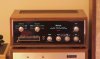
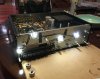
First things first: the lamps were burned out on the C26 so I replaced them with white-light LEDs.
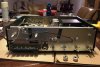
front_open.jpg

front_lit.jpg
 
Last edited:
Register to hide this ad
I really like the clean layout of the C26.

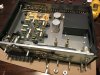
Here is the top side:
top_open.jpg

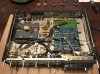
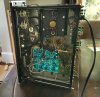
And here is the bottom:
bottom_open.jpg

In addition to replacing the bulbs I did a quick Deoxit clean of all the contacts. There is still a bit of an issue with the bass control switch. This is not a pot but a multi-position switch with discrete resistors. Any pressure against the knob causes a serious crackle and hum. It does not sound like a dirty contact, but like something might be cracked. Does anybody have advice on rebuilding or replacing this controller? Luckily, there is no problem if you don't fiddle with it.
 
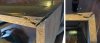
Neither the amp nor the pre-amp came with a case, so I searched the usual online sources and eventually found a busted L-12 case for the pre-amp. It had a lot of water damage and looked like it had been dropped from a considerable height. One entire edge was detached and had a couple of floating chunks of MDF rattling around in the gap.

busted.jpg

The veneer had also detached over some sections. I carefully realigned everything, glued it, and clamped it up tight.
glue_up.jpg
 
The re-gluing worked pretty well, but the finish still looked like crap.

glued.jpg

So I sanded as much as I thought prudent, starting with 320 grit sandpaper in my orbital sander.

sanded.jpg

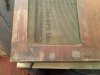
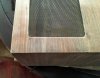
Unfortunately you can still see a little circular clamp mark in the corner where I attached the clamp directly to the case. This little clamp was necessary to hold a couple of detached pieces of MDF from the inside, but I should have been more careful.

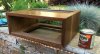
Finally, I applied my favorite polyurethane-based finish, called The Good Stuff (no affiliation):
finish_1.jpg
 
Last edited:
I have the house to myself this afternoon, so I decided to pop the cover on the C26 and do a little more work. The service manual only lists eight electrolytic capacitors (4x100 µF and 4x10 µF) so I decided to replace them from my stash of Nichicon Golds.

Once again, I appreciate how easy this unit is to deal with: (1) it is light; (2) the panlocks are easy to use; (3) the top and bottom come off with a handful of screws; and (4) everything is laid out nicely.

open_bottom.jpg

Seven of the electrolytics are on the top side and one is on the bottom. Interestingly, my unit appears to be an early production model, so the four 10µF capacitors are actually tantalum film rather than electrolytic.

Here is a BEFORE picture:

before.jpg

And here is AFTER:
after.jpg

This re-cap actually fixed a pretty serious issue. I had noticed that the right channel was significantly stronger than the left but I assumed that the problem was in the power amp and so I compensated by adjusting the gain settings on the MC2120. After replacing the capacitors and reflowing most of the solder joints, however, the two channels are now exactly matched.
 
Last edited:
The issue that I would like to tackle next is a bit of noise that I can hear in the phono stage. It's not significant at normal listening levels but I would like to see how close I can get it to zero. I suspect the old transistors in the phono stage are the main culprit. Does anybody here have advice on modern, low-noise replacements for these transistors?
 
Last edited:
Rebuilding, upgrading, the multicap based power supply can greatly improve and reshape the noise spectra of all the gain stages.

If the original transitors are not failing replacing them with modern replacements will acomplish little.
 
Isn't great there are folks out there who love restoring pieces. I am always thrilled to see a Very early SS Mac being brought back to life. There something really special and satisfying about restoring a piece of Mcintosh. I use to love working on the old professional Ampexs from the late 50's and 60's/ SS Kind of took away the fun for me. Revox A-77 and B-77 were fun, too. I know Ampex 1000 an 2000 series machines were strictly for the home. But once tuned up performed really well. Use of better grade of belts really extended there service life. I am not what you would call an electronic technician, but I've been known to repair 2100's 250's 3500's and 2300's in the field when I didn't have any other choice. They were all pretty simple. By the time the 2255 and 2155 came along I declined. Oh I tinkered with older Ampexes up until my last day in 2004, and still mess around with my AG 500, F-4460, and friends and my Revox units when I have my arm twisted. But thats very rare now days.
 
Rebuilding, upgrading, the multicap based power supply can greatly improve and reshape the noise spectra of all the gain stages.

If the original transitors are not failing replacing them with modern replacements will acomplish little.

In my experience, noisy phono stages in older SS units are often associated with noisy small-signal transistors. There are also a few threads devoted to the topic here on AK:
http://audiokarma.org/forums/index....ilure-prone-whatever-and-replacements.731653/
http://www.audiokarma.org/forums/index.php?threads/noisy-small-transistors-in-g-3000.499623/
http://www.audiokarma.org/forums/index.php?threads/are-the-2sc1344-noisy-transistors.428489/

I haven't looked to see whether the particular transistors used in the C26 have been reported to cause problems, but it sounds like you are saying that they are as good as it gets.
 
Have you changed your opinion since this quote from 2011?

...To my memory as we replaced a malfunctioning transistor with a new replacement we would see a substantial S/N improvement and would often swap new parts into the functioning channel to bring it also to a higher performance level. To be fair this was most often in the phono stages of C-28 and older units. ...
 
DOB was very impressed with the Toshiba SC2240bl and SA970bl transistors.

The BL selected parts when they were still made by Toshiba were excellent parts and between the two of them replaced over 3 dozen previous Mac parts.

The GR grade are mediocre and I have found that recent purchases of the devices from known good sources barely meet BL spec.

Mac went to a Sanyo device when Toshiba stopped production of thru hole devices.

I believe that device is also out of production.

While doing a clinic with DOB if a phono section did not meet spec the old low noise BC416 devices would be replaced not only in the malfunctioning channel but also the good channel to make sure both would meet spec. We did not touch the power supply because they would meet spec every time I can remember.

However, The S/N expectations from back in the 60s were a lot lower than what is expected today. The single rail power supply 75 volts to 10 to 9.5, is very much lacking in today's expectations.

Do as you wish but actual spectral analysis shows a improved noise floor when the power supply is properly upgraded to a far greater extent than what shows up when the properly working transitors are replaced.
 
DOB was very impressed with the Toshiba SC2240bl and SA970bl transistors.

The BL selected parts when they were still made by Toshiba were excellent parts and between the two of them replaced over 3 dozen previous Mac parts.

The GR grade are mediocre and I have found that recent purchases of the devices from known good sources barely meet BL spec.

Mac went to a Sanyo device when Toshiba stopped production of thru hole devices.

I believe that device is also out of production.

While doing a clinic with DOB if a phono section did not meet spec the old low noise BC416 devices would be replaced not only in the malfunctioning channel but also the good channel to make sure both would meet spec. We did not touch the power supply because they would meet spec every time I can remember.

However, The S/N expectations from back in the 60s were a lot lower than what is expected today. The single rail power supply 75 volts to 10 to 9.5, is very much lacking in today's expectations.

Do as you wish but actual spectral analysis shows a improved noise floor when the power supply is properly upgraded to a far greater extent than what shows up when the properly working transitors are replaced.

Great! Thank you for providing such a detailed response!

This is the kind of 'inside baseball' information that makes AK great. For now, I will abandon the idea of replacing the transistors and focus on the power supply.

Thanks again! I love you guys.
 
Back
Top Bottom