• The move to the new server is done. There are some software and database maintenance updates in process. This has us passing the hat around to help out. We appreciate any donations. Seriously, even a dollar helps. The payment page may be found here - https://www.audiokarma.org/support.html

My new "broken" Parasound HCA-1200

Depending on how you describe it, burnt and open can mean two different things. To me, burnt means a short. Open just means disconnected from either end. Open would (sometimes) be good. Burnt would be bad.

If you go and put in new fuses, then keep your eye on it. If there is a short, it will blow at the instant of turn on.
 
Were the fuses black? Blackened fuse(s) indicates a short somewhere and you won't want to just replace them blindly hoping that it will work. Make sure the outputs are good before replacing the fuses.

Most of the fuses I have seen in equipment is listed as 250 volt so try to find the 12Amp-250 volt fuse.

This is a good point. You can often tell how severe a problem is by the appearance of the blown fuse. If the fuse filament is just open, that can be simple filament fatigue or maybe a power line surge. But if the glass is black with shiny metal splattered inside it usually indicates a dead short.

Hard to see that with ceramic fuses though... :sigh:
 
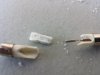
I've still got one of the fuses, let me pop it open and take a picture. It isn't that bad, just open. I thought I cut the filament when breaking the fuse, but you could see the little bit that heated up and opened the circuit.

attachment.php
 

Attachments

  • 2014-07-19 16.36.33.jpg
    2014-07-19 16.36.33.jpg
    42.1 KB · Views: 103
Last edited:
Why would you not replace the fuses, even if they're just some underrated/temp ones, then check for DC at the output before replacing all the transistors?

If there isn't DC at the output there isn't any reason to replace any of the transistors.
 
Why would you not replace the fuses, even if they're just some underrated/temp ones, then check for DC at the output before replacing all the transistors?

If there isn't DC at the output there isn't any reason to replace any of the transistors.

I worded that weird. I'm going to test the transistors and if some are bad, I'll just replace them all.

My understanding was if there is a short, I could be risking causing more damage if I just replaced the fuses without fixing the problem.
 
If they're output fuses it will still be no load/open circuit if you don't connect speakers. Testing with the meter is essentially no load.

If you're concerned you could use a dim bulb tester to limit the current the amp draws.

I think there is an opportunity to potentially save lots of work with very little up front effort and very little, if any, additional risk.
 
If they're output fuses it will still be no load/open circuit if you don't connect speakers. Testing with the meter is essentially no load.

If you're concerned you could use a dim bulb tester to limit the current the amp draws.

I think there is an opportunity to potentially save lots of work with very little up front effort and very little, if any, additional risk.

Sounds good to me. I'll run down to radio shack and snag some 10A fuses. I'll report back after I test it.
 
Just a thought, don't replace the output transistors until you figure out why the fuses blew. The output transistors did not blow the fuses....
 
Sounds good to me. I'll run down to radio shack and snag some 10A fuses. I'll report back after I test it.

You don't even need anything that big just for testing. Although, if you find no DC on the output, 10A fuses almost certainly will be just fine for use unless you're going to crank the snot out of it.
 
Actually, in hindsight, you don't need any fuses at all to check for DC at the output if you can figure out which terminal of fuse holders comes from the amp output. Just check from that terminal to ne negative speaker terminal on each channel.
 
I know I must look like an idiot, about the transistors, but I'm getting conflicting advice. I've been told to check the transistors by parasound and other AK'ers. That seems to be the next component that would receive damage from the over value fuses. I was looking at replacing all of them because the original transistor is no longer available and I found a comments on how poorly made they were.

I'll go get a fuse in a bit and start with that.

Actually, in hindsight, you don't need any fuses at all to check for DC at the output if you can figure out which terminal of fuse holders comes from the amp output. Just check from that terminal to ne negative speaker terminal on each channel.

Never mind. This is perfect. I'll give It a go
 
Certainly you may indeed find the outputs are hosed, but this is such a simple test to do. If you find rail voltage you're not out anything but a couple extra minutes beyond what you had already planned to do. If you find just normal DC offset, well, you may have saved a bunch of work, if only for now to see if it actually plays.
 
Certainly you may indeed find the outputs are hosed, but this is such a simple test to do. If you find rail voltage you're not out anything but a couple extra minutes beyond what you had already planned to do. If you find just normal DC offset, well, you may have saved a bunch of work, if only for now to see if it actually plays.

No doubt. This is the logical first step. I appreciate your patience. I know just enough to get myself in to trouble. :) Sometimes, rather than taking the first step, I get ahead of myself and jump to conclusions. Pretty silly, actually.
 
I think you've gotten good advice from Parasound, they're not going to steer you wrong. Hopefully it'll be an easy fix and you'll be up and running.
 
I'm getting -1.9 V on each channel without a source. With a source (volume barely cracked) it bounces from -1.2v and -2.2v

That's with negative probe on negative terminal and positive probe on the amp side of the fuse.
 
Last edited:
Nearly 2 volts is sure higher than it ought to be (hopefully zero, but some number of millivolts isn't unusual depending on the amp) and I think too high to connect speakers.

Doesn't seem representative of shorted outputs though. Maybe something further up the circuit?

Might not hurt to ask for this to be moved to the DIY forum for more troubleshooting/repair help from our resident experts.


Oh...did you measure using AC or DC range? Using the DC range would be correct for checking DC offset/DC presence, but you'd need to use the AC range to measure output using music or a test tone.
 
Nearly 2 volts is sure higher than it ought to be (hopefully zero, but some number of millivolts isn't unusual depending on the amp) and I think too high to connect speakers.

Doesn't seem representative of shorted outputs though. Maybe something further up the circuit?

Might not hurt to ask for this to be moved to the DIY forum for more troubleshooting/repair help from our resident experts.


Oh...did you measure using AC or DC range? Using the DC range would be correct for checking DC offset/DC presence, but you'd need to use the AC range to measure output using music or a test tone.

I measured it using DC. I thought that's what we were working with. I'll give it Ita run with AC. I'm out and about. Gonna snag some fuses while I'm out.
 
I'm getting 57.4V when reading AC. Same setup as before: negative probe on negative terminal and positive probe on fuse point.

I put in 10A fuses and I'm rocking like .5 mV DC.
 
Last edited:
Back
Top Bottom