• The move to the new server is done. There are some software and database maintenance updates in process. This has us passing the hat around to help out. We appreciate any donations. Seriously, even a dollar helps. The payment page may be found here - https://www.audiokarma.org/support.html

My system (Crown amplifier controversy busted)

ZZwergel

Member
The first place and time I've seen a Crown amplifier was at the Dick's Sporting Goods in Homestead, PA while at work there. It's a Crown Com-Tech 210 used in the store sound system. Originally, I didn't know what this black box was as It had lights on it that read "SPI" which I knew could mean "Serial Peripheral Interface" on it. One time, I looked this device up online and it is what I though it might be, an amplifier. After finding out that they could be had for cheap, I wanted to build a stereo system around it. However, a post at avsforum.com says this.
You have high-quality speakers there.

Using a Crown amplifier with them is sort of like spending $150,000 for a Ferrari, and then going to Pep Boys and telling them to put the cheapest tires they have on it. It would be almost criminal.

Crown amplifiers are not intended for a high-fidelity system, and their sound quality is 3rd-rate. They are suitable for a public address system in an auditorium or baseball stadium. Using them with those speakers would be a tragedy.

You also do not need anywhere near that much power for those speakers. They have a 90 db per watt sensitivity, which means that any amplifier rated for 40 watts or more would be quite adequate. Any amplifier rated for more than 100 watts would have the potential to damage them.

The Cambridge Audio CXA60 would be a good choice, or the Music Hall A15.3. They are high-fidelity amplifiers that will make your speakers sound wonderful.

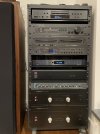
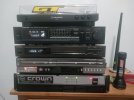
Due to this, I looked into it further. After reading that Crown amplifiers are accurate and don't color the sound, I thought I'd give it a try. I purchased a Crown CT-210 amplifier, an Audio-Technica AT-LP60X Turntble, a Technics ST-K50 Tuner, and a Kenwood KC-206 preamplifier. I used a DVD-VCR combo we already had for playing CDs.

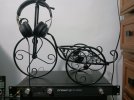
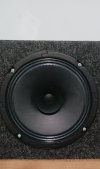
After wiring it all up with some generic bookshelf speakers, I actually sounded pretty good. Later on, I purchased a Rockville subwoofer, some small automotive speaker boxes, and 6.5 inch 8-ohm whizzer cone full-range drivers. After these came, I assembled the speakers and installed the subwoofer between the amplifier and speakers. Even later, I got a Crown D-75A that I use to power a pair of Audio-Technica AT-PRO7X headphones.

Any thoughts on this system
20240203_230108.jpg

20240316_212707.jpg
20240118_195204_resized (1).jpg
 
Register to hide this ad
A number of AK posters, myself included, use Crown amplifiers. I use a bridged pair of XLS-2002's to drive my DIY TL subwoofers.
I'm slogging through a few projects that when I'm done with them I want to do the same with a pair of CDi's I have.
 
If it sounds good to you, feels solid, and you are happy with the performance. Win.

And as long as you can hear decently, youll be able to tell when you may be pushing your speakers a bit too hard. Having an abundance of power is preferable to sub standard power. Ask the tweeters on my old jbl home theater speakers what they thought about 45w per channel lol. It's easier to hear speakers breaking up then super high freq clipping.
 
There's an old thread called "Crown, a victim of unfair generalization" you might find interesting. I'd post a link, but I'm not that forum savvy lol

 
Say what?
Sounds like an unstable amplifier instead of a not enough power problem.
i was implying if you find yourself pushing a lower wattage amplifier too long the higher frequencies in the clipping will damage many tweeters. Was an older onkyo avr that had 45w per channel iirc, this was probably 10 years ago now or close to it and the AVR wasn't new already lol. Had big dual woofer jbl nd310s for my l/r channels that handled something close to 300w each @90-something DB sensitivity. Had 3/4" titanium dome tweeters. No ferro cooling or heatsink or anything like that. I pushed the thing quite often more then i should have, and one day the tweeters couldn't take the clipping anymore and bit the dust. I even did it once more again (lol) and that timethe tweeters, and one of the lytics in one crossover went (?...lol, was a 100v rated lytic too). I tended to go til i could hear the distortion, then back the amp off just under that point, and let it ride for long periods with music. At the time i didnt realize that the amplifier was still likely clipping.

It Won't exactly work this way with tube circuit clipping, tubes clip much more softly and smoothly, Its less like clipping and more like "blunting" the wave. The clipping has FAR less high frequency content as a result. When you are clipping through a transistor or an opamp, you are essentially sending a square through it's output. Tweeters unlike a a normal dynamic driver have low enough mass to actually respond to high freq square waves and transistor clipping's high freq content will absolutely make them overheat if they can't dissipate the energy quickly enough.

And the clipping from pushing an amplifier too hard into speakers that can handle a lot more power then that, at least in my experience, is not as blatantly obvious as a speaker cone screaming for mercy, and absolutely 100% can damage tweeters that should be able to handle far more power then you are actually pushing. If the clipping is right on the edge for a long period and you cant really hear it, you can still damage your tweeters depending on their excursion limits and ability to dissipate heat and how long they were exposed to those conditions. The tweeters i have right now prob wouldn't mind a little clipping. They handle 50w, go down as low as 1000hz, and are ferro cooled. Those little titanium button tweeters in those JBL's sure as hell minded though.

If i had a more powerful amplifier at the time, i wouldn't have fried up those tweeters, almost guaranteed. It does sound counter intuitive, but in most (not all) contexts you are absolutely more likely to damage speakers using an amp that's to weak, rather than too powerful, assuming you can hear and are using solid state equipment anyway. (Although i have read some mosfet/jfet implementations will soft clip much like tubes)
 
Last edited:
i was implying if you find yourself pushing a lower wattage amplifier too long the higher frequencies in the clipping will damage many tweeters. Was an older onkyo avr that had 45w per channel iirc, this was probably 10 years ago now or close to it and the AVR wasn't new already lol. Had big dual woofer jbl nd310s for my l/r channels that handled something close to 300w each @90-something DB sensitivity. Had 3/4" titanium dome tweeters. No ferro cooling or heatsink or anything like that. I pushed the thing quite often more then i should have, and one day the tweeters couldn't take the clipping anymore and bit the dust. I even did it once more again (lol) and the tweeters, and one of the lytics in one crossover went (?...lol). I tended to go til i could hear the distortion, then back the amp off just under that point, and let it ride for long periods with music. At the time i didnt realize that the amplifier was still likely clipping.

It Won't exactly work this way with tube circuit clipping, tubes clip much more softly and smoothly, Its less like clipping and more like "blunting" the wave. The clipping has FAR less high frequency content as a result. When you are clipping through a transistor or an opamp, you are essentially sending a square through it's output. Tweeters unlike a a normal dynamic driver have low enough mass to actually respond to high freq square waves and transistor clipping's high freq content will absolutely make them overheat if they can't dissipate the energy quickly enough.

And the clipping from pushing an amplifier too hard into speakers that can handle a lot more power then that, at least in my experience, is not as blatantly obvious as a speaker cone screaming for mercy, and absolutely 100% can damage tweeters that should be able to handle far more power then you are actually pushing. If the clipping is right on the edge for a long period and you cant really hear it, you can still damage your tweeters depending on their excursion limits and ability to dissipate heat and how long they were exposed to those conditions. The tweeters i have right now prob wouldn't mind a little clipping. They handle 50w, go down as low as 1000hz, and are ferro cooled. Those little titanium button tweeters in those JBL's sure as hell minded though.

If i had a more powerful amplifier at the time, i wouldn't have fried up those tweeters, almost guaranteed. It does sound counter intuitive, but in most (not all) contexts you are absolutely more likely to damage speakers using an amp that's to weak, rather than too powerful, assuming you can hear and are using solid state equipment anyway. (Although i have read some mosfet/jfet implementations will soft clip much like tubes)
Having headroom is a good thing for sharp transients as well.
 
I toured with DC-300s: almost indestructible, even by IATSE stagehands. I have owned a pair of D-75s, a PSA-2, and some ComTech something or other. I have never had a complaint about them. All have sounded great and been reliable. But they have never sounded special or engaging to me.

I find this to be true of a lot of pro amps. They are voiced to be neutral so the engineer or installer can put their own stamp on the sound.
 
Having headroom is a good thing for sharp transients as well.
Very true. But it's not that simple either, voltage slew rates play a critical roll in many amps as far as i understand it, and in my own personal tinkering experience, i've concluded the quality of capacitors in the power supply (how fast they can charge to capacity, and how fast they can discharge to empty) also greatly impact dynamic presentation and transient speed, at least in a power amplifier.

And an amplifier channel, is largely just a power supply modulator after all.

I toured with DC-300s: almost indestructible, even by IATSE stagehands. I have owned a pair of D-75s, a PSA-2, and some ComTech something or other. I have never had a complaint about them. All have sounded great and been reliable. But they have never sounded special or engaging to me.

I find this to be true of a lot of pro amps. They are voiced to be neutral so the engineer or installer can put their own stamp on the sound.


This is exactly why i prefer using a mixing/mastering interface for pretty much all my DAC needs, and the most colorless/neutral class D power amplifier i could come up with. When im listening to music for enjoyment, not making music, i play with that space in between the two.
 
If i had a more powerful amplifier at the time, i wouldn't have fried up those tweeters.
I have had the experience of blowing up a number of drivers. Some from underpowered amps, some from over powered amps, some from running too long and overheating, and even a couple ‘cuz the amp failed and sent a few too many volts of DC. In every case (except the last one) I was to blame and I knew beforehand that I was running on the edge (but I didn’t stop).

You gotta be running some high dB or using speakers in the wrong scenario to pop a tweeter. With marginal speakers at 4 meters you will still be around 90dB. If you are trying to recreate a live concert with a 45 watt receiver there may be consequences.

Headroom is fine and healthy, until you use it all up.

EDIT: all that said, an audio hobbyist is more likely to blow up a speaker from lack of amplifier power than other causes because most speakers have a higher wattage rating than most amplifiers. Class D may change that.
 
Last edited:
Those were the only drivers i ever killed without knowing exactly what killed them when they kicked it. Took me a bit to figure it out what killed them lol


Ive checked out several used sets of inexpensive speakers since, with dead tweeters and assumed this was the likely culprit. But i have no idea lol. Also assumed they were from owners like i used to be. Loud music, most of the time im at home, playing from the den when i may be any of number of places in the house. Something ive come to realize MANY music lovers do. And having speakers capable of handling more power then an amp can dish out is a lot more common then the other way around. But only in my own life's experience with the people i know and find myself around.

Im definitely over explaining a bit, my point for the OP was just id rather have an amplifier of higher power then my speakers then lower. The jbl example was just an extreme "haha" kind of example to support that lol

When you pump too much power into a speaker, in my experience the result is a more abrasive, poorer sound then a tiny bit of hard clipping from an amp, and a person will def back off the volume much more willingly in that scenario.... or it least id really hope so, but i can totally understand your average music lover clipping on an underperforming amplifier and killing some inexpensive tweeters, i did it twice before i even realized what was doing it. I would expect damaging speakers without even realizing your doing it to be much more common with an underpowered amp, than with an overpowered amp, but dont have the slightest idea in reality.

I have damaged drivers with too much power, but havent killed a tweeter that way yet, the crossovers have had my back i guess, at least with tweeters... Unlike overheating through clipping. One of those titanium domes literally melted its plastic backplate to the magnet and melted the glues on the former and seized it up like a car without oil and i didnt even know i was doing it.
 
Last edited:
Back in the Day ..
Crown gave itself it's reputation for hard edged brittle sounding amps .. even compared to most receivers ..

If they went to work and changed that reputation .. all the better, but those amps in the 70's were nasty sounding beasts ..
That reputation was well deserved.
Good to hear that they changed their stripe over the years.
 
I remember certain Rock groups using Crown amps as opposed to Marshall. I think it may be that the British groups used Crown mainly and the American groups used Marshall. As far as HiFi goes the rep of crown used to be that it was brute strength without enough refinement for HiFi, but when you look at it objectively this is pure bs in my opinion. The watts per channel has as many have mentioned a quality all its own in that there's always plenty on reserve to prevent clipping. Anyway, I don't see any reason why a Crown can't be the center piece of a fine audio system which is what you have done. Although, I would recommend against stacking gear on top of your amp as it needs to ventilate.
 
Back in the Day ..
Crown gave itself it's reputation for hard edged brittle sounding amps .. even compared to most receivers ..

If they went to work and changed that reputation .. all the better, but those amps in the 70's were nasty sounding beasts ..
That reputation was well deserved.
Good to hear that they changed their stripe over the years.
I always assume those pontificating here have actually heard the components they are maligning, but I realize all too often that's not the case and they are simply parroting Internet lore.

Crown's reputation in the '70s for "brittle" sound came more from their early attempts at pre-amps than it ever did from their power amps. The First Gen IC-150 in all actuality was the first to get such reviews and was quickly followed by the IC-150A which, as good as it was, was really never able to shake that reputation. I bought my first Crown amp around 1970 but that reputation kept me from trying the pre-amp. Once Crown brought out their consumer version Straight Line Two and PSL2, I never heard a derogatory review and that pre-amp maintains a stellar reputation today and commands strong prices on the used market. I am lucky enough to own two of those.

My first outing into the world of Hi-Fi as a teen was with a Kenwood receiver and my Dad's old mono-JBL system with another added later for stereo. At some point one of the 075 tweeters went silent so I sent it back to JBL under their "Lifetime" warranty. They repaired a fried voice-coil and sent it back to me with a note suggesting I check my amp for a "high-frequency oscillation". I later learned the cause was most likely overdriving an underpowered amplifier. Regardless, I traded the Kenwood on a Fisher SA-1000 amp and Mac C-20 pre which I kept until the Fisher was eating me out of teenaged budget in tubes each year. My local JBL, McIntosh dealer realized I wasn't likely to be able to afford a mew Mac amp at my age and suggested I take three Crown's home to try. These were the D60, D150, and DC300. My teenage. budget stretched for the D150—which I still have today over 50-years later. When I'd take my Crown and my C-20 to that store's McIntosh Clinics, Dave O'Brien himself commented on the incredible distortion graph produced from the Crown each time, as he worked on the C-20 to get it to meet spec.

So my introduction to Crown was as quality hi-fi amplifiers for home use as reasonable alternatives to the even-then-Iconic Macs. I learned to appreciate them and have used Crown amps now for over 50-years along with a collection of JBLs from original 030 and L100 to the crown-jewel 4345s, culminating in my finding a Crown Studio Reference-II whose specs and performance will open anyone's eyes to all the misinformation Crown has put up with in the past half-century.

So, don't believe everything you read about Crown amps. Most of it, like the East-Coast—West-Coast discussion of JBL sound today, are simply myths enhanced over the years by those who read and repeat without any experience. I own an original L100 Century JBL pair so I know what I'm saying when I say I don't like their sound and that they have little comparison with JBLs that came before or after the L100. Likewise, I've never met a Crown that didn't do just what it was supposed to. Forget the Internet legend and listen to those who own them and use them—professionally as well as in their homes. I can't tell you anything about the current Samsung Chinese-made Crowns so my comments are only on what I know and use which is everything from D45 to Studio Reference-II.

Livingroom stereo rack.jpg
 
Back
Top Bottom