• The move to the new server is done. There are some software and database maintenance updates in process. This has us passing the hat around to help out. We appreciate any donations. Seriously, even a dollar helps. The payment page may be found here - https://www.audiokarma.org/support.html

Mystery speakers, no branding anywhere

jubalation

New Member
Picked up a pair of these locally for fairly cheap, they looked pretty well made to warrant the gamble. The cabinets are pretty thick and heavy MDF, with a black textured paint on the outside. There are 2 6" woofers and a single dome type tweeter. The only identifying marks are on the woofers, there is "YC 141A" on the surround and the number 1021 on the back.

Can anyone identify any origin of these or the drivers? Thanks!
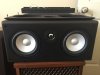
IMG_2344 (1).jpg IMG_2345 (1).jpg IMG_2346 (1).jpg IMG_2347 (1).jpg IMG_2348 (1).jpg
 
Register to hide this ad
The speakers look like 'real' speakers, and not DIY. And with no brand names or markings, I'm thinking they are an internet direct product. But, so far, nothing from Ascend Acoustics, Axiom, AV123, Aperion Audio, Fluance, HSu, HTD, RSL, Salk, Selah, SVS, and XTZ. So hopefully, someone else will recognize these. Hope they sound as good as they look?
 
The model number is on the crossover.

Truaudio CT-66A

Great catch, I completely glossed over the crossover numbers. Mystery Solved.

@StimpyWan Haven't really given them a thorough listen, but did briefly test them right after I picked em up. They sounded pretty good for their size at medium-high volumes. Pretty good bass response from those woofers.
 
I was given a pair of these speakers. I am thinking about replacing the tweeters. Based on the picture of the crossover above, can anyone tell me what the crossover point is for the tweeter so I can replace is appropriately?
 
To even have any hope of guessing at that, one would need to know at least the values of the two capacitors, which aren't readable there. Can you open one of yours and look?

It would actually be good to have a complete schematic, to see where those caps are located in the circuit. It would not be too hard to do just from looking at the crossover and reverse engineering it.

Do you have any test gear? Measuring the inductors would be the next thing. One could make a guess from the caps though.
 
Wow, that was quick response toxcrusadr. Thank you! All I have is a multimeter. I will get one crossover out tonight and I'll try to post pictures of the capacitors and maybe the schematic is visible on the back of the crossover.
 
OK. What's making you want to replace the tweeters? Just curious (and it will impact your decision making).
 
I just don't like the way it sounds the way the manufacturer made them. To me they have a boomy low end and heightened mid range which hurts my ears. I stuffed the cabinet with foam from a pillow my wife won't miss and that got rid of the boominess I was hearing and tamed the mid range but now I feel they lack definition in the high end of the sound spectrum...kinda the sparkle if you will. The midrange overpowered the tweeters in my opinion so they lacked definition. So I figure, maybe its the tweeters, which look underwhelming to me. I plan to buy one off parts-express the peerless model d27tg35-06. Maybe, they will solve my issues and make the speakers sound good to me...what you think?
 
Hmm, well if the sparkle is not there, its possible the tweeter can't reach that high. OR the midrange is too hot, either because of the crossover point they chose, or the driver(s) response curves. If the latter, the midrange could be tamed by modding the crossover, allowing the top end sparkle to be heard. To do all that right, you'd almost need some sound measuring equipment and a driver tester which would cost a couple hundy at least.

The only risk you run just replacing the driver is that the woofers play a part in the midrange as does the crossover and it may sound largely the same afterwards. That is kind of a cheap looking tweeter though, so the Peerless may do just fine.

You can always play with the crossover later - there are ways to make a filter stage to tame a part of the spectrum for example.

Back to the original question: you would need to estimate the crossover point because in a 2-way the tweeter has to go LOW enough to get down to it.
 
Thank you. I definitely won't be buying a driver tester if they cost that much. I will buy the peerless tweeter anyway since it looks like it can go low into the sound spectrum and looks like it can go high as well. My only worry is if the crossover the speaker came with will not allow the new tweeter to function within its designed limits. If the new tweeter can go much lower than the original tweeter, will the crossover prevent it from working close to the mid range spectrum? Will the cross over also prevent the new tweeters from working in the highest spectrum that adds sparkle to the sound?
 
You can find test items for less than $20 on epay that will give you a good enough measure of the inductors and can also be used for checking capcitors. I think the most expensive single piece of equipment for measuring the drivers is a calibrated microphone. That alone will set you back about a Benjamin or more.
 
Ok, so I’m trying not to sound too ignorant of electronics but, is there anyway you can figure out the minimum output you get out of the positive end of the tweeter side of the crossover with a multimeter? If yes, can you then extrapolate what frequencies are allowed to get to the tweeter based on that value? I’m just trying to save some work from taking the crossover out of the box to look at the capacitor values. Any thoughts? Is this possible?
 
The crossover will limit what goes to the tweeter on the low end, but as long as the tweeter can function down that far at least, there is no harm in that, in and of itself. On the upper end, any typical crossover will send everything from the crossover point and up, to the tweeter. Some tweeters just can't reproduce it all the way up.

What you're asking in the above post is not really possible. You can usually look at the crossover by removing a woofer and using a flashlight. In fact some (crossovers) are very difficult to remove. With luck the component values are facing in the general direction of 'up'.
 
Last edited:
Back
Top Bottom