

You are using an out of date browser. It may not display this or other websites correctly.
You should upgrade or use an alternative browser.
You should upgrade or use an alternative browser.
NAD 3020 Rebuild and Upgrade
- Thread starter leesonic
- Start date


doctor fuse
Super Member
It's not too difficult to upgrade the speaker posts.

I've got to do this for my 3020 (as well as an old Monarch tube receiver, some old speakers, and other stuff...).

dkneyle
Member
A tip for 3020A owners on setting bias if you have modified your amp as suggested by Lee.Something that should be clarified about these NAD 3020 amps is how to adjust the bias and offset. Early amps can be identified as those which have the four main smoothing caps behind the headphone jack, later ones have these in the center of the board, and even later ones have just two larger caps.
For the early versions, it says to measure across resistors R653 and R654, but these are not fitted on the board, at least not on the ones I've ever worked on. These resistors are also not shown on the schematic, not very helpful either, they are in the component listing however (confusingly as R653 and R656), listed at 0.22 ohms. Fitting these resistors is straightforward, but you'll need to cut the track underneath them as they are shorted out. If you have fitted trimmers (recommended), you can then adjust the bias to between 5 and 11mV. I adjust for 11mV, just so I can say "these amps go to 11".
For the later versions, a 1 ohm resistor is already fitted in each channel (R653 and R654 again), and there should be a solder bridge across it. Simple unsolder this, and measure across it. Again, if you have taken the step to fit trimmers, it is easy to adjust the bias current to within 30 to 60mV. Some versions of the service manual suggest somewhere in this range, others like for the 3120/3020B say to adjust it for 30mV. I try and stick to 30mV or slightly higher.
Just make sure you are using the correct resistor and set the bias for that resistor. There's no reason why you can't use a 1 ohm resistor in an early amp, set the bias to 30mV, and then bridge the resistor with solder or a wire like - VERY IMPORTANT! Rather than try and probe the boards, I always solder a couple of scraps of wire onto the pads for these resistors, and bring them out under the front panel. Just be careful not to let them touch anything, I tape them to the bottom of the panel to stop them flapping in the breeze.
As for the offset, I'm still considering this. All the 3020s I've worked on, the factory offset trimmer is always adjusted right over almost to one side. On a 20k trimmer, I'm measured resistances of as low as 4 ohms, which doesn't seem like a good use of a 20k trimmer. Even with the Bournes multi-turn trimmers, I've found I've always had to adjust them right at one end. I'm experimenting with some different values for the trimmer and the resistors around it - watch this space!
I'm adding this posting to both NAD 3020 threads I have, not to try and bump them, just in case anyone comes across one or the other when working on one of their own amps.
Hope this helps,
Lee.
I was having trouble getting any bias voltage measurement across the 1 ohm resistor (I thought I must have made a mistake during recapping and modification). Eventually after many turns on the multi-turn trim pot the voltage started to come up. Same issue on other channel, and I turned too fast and voltage went from zero to infinity (well, very high) too quickly and I shut off before damage could occur. I went back and measured the combined resistance across the trimmer and had a value of ~125 ohms. I set the other channel to that resistance value, turned on, and the bias voltage was now in the right ballpark.
Hopefully this tip might help others when setting the bias. The use of multi-turn pots certainly makes setting bias and DC offset much easier than old fashioned trim-pots.
(And yes, this restored amp is working beautifully. Those electro caps were well past their use-by date. This amp had a terrible turn-on buzz/thump/hum which has all gone. Just the regular low level thump at power on as would be expected. I suspect the main filter caps had worn out. I replaced with 4 x 3300uF - same physical size, greater capacity.)

On later amps, the bias adjustment resistors (R645/646) are 180R, with a value set by the factory in parallel with them (RX1 and RX2). "Later" amps are the ones without the power supply board on the back, and the four caps in the center of the board. This also extends to A and B models, plus the 3120. I always swap out R645/646 with a 1K2 resistor, that makes the adjustment easier.
Lee.
Lee.


Rob357
New Member
Lee, did you ever decide which trimmers to replace the two types in the 3020? I saw a "Watch this space"!.On later amps, the bias adjustment resistors (R645/646) are 180R, with a value set by the factory in parallel with them (RX1 and RX2). "Later" amps are the ones without the power supply board on the back, and the four caps in the center of the board. This also extends to A and B models, plus the 3120. I always swap out R645/646 with a 1K2 resistor, that makes the adjustment easier.
Lee.

Hifibythekg
Super Member
Hi Lee,
Fantastic work throughout..!
I have a NAD 3020 A, and want to replace the four 35V 22uF capacitors.
Can anyone recommend which brand and series are reckoned to be the best to use in this location?
Fantastic work throughout..!
I have a NAD 3020 A, and want to replace the four 35V 22uF capacitors.
Can anyone recommend which brand and series are reckoned to be the best to use in this location?
Hifibythekg
Super Member
Thanks Lee, that's really helpful.
In London I tend to use RS online. They have the following series type in stock, are any of them appropriate?
BT
CX
PA
PS
PW
VR
VY
VZ
If not, I'll search other stockists.
Also, for Panasonic would FM be the best option?
In London I tend to use RS online. They have the following series type in stock, are any of them appropriate?
BT
CX
PA
PS
PW
VR
VY
VZ
If not, I'll search other stockists.
Also, for Panasonic would FM be the best option?
Hifibythekg
Super Member
My NAD 3020A has a substantial "hiss" through the phono stage, but all the other outlets are super quiet.
Any suggestion as to what would cause this?
Also, meant to say "for Panasonic would FC be the best option?"
Any suggestion as to what would cause this?
Also, meant to say "for Panasonic would FC be the best option?"
I'm currently doing a favour for a friend who recently lost his job due to covid. The story of this amp is that it was found in a family members shed not working has been revived with one of those eBay recap kits by the current owner, with mostly low quality caps and he wasn't happy with the sound and put it to the side for a few years.
I want to keep the parts cost as low as possible for him for obvious reasons. I'm going to keep some of the caps from the kit but want to know if I'm on the right track with some replacements that will make the most difference so to speak,
Signal caps with values 1uf to 4.7uf - wima mks2
Signal caps over 4.7uf such as c421/22 on exit from phono stage - Nichicon KL
Caps in the pre-amp etc power supply - all low impedance - Panasonic Fm / nichicon pw, upping the 330uf at c905/6 to 470/680uf
A well as caps replace dc offset trimmers with multiturn and add in bias trimmers.
Any other suggestions for cheaply done useful upgrades.
Also need suggested replacement for baw76 diode (I'm thinking 1n4148) as a couple have somehow been covered in candle wax!
I want to keep the parts cost as low as possible for him for obvious reasons. I'm going to keep some of the caps from the kit but want to know if I'm on the right track with some replacements that will make the most difference so to speak,
Signal caps with values 1uf to 4.7uf - wima mks2
Signal caps over 4.7uf such as c421/22 on exit from phono stage - Nichicon KL
Caps in the pre-amp etc power supply - all low impedance - Panasonic Fm / nichicon pw, upping the 330uf at c905/6 to 470/680uf
A well as caps replace dc offset trimmers with multiturn and add in bias trimmers.
Any other suggestions for cheaply done useful upgrades.
Also need suggested replacement for baw76 diode (I'm thinking 1n4148) as a couple have somehow been covered in candle wax!
Hifibythekg
Super Member
Good luck Reddish, sounds like an excellent approach, sorry I can't offer help at this stage but I'm hoping to commence a similar path very soon.
Does anyone have some clear photos of their recapped NAD 3020?
It would be a great help for me to be able to see which cap 'types' are in the signal path, which in the power supply, etc. etc.
Does anyone have some clear photos of their recapped NAD 3020?
It would be a great help for me to be able to see which cap 'types' are in the signal path, which in the power supply, etc. etc.
A quick question on the plastic isolators for the screws on the output transistors, I've found when taking these out to renew the mica insulator pads that they don't seem to fit flush to the holes in the heatsink, what's anyone using as replacements for these?
Cut them down if they are too long. After thorough cleaning of the transistors, mica washers, heatsink and screws, I place those insulators in the heatsink holes and trim them down. Replace any mica washers that are cracked.
You can use new TO3 hardware, I don't have a part number to hand right now. But some of these are shouldered washers, and may raise the heatsink up slightly. If you are reusing the original transistors, there might not be enough of the lead poking through the PCB.
Lee.
Cut them down if they are too long. After thorough cleaning of the transistors, mica washers, heatsink and screws, I place those insulators in the heatsink holes and trim them down. Replace any mica washers that are cracked.
You can use new TO3 hardware, I don't have a part number to hand right now. But some of these are shouldered washers, and may raise the heatsink up slightly. If you are reusing the original transistors, there might not be enough of the lead poking through the PCB.
Lee.
Found some that fit perfectly, Mouser part number 761-M0501-3-N
I know this is for 3020 but I assume I can upgrade my 7020 those 4 2200/35 with 3300/50 as well? Mine looks bad but still sing nice though.You mean four 2200uF 35V? Upgrade them with 3300uF 50V caps. Something reputable like Nichicon KW or FWs, or anything you can get that is low leakage. Mouser only shows 16 different caps in stock at the moment for this value and voltage.
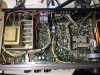
I know this is for 3020 but I assume I can upgrade my 7020 those 4 2200/35 with 3300/50 as well? Mine looks bad but still sing nice though.
Going to reply to your thread you started on this receiver.