• Please note that Audiokarma will be offline briefly for updates early on Monday morning, September 28th.

NAD 3020 Rebuild and Upgrade

D701 can be replaced with a 1N4148 as it's just a signal diode. It's actually part of the soft clipping circuit, which I have never ever used. If it's an amp that I was going to use myself, I would pull all these components : C701 to C706, D701 to D704, R701 to R712.

The brown stuff on the caps is glue. Clean it off the board with acetone.

Thanks, I've replaced those caps, and I will R&R D701-704 now that I know the part. Funny, my neighbor came over to see what I was up to, and we went over the schematic. He figured out it was the soft clipping circuit (voltage limiter) and explained to me how it worked. I guess I have a good resource. It only cost me 1 beer.

Hadn't thought of the resistors, but I may as well. The first thing I noticed on the board was R643 and R644 burned out. I figured that was a symptom, not a cause but those have been replaced. I am concerned about the small mylar caps at C611 and C612 as they were up against those resistors and the green covering looks a little burned. The amp would blow both 4A fuses when turned on, but the preamp still worked. I found three bad caps on the right channel side, and on the left, Q615 2N3055 tested as a resistor and C615 was a failure/unknown on the tester, as well as the naked diode situation. Tested all the right-side transistors and they seem fine but have yet to check the remaining left channel transistors. Some are not the same as listed in the service manual I have.

That glue is everywhere. Luckily I have some handy acetone.
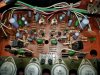
20230131_204752-resize.jpg
 
Another question: While recapping what I think is the small board with the 9XX parts (Power for preamp?) I was flipping the board a bunch to R&R caps. I noticed this white that is part of the bundle going to the board with a free end. I think I found where it goes, but was wondering if anyone knows for sure. I found a hole in the points for the 2Amp fuses that it seems to fit. Can't really confirm, but I found this ghost mark in the service manual that looks sot of correct. Before I solder it in and blow everything up, I welcome opinions on correct placement.

Screenshot 2023-02-26 181212.jpg


20230226_175820-marked.jpg
 
OK, I figured it out from some photos @leesonic posted. Putting this wire on the power board is totally wrong. There are insert points labeled "Y" that have one end in the right channel positive speaker output after the inductor, and the other end on the board in front of cap C616. This is not on the schematic, and I have no idea what it does. But, with that settled I can finish this up and test it out. I did power it up with a dim bulb tester and all went fine. I plugged it in separately and let it warm up to set the idle and offset. I have a 1980 build unit that calls for 0.22 resistors in R653 and R654 spots. I used 2k trimmers for Rx1 and Rx2. There were 1k resistors in those spots and I wanted some flexibility. I was able to adjust to 10.5 mA fairly easily but couldn't quite match up 11, and my OCD wouldn't let me leave it at 10.8 and 11.3, so I went with a 10.5 on each which I could easily match for some reason. This will also keep @leesonic as the king at 11. I also had to replace VR5 and VR6. I desoldered them to clean them up and they disintegrated. They measured around 700 ohms between outside and middle leads on the board and the inside middle ends were common. I also used 2K trimmers there and it was easy to get the DC offset to 0mV. I am a little concerned that I used 1/4- watt trimmers. They look pretty delicate in there and I don't know it they should be beefier. I guess I will find out unless someone else has advice.
20230307_232539.jpg 20230307_234917.jpg
 
You mean four 2200uF 35V? Upgrade them with 3300uF 50V caps. Something reputable like Nichicon KW or FWs, or anything you can get that is low leakage. Mouser only shows 16 different caps in stock at the moment for this value and voltage.
Reviving this to see if it comes back to life. Why would this be beneficial?
 
Reviving this to see if it comes back to life. Why would this be beneficial?
My understanding, (since this has gone a while without answer, I'll chime in....)
is that these old 3020's are quite sensitive to input voltage ripple and installing a higher capacitance ensures the filter cap side of the circuit does a decent job of feeding clean power to the rails and preamp circuits etc. The higher voltage rating is a smart move, adding in some headroom means the caps never get too stressed and in theory should last longer, Not sure what the grid is like where you are but here in NZ its all over the place, brownouts, spikes, full on surges.... very bad for audio gear and sensitive electronics so upgraded filter caps is a damn good idea in my opinion at a minimum on most power supplies where increased capacitance isn't going to upset anything, there was at least one exception I discovered last year where a supply had some sensitive input monitoring and feedback circuits and upgrading filter caps to prevent it randomly going into protect meant the supply went into a hard protect mode, that was a large cutting laser driver supply which almost caused a coronary as I thought I had cooked it, live and learn, backed the caps off to the original rating and she went back to the usual semi behavioral state.
I learned that day.
I also concluded a while back to have UPS backup/power smoothing systems on every expensive appliance due to several large industrial plant frequently starting up down the road and blowing my hot sides on every supply in just about every appliance. I don't know what the heck would be going wrong with their gear to cause a local grid voltage increase let alone ones of such violent nature but I'm hoping you have a better mains line and neighbors than I do. :rflmao:
 
My understanding, (since this has gone a while without answer, I'll chime in....)
is that these old 3020's are quite sensitive to input voltage ripple and installing a higher capacitance ensures the filter cap side of the circuit does a decent job of feeding clean power to the rails and preamp circuits etc. The higher voltage rating is a smart move, adding in some headroom means the caps never get too stressed and in theory should last longer, Not sure what the grid is like where you are but here in NZ its all over the place, brownouts, spikes, full on surges.... very bad for audio gear and sensitive electronics so upgraded filter caps is a damn good idea in my opinion at a minimum on most power supplies where increased capacitance isn't going to upset anything, there was at least one exception I discovered last year where a supply had some sensitive input monitoring and feedback circuits and upgrading filter caps to prevent it randomly going into protect meant the supply went into a hard protect mode, that was a large cutting laser driver supply which almost caused a coronary as I thought I had cooked it, live and learn, backed the caps off to the original rating and she went back to the usual semi behavioral state.
I learned that day.
I also concluded a while back to have UPS backup/power smoothing systems on every expensive appliance due to several large industrial plant frequently starting up down the road and blowing my hot sides on every supply in just about every appliance. I don't know what the heck would be going wrong with their gear to cause a local grid voltage increase let alone ones of such violent nature but I'm hoping you have a better mains line and neighbors than I do. :rflmao:
Thank for the input. We have pretty stable power here, including a "peaker" power plant down the road that occasionally kicks in during the hot summer months. But given that my original 3020 fried when pushing it, upping the caps in that restoration and the 7020's I'm working on for voltage and/or capacitance might be a good idea. I've now done both 2200/50 and 3300/50. Spec is 2200/35. They sound darn good, but I haven't heard anything noticeable between the two versions. 2200/50's are a lot cheaper though. I run a research lab, and that building is chronically under-voltage and has power issues. Everything valuable there has a UPS on it after some hard and expensive lessons.
 
Back
Top Bottom