• The move to the new server is done. There are some software and database maintenance updates in process. This has us passing the hat around to help out. We appreciate any donations. Seriously, even a dollar helps. The payment page may be found here - https://www.audiokarma.org/support.html

Nakamichi 480 power supply issue (control cam)

gnexus

Active Member
I bought another cheapo 480 for parts. But it was completely unmolested and turned out to be much better than mine. :) This 480 does have a minor power supply issue however:

The control cam oscillates very rapidly upon power on. It does not really change position at first. Just wiggles very rapidly. Then, as the power supply settles, it gets slightly out of correct position. Then that takes a power cycle or two to get it to the correct stop position. The control cam is correctly calibrated. It's fine and perfectly calibrated after the P/S stabilizes. Haven't yet checked voltages or anything else. Otherwise it works perfect. The control cam is spot on after a several minute warm up period...

But it's an annoying issue! It's also probably not good for the motor or electronics. I haven't yet investigated the issue further. I currently need that deck to finish testing old tapes. I also must continue working on the other two Naks.

What could be the cause?

Thanks for any ideas on what to check first.
 
Register to hide this ad
Then, as the power supply settles, it gets slightly out of correct position.
The power supply should settle almost immediately. I don't know what you mean by the above comment.
First check the main 24V power to make sure that it is stable.
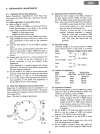
  • Check C405 3300uF cap and C404 2200uF cap to make sure they are good.
  • Check the output of the voltage regulator IC401 pin 2 to make sure it is 24VDC.
1788822199394.png
Did you do this?
1788823066300.png
1788823103451.png
 
Last edited:
The power supply should settle almost immediately. I don't know what you mean by the above comment.
This one certainly doesn't! :(

"Should" is the proper term...

Thanks for your input. Those were also my first suspects. I'd also suspect a big cap as it takes quite long to settle.

But, wow! This 480 just sounds really fantastic! Even with 46 year old tapes! My 46 year old "Heart - Dreamboat Annie" tape still sounds significantly better than a downloaded "audiophile" FLAC of same LP supposedly recorded from a Linn turntable!

This deck works perfect once the P/S settles! Hate to even touch it anymore...

Question:
Does the control cam logic use 24V or 12V?
I haven't looked yet. But if it's 12V it couldn't it also be the RC4558 or related caps?
 
Last edited:
Another thing on this 480 that's probably power supply related is that the PLAY button lamp randomly doesn't illuminate.

At first thought the new bulb just replaced burned out again! But then it reappeared! Then disappeared!
 
I bought another cheapo 480 for parts. But it was completely unmolested and turned out to be much better than mine. :) This 480 does have a minor power supply issue however:

The control cam oscillates very rapidly upon power on. It does not really change position at first. Just wiggles very rapidly. Then, as the power supply settles, it gets slightly out of correct position. Then that takes a power cycle or two to get it to the correct stop position. The control cam is correctly calibrated. It's fine and perfectly calibrated after the P/S stabilizes. Haven't yet checked voltages or anything else. Otherwise it works perfect. The control cam is spot on after a several minute warm up period...

But it's an annoying issue! It's also probably not good for the motor or electronics. I haven't yet investigated the issue further. I currently need that deck to finish testing old tapes. I also must continue working on the other two Naks.

What could be the cause?

Thanks for any ideas on what to check first.
A bad filter cap allowing the motor to see AC . . .
 
A bad filter cap allowing the motor to see AC . . .
Actually just found that the two big filter caps are showing slightly higher capacitance (in circuit) than their rating. So it's doubtful they're causing the issue. But then again that's with the power on for several hours. May be different once power is gone for a while...

Probably should have checked voltages at the same time. But hey, the power was off and I was too tired to press the switch! ;)
 
Last edited:
Just looked at the schematic and the RC4558 IC is connected, in a way, to the play lamp. So it actually seems a more likely culprit. But then you'd think that it would also affect the other motors like capstan, and it doesn't...

Might then be two separate issues...
(Might even be intermittent open in my wiring for new play lamp! (VERY doubtful!) ;)

Anyway, it works well enough after some coaxing, and who really needs a play lamp shining (too) brightly ;)
 
A bad filter cap allowing the motor to see AC . . .
Yep!!
It's definitely the big caps causing the control cam issue!

Checked the voltage at the voltage regulator this morning right when turning it on. The input was fluctuating like AC. That's after the rectifier. The control cam was happy once the voltage settled. The regulator output is correct.

It took much less time this morning for the voltage to recover. It was only a second or two with no need to power cycle to reset the cam. So it seems the caps are slowly regenerating after years of non-usage. Obviously they still should be replaced. But no rush...

The play lamp thing is a different story. Strange issue! Can't remember if it was on or off this morning. But otherwise this 480 works fine and sounds absolutely fantastic! Better than CD even with 40+ year old tapes!
 
The control cam issue is getting better all the time as the big capacitors get reconditioned from usage. :)

But the weird play lamp thing is still there... :(
Play lamp is also quite dim compared to the others, at least when it's working...
 
Last edited:
Actually just found that the two big filter caps are showing slightly higher capacitance (in circuit) than their rating. So it's doubtful they're causing the issue. But then again that's with the power on for several hours. May be different once power is gone for a while...

Probably should have checked voltages at the same time. But hey, the power was off and I was too tired to press the switch! ;)
Reading higher on cheapo meters is a sign of failure of the cap. Unlike a more proper bridge tester, they measure charge time, and massive leakage slows that down, making the cap look like it went up in value, when all it really did was $h1t the bed . . .
 
Reading higher on cheapo meters is a sign of failure of the cap. Unlike a more proper bridge tester, they measure charge time, and massive leakage slows that down, making the cap look like it went up in value, when all it really did was $h1t the bed . . .
Thanks very much for that information! :)

Unfortunately all I currently have is cheapo test equipment. All the good tools were on lower level of storage container and were destroyed in the flood.

Thought the 480 had survived... False hope... But at least not totally destroyed like many other things. :)
 
Thanks very much for that information! :)

Unfortunately all I currently have is cheapo test equipment. All the good tools were on lower level of storage container and were destroyed in the flood.

Thought the 480 had survived... False hope... But at least not totally destroyed like many other things. :)
Don't get me wrong . . . they mostly work, just most testers these days don't check leakage. It's kinda like measureing how big a bucket is by timing a controlled fill rate takes to fill it . . . and the bucket has a hole in it . . . The key is to recognize that it's pretty much impossiblr for capacitance to go up with aging, and interpret that change accordingly.
 
Decided to just swap the power caps with ones from other deck. The old ones both had signs on the bottom that the electrolyte had leaked out.

These very old larger caps are all now all discontinued. Only smaller ones with a shorter lead spacing are available. So must splay the leads. Won't look as correct. But at least will work much better.
 
These very old larger caps are all now all discontinued. Only smaller ones with a shorter lead spacing are available.
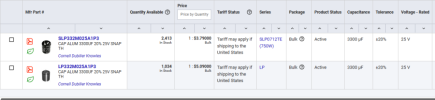
What lead spacing do you need? Looks like about 10mm lead spacing.
C405 3300uF/25V​
C404 2200uF/50V​
Digikey has these in stock 10mm lead spacing.

1789074721672.png

1789075229161.png
 
Last edited:
C405 3300uF/25V has ~10mm lead spacing
C404 2200uF/50V has ~12mm lead spacing

The ones you show are "snap in" without long leads. I saw those yesterday on DigiKey but didn't think snap in leads would work. Will snap in leads work?

The snap in leads, if possible to use, are so short they would need to be exact. Don't think those will fit exactly...

I almost ordered the ones with 7mm leads then from DigiKey. I know those will work by splaying the leads. But decided just to steal the ones from the old 480 for now as it already got its belts stolen.
 
The extra good news is that record + pause now works correctly without first muting the volume.

Hopefully the play lamp thing is just a bad wire on the bulb I replaced. The bulb itself is good. Difficult to see how it could be something other than wiring.
 
Why don't you measure the distance between holes on the PCB.
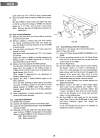
I just estimated the spacing by using the board drawing in the SM, measured the spacing from an 8-pin DIP component (lead spacing 0.1"), scaled the drawing and measured the distance between the PCB mounting holes for C405 and C404. I got just about 10mm.
 
Why don't you measure the distance between holes on the PCB.
That's what I did. But all I currently have is a tape measure and not a dial caliper. The holes lie between the tape divisions and are thus approximate.

Note there's also extra holes for both caps. Thus there are both 10mm and 12mm holes.

So will the 10mm snap-in's work?
 
Last edited:
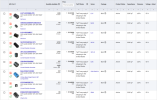
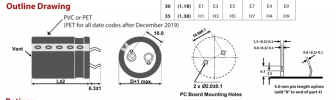
I think they should work OK. Here are the dimensions. (see drawing) Please double check.
  • 10mm lead spacing
  • 6.3mm lead length
  • PCB mounting holes 10mm with 2.0mm mounting holes

1789079341268.png
 
Back
Top Bottom