• The move to the new server is done. There are some software and database maintenance updates in process. This has us passing the hat around to help out. We appreciate any donations. Seriously, even a dollar helps. The payment page may be found here - https://www.audiokarma.org/support.html

Need Help in Choosing the Right Protractor for Cartridge Alignment for a Newbie

ThomasG73

New Member
Hi All:
Listen, I know this is a topic that has been beaten to death, and I have read much about the subject, but I would love an answer in very Simple terms, as I just cannot seem to find the answer to my question.
Ok, Ill explain. I have an AT-LP120XUSB TT. It came with the AT-VM95E. Cart was already pre-mounted on headshell. Used the online protractor that they suggested on their website to make sure everything lined up. All was perfect
Now, I am about to install another cartridge. This will be my first time. I ordered another AT cart on already mounted on the headshell. AT tech support told me that cart is set at 15.5mm overhang, and my TT required 16mm, so I am going to have to do some fiddling. My question is do different protractors use different overhangs???? This is where I always get confused. I am not worried about the terminology, cause to me it doesnt matter. MY main concern is getting the overhang correct. Ill show two examples of protractors, and that might help you answer the question easier.
OK. Here is protractor 1 This is the one that AT has on their site for my turntable. I believe it is a Stevenson. Here is the link : 0406_2904_00_cartridge_headshell_alignment_sheet.pdf (audio-technica.com)
Here is Protractor 2. This is a custom protractor made for my and other model AT TT's. As you can see it has a 16mm overhang. Amazon.com: Tracking Wizard Tonearm Cartridge Alignment Protractor Compatible with Audio-Technica AT-LP120 & AT-LP140 Turntables : Electronics
SO after all this, do different protractors have different overhangs (as I know there are others, Baldwin, Universal) or is it once you line your stylus tip on the dot, does that automatically set your overhang correctly.??? Im not so worried about the math, the numbers, I just want to make sure I am going to get my overhang correct. BTW, I hear the Stevenson is always a good one for S-Tone Arms like mine. Any info would be great
 
Last edited:
Register to hide this ad
Stylus overhang depends on the length of the tonearm and the length of the headshell whereas stylus location on the record is determined by the distance from the tonearm pivot point to the stylus. I think you should use a protractor that is not specific to the turntable. Then the stylus is located correctly no matter which tonearm/headshell/cartridge combination you use. Which protractor to use has long been a matter of discussion as there are several methods of locating the correct placement.
 
I would assume an Arc Type would be the more accurate protractor. That sight-line/universal types are sort of a "one fits all", there's a chance of mis-interpretation/sighting error, and null geometry might not be optimal.

I have seen these Arc protractors you link to, and are commonly sold by overseas sellers. Commonly about $30.

I imagine you could first try the original Protractor you first used, and see what results you get?
 
Overhang is an outcome. Different alignments result in different overhangs.

Some TT manufacturers provided overhang jigs as an easier way of cartridge alignment; in this case, you end up with the alignment preferred by the manufacturer.

Ac protractor are indeed easier to use, but are specific to tonearm mounting distance.
 
Last edited:
If you are trying to visualize overhang, image your tone arm swung over to where the cart sits right on the spindle. (Not all tone arms allow such) If the tip of the stylus sat right in the middle of the spindle, that’s 0mm overhang. Common overhangs are typically in the 12~16mm range. Stevenson is a lower number, Baerwald typically a couple mm’s more. So that means the stylus will now sit that amount past the center of the spindle.

Alignment is if you look at the cart from directly overhead, is it parallel to the headshell, or angled in towards the spindle.

Once you have those two things visualized, it makes it easier to know just what a protractor is doing.

Myself, I use the Feickert tool because it will be able to set Stevenson or Baerwald overhang precisely on any arm due to the way that tool is designed.

YMMV
 
I imagine you could first try the original Protractor you first used, and see what results you get?
Yes, I already have the protractor printed out from the AT website. Even made easier to use. Got the paper I printed on completely flat, trimmed the spindle hole, cut off the excess paper, and taped it to a crappy old record. Worked like a charm with my current cart. Only used to to make sure that AT it lined up correctly, as it was the cart that came with my TT. It was dead on. And, I am very happy with the alignment. No inner groove distortion, it sounds good. I ordered another AT cart (AT-XP3) already on the headshell, as AT said, it is factory set at 15.5mm. Ill use the same protractor and hopefully I can get it aligned without too much effort. From reading, I heard the hardest is getting the inner point to match with outer.
 
Out of curiosity, Can I use the same protractor for a 12" arm as I used for a 9" arm? If not, what do I use - it's for an SME 312s on my Clearaudio Innovation. For my SME V on my Delphi I use the Oracle protractor.
 
If you are trying to visualize overhang, image your tone arm swung over to where the cart sits right on the spindle. (Not all tone arms allow such) If the tip of the stylus sat right in the middle of the spindle, that’s 0mm overhang. Common overhangs are typically in the 12~16mm range. Stevenson is a lower number, Baerwald typically a couple mm’s more. So that means the stylus will now sit that amount past the center of the spindle.
THANKS! That is the best description of overhang that I have ever read! I get it now! To be honest with you, I am very happy with the results using the protractor that AT has on their site for my TT (no inner-groove distortion, cart sounds fantastic) Even though the cart came pre-aligned, many ATLP120 users said to check it anyway, just to make sure its correct. Mine was lined up dead on, so I didnt have to do any adjusting. Since this will be another AT cart (AT-XP3) I am going to use the same protractor, even though it seems from what I have read that using different protractors usually have nothing to do with the cart, but for the type of tonearm they have. I just wish that the AT TT didnt use the 16mm overhang, as this table is a 1200 clone and the Technics 1200s are 15mm. There has been lots of talk about using an overhang gauge also. I was wondering just for the heck of it, wouldnt it be the easiest to set up a cart with both an overhang gauge, and then use the protractor. I guess the overhang gauge could get you right in the ballpark, and then might take less messing around, as once the cart looks like its pretty close on the overhang gauge, you could now use the protractor to see if you are dead on, or need to make a minor adjustment. They dont make a gauge for my TT. I would have to order a custom Pioneer one on EBAY (they are set at 15.5) and then measure out another .5mm, and draw a line, or I could use a Technics gauge (15mm) and measure out another mm).. They are only about 10 bucks, so I might get one, just to see if it makes set up even easier
 
Out of curiosity, Can I use the same protractor for a 12" arm as I used for a 9" arm? If not, what do I use - it's for an SME 312s on my Clearaudio Innovation. For my SME V on my Delphi I use the Oracle protractor.

2 point protractor, yes. Arc protractor, no.
 
If you are trying to visualize overhang, image your tone arm swung over to where the cart sits right on the spindle. (Not all tone arms allow such) If the tip of the stylus sat right in the middle of the spindle, that’s 0mm overhang. Common overhangs are typically in the 12~16mm range. Stevenson is a lower number, Baerwald typically a couple mm’s more. So that means the stylus will now sit that amount past the center of the spindle.
THANKS! That is the best description of overhang that I have ever read! I get it now! To be honest with you, I am very happy with the results using the protractor that AT has on their site for my TT (no inner-groove distortion, cart sounds fantastic) Even though the cart came pre-aligned, many ATLP120 users said to check it anyway, just to make sure its correct. Mine was lined up dead on, so I didnt have to do any adjusting. Since this will be another AT cart (AT-XP3) I am going to use the same protractor, even though it seems from what I have read that using different protractors usually have nothing to do with the cart, but for the type of tonearm they have. I just wish that the AT TT didnt use the 16mm overhang, as this table is a 1200 clone and the Technics 1200s are 15mm. There has been lots of talk about using an overhang gauge also. I was wondering just for the heck of it, wouldnt it be the easiest to set up a cart with both an overhang gauge, and then use the protractor. I guess the overhang gauge could get you right in the ballpark, and then might take less messing around, as once the cart looks like its pretty close on the overhang gauge, you could now use the protractor to see if you are dead on, or need to make a minor adjustment. They dont make a gauge for my TT. I would have to order a custom Pioneer one on EBAY (they are set at 15.5) and then measure out another .5mm, and draw a line, or I could use a Technics gauge (15mm) and measure out another mm).. They are only about 10 bucks, so I might get one, just to see if it makes set up even easier

You cannot use both a protractor and a gauge. Again, overhang is an outcome of a particular alignment.

They will provide exactly the same overhang only if the gauge was designed to produce the same alignment as the protractor.

The Technics and Pioneer gauges each produce slight variations of the Stevenson alignment, when used with any tonearm of the same mounting distance.
 
Last edited:
You cannot use both a protractor and a gauge. Again, overhang is an outcome of a particular alignment.
They will provide exactly the same overhang only if the gauge was designed to produce the same alignment as the protractor.
The Technics and Pioneer gauges produce slight variations of the Stevenson alignment
.
Thanks, I understand!! Actually, I think I read that somewhere to use either one (Gauge) or the other (Protractor) but not both (as u said). It seems best just to use the AT Protractor that is available on their website. They probably have it designed for 16mm overhang for the outcome once stylus is sitting on the dot (I might just measure for poops and giggles) Anyway Love the way the current cart sounds, and no inner-groove distortion. I think sometimes people really get hung-up on this (as I did, lol) because it can be a bit over-whelming if you over-think it. It crazy to see some of these online protractors have custom settings, so pretty much set up a cart to your turntables specs, or fool around with it, and see if you can find a sweet spot. If I am satisfied with the way the cart is already aligned, hopefully on my new one, I will be able to get it set up correctly without banging my head against the wall. THANKS AGAIN for your info. With the hundreds of forums I read on this, this if the first time that I got an explanation that makes sense. Maybe you need to start your own forum or post YouTube videos for newbies or beginners to the "setting up the cartridge" world. Yes, there are videos on youtube, but overhang is rarely mentioned, just showing how to get your cart lined up correctly in the lines.
 
Thx, but I am far from an expert on the subject. There are many here at AK, and on Vinylengine who know MUCH more than me.
 
There are many here at AK, and on Vinylengine who know MUCH more than me.
That might be true, but at least you described everything in easy terminology. I've done some extensive reading on aligning carts, sometimes people have too much knowledge. LOL. People ask simple questions, as myself, and get answers that are complicated and confusing, or some people just get out of control with the matter. Aligning a cart shouldn't be rocket science, but some perceive it as that. Yes, I got a bit of OCD, so I always wanna make sure that I am doing things to make sure I get the most out of my TT and cart, even if it isnt an audiophile table or cart. I think I was just more curious of why there are so many different ways to align your cart, and why overhang is stressed to be so important. Ya know, I bet you that on my system, if I just pulled the new cart out of the box, slapped it on, and set the VTF without aligning it, it might still sound pretty good. Its factory set at 15.5mm, so would .5mm make a difference. It might, might not. Not really sure how much error is allowed. Might just depend on the equipment used. But I will just stick to what works, the nice printable protractor from AT. I hear no inner groove distortion with it, so IMO that is just fine. Happy Friday, and have a great weekend
 
I made my explanation overly simplistic. You can get Barewald overhang by using just an alignment gauge, but it may take a while of sliding the cart back and forth until you get it aligned at both points. That’s where an arc protractor has an advantage.

For me, the Feickert was a great beginners tool. I never had to slide the cart back or forth more than 1/2 a mm when doing the aligning step, but I will probably sell it.

The below gauge easily tells you if you need more or less overhang depending on what the cart looks like at the inner position. Once you get proficient, you will remember those orientations and know which direction to slide it in the future.

5C6F83AE-8634-467A-8BD5-6E01C210FF4F.jpeg
 
Out of curiosity, Can I use the same protractor for a 12" arm as I used for a 9" arm? If not, what do I use - it's for an SME 312s on my Clearaudio Innovation. For my SME V on my Delphi I use the Oracle protractor.

Yes, the Oracle protractor should work for all of your tonearms – it’s a universal alignment protractor that can be used for any tonearm to apply one of the three different two-point alignment methods they provide on the protractor. Arm length is irrelevant.
 
(...) as I just cannot seem to find the answer to my question.

I'd suggest you to register over on VinylEngine, in case you haven't yet, and play around a bit with JaS' pretty neat alignment calculator, which you can find in the "tools" section of VE. In my view that's a very nice tool, which can provide quite a good bit of insight - like for example, that there isn't just one Baerwald/Loefgren A, Loefgren B and Stevenson alignment each, but basically an unlimited number, depending on the playback area (i.e. the particular outer and inner plaback radii) one calculates these alignment ansatzes (or actually Ansätze, as Ansatz is a German word...) for.

Another nice thing about JaS' calculator: VE's tonearm database is linked to it. I.e., in case of turntables/tonearms with sufficient parameters (offset angle as well as two of those three: overhang, effective length and mounting aka pivot-to-spindle distance) the resulting null points of the original manufacturer alignment are not only listed, but also serve as a link to the calculator with already entered parameters, so that the original manufacturer alignment can easily be compared to the three standard alignments.

Wheras comparing alignments for different playback areas isn't quite as easy or respectively convenient - because the calculator can only calculate for one particular outer and inner radius at a time. So if you'd like to compare for example Loefgren B and Stevenson calculated for the playback area according to RIAA to the one calculated for DIN, you'd need to calculate for one of the two first, then enter the resulting parameters as "custom" parameters, and then calculate for the other. And the calculated tracking error angles and distortion values as well as the corresponding graphs (which are only visible to users, that are logged in) always refer to the playback area, that the calculation has been done for. Hence, back to our example, entering the other parameters as custom parameter as well would be necessary, if you easily want to switch back and forth or even want check, how well each two alignments would fare in case of a particular non-standard playback area.

And of course the custom parameter option also makes it possible to simulate the consequences of a not so precise alignment.

Greetings from Munich!

Manfred / lini
 
I made my explanation overly simplistic. You can get Barewald overhang by using just an alignment gauge, but it may take a while of sliding the cart back and forth until you get it aligned at both points. That’s where an arc protractor has an advantage.

For me, the Feickert was a great beginners tool. I never had to slide the cart back or forth more than 1/2 a mm when doing the aligning step, but I will probably sell it.

The below gauge easily tells you if you need more or less overhang depending on what the cart looks like at the inner position. Once you get proficient, you will remember those orientations and know which direction to slide it in the future.

View attachment 2418056

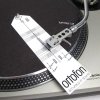
This is the same protractor I'm using, very simple to use. With this protractor I can have a cartridge aligned within a couple of minutes.
ortofon-stylusprotractor-tt1_grande.jpg

Not a fan of printing a free one with the chance the printed version might not be exactly to scale. What are you saving, $7 lol.
 
The Technics and Pioneer gauges each produce slight variations of the Stevenson alignment, when used with any tonearm of the same mounting distance.

The gauge only sets the position in the headshell. How this relates to the overhang and offset angle depends on the tonearm design. Some early Technics turntables use the same effective length and overhang dimensions as current Technics models, but the offset angle is different, resulting in a very different alignment.
The headshell tail to stylus tip distance is also the same, so the same gauge can be used..

I would have to order a custom Pioneer one on EBAY (they are set at 15.5) and then measure out another .5mm, and draw a line, or I could use a Technics gauge (15mm) and measure out another mm).. They are only about 10 bucks, so I might get one, just to see if it makes set up even easier

The Technics will result in 15mm overhang on turntables which have a pivot to spindle distance that is 0.5mm longer. So the difference would probably be 0.5 mm and not 1 mm.

Not a fan of printing a free one with the chance the printed version might not be exactly to scale. What are you saving, $7 lol.

Easy fix: just print it to scale. :)
It's probably not all that critical for a 2 point protractor as the null points just shift a little. For arc protractors it's very important, though.

If you're going for a particular alignment geometry, there isn't much choice out there. Most protractors seem to be designed for Baerwald with an IEC groove area. If for some reason you want a different alignment, I guess you're better off printing your own.
 
The gauge only sets the position in the headshell. How this relates to the overhang and offset angle depends on the tonearm design. Some early Technics turntables use the same effective length and overhang dimensions as current Technics models, but the offset angle is different, resulting in a very different alignment.
The headshell tail to stylus tip distance is also the same, so the same gauge can be used..


The Technics will result in 15mm overhang on turntables which have a pivot to spindle distance that is 0.5mm longer. So the difference would probably be 0.5 mm and not 1 mm.


Easy fix: just print it to scale. :)
It's probably not all that critical for a 2 point protractor as the null points just shift a little. For arc protractors it's very important, though.

If you're going for a particular alignment geometry, there isn't much choice out there. Most protractors seem to be designed for Baerwald with an IEC groove area. If for some reason you want a different alignment, I guess you're better off printing your own.

and you know it's accurately to scale how?:dunno:

If you're (you're in general terms) such a cheapskate that a few dollars for a proper alignment protractor is too much then your using the wrong music medium.
 
Back
Top Bottom