• The move to the new server is done. There are some software and database maintenance updates in process. This has us passing the hat around to help out. We appreciate any donations. Seriously, even a dollar helps. The payment page may be found here - https://www.audiokarma.org/support.html

Need help repairing HK 330C

cesmith5600

Active Member
HI Everyone,

I am new to this group and new to the world of vintage audio upgrade and repair. Not an EE but strong technical background in other disciplines so I can usually figure things out with some reading and support. I have gotten reasonably comfortable with speaker crossover upgrades and recently did my first stereo receiver repair, an HK 330i where I fixed a left/right channel volume and noise issue. I have desoldering and soldering tools, oscilliscope, multimeters, tone generators, ESR meters, etc and not afraid to screw up!!

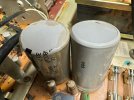
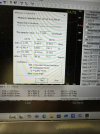
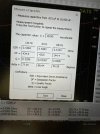
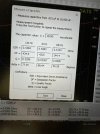
So, I purchased an HK 330C (HK fan) that was advertised as powers up with lights but no sound as a new project. On initial inspection, speakers fuses were good but the 4 A 250V fuses on the rectifier board were blown. The 3A 250 was fine. There were no disconnected wires or shorted wires or cracks in the board traces that I could see and the unit did powerup with all lights. Both main caps do have a slight bulge on the top of them but not nearly as bad as pics I have seem on the net. So, I replaced the 4A 250V fuses and when I hit the power button they blew instantly. Not, a few seconds later but simultaneously with hitting the power switch. The only thing I have checked so far is the on board capacitance and ESR of the main caps. The values are in the attached pics.

My simple questions are 1) Are the on board measured ESRs high, 2) do I need to remove the caps for a more accurate ESR reading, 3) could this be the reason behind the blown fuses and 4) to remove these caps to I desolder directly through the board pads?

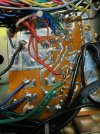
I plan to do a full recap/restore as has been posted previously on the HK330C but want to sort the blown fuse issue first. Thanks in advance for any help on this. Pics attached of the main caps. the underside of the rectifier board and the on board ESR readings across the main caps.
 

Attachments

  • HK330C_1.jpeg
    HK330C_1.jpeg
    85.4 KB · Views: 35
  • HK330C_2.jpeg
    HK330C_2.jpeg
    65.7 KB · Views: 32
  • HK330C_3.jpeg
    HK330C_3.jpeg
    97.2 KB · Views: 35
  • HK330C_4.jpeg
    HK330C_4.jpeg
    75.4 KB · Views: 35
  • HK330C_5.jpeg
    HK330C_5.jpeg
    68.5 KB · Views: 34
Register to hide this ad
Blowing the fuses instantly points to a major short. Check the output transistors. They are probably your prime suspects for a short from rail to ground. Unfortunately, when they short, they often take other components with them so they may not be your only problem. I didn't see you mention having a dim-bulb tester. You really need one for troubleshooting this.
 
I agree with Brian regarding the output transitors and I'll add that you should fix it before doing any so called upgrade of anything
Blowing the fuses instantly points to a major short. Check the output transistors. They are probably your prime suspects for a short from rail to ground. Unfortunately, when they short, they often take other components with them so they may not be your only problem. I didn't see you mention having a dim-bulb tester. You really need one for troubleshooting this.
Thank you both for your insights. I'll pull these tomorrow, test them and let you no what I find. Any recommendations on a dim bulb tester?
I agree with Brian regarding the output transitors and I'll add that you should fix it before doing any so called upgrading of anything.
 
There are a million how-to's for building a dim bulb tester - you can just google "diy dim bulb tester" You can make one from an extension cord, lightbulb socket, and an incandescent bulb pretty quick and easy. Finding an incandescent bulb might be the hardest part these days. A 40 watt bulb would be good for what you're doing. If you're not familiar with how to use it, you'll want to read up a bit on that too. All it's doing is limiting the current that can get to the receiver so if you have a short, hopefully you won't keep blowing up components (and fuses).
 
Last edited:
Looked at the schematic and the 4A fuses are between the transformer and rectifier diodes. I would also check the four of them for a shorted one. Had an old Sansui 800 that had a shorted rectifier diode it would blow the main fuse pretty much the instant the power button was pushed. Receiver never lit up just could hear the pop in back as the power button was pushed, a fuse in that situation is usually not quiet.

Would still check the outputs some failures can damage multiple components. The power going to the output transistors will be passing through the rectifier diodes and filter caps.

It is a nice sounding little unit when fixed. The one I got was sold as no sound a good control cleaning fixed it and needed a few new bulbs.
 
Looked at the schematic and the 4A fuses are between the transformer and rectifier diodes. I would also check the four of them for a shorted one. Had an old Sansui 800 that had a shorted rectifier diode it would blow the main fuse pretty much the instant the power button was pushed. Receiver never lit up just could hear the pop in back as the power button was pushed, a fuse in that situation is usually not quiet.

Would still check the outputs some failures can damage multiple components. The power going to the output transistors will be passing through the rectifier diodes and filter caps.

It is a nice sounding little unit when fixed. The one I got was sold as no sound a good control cleaning fixed it and needed a few new bulbs.
Thank you
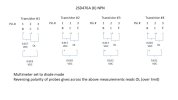
I pulled the the 4 output transistors and tested them with a multimeter in diode mode as suggested by Brian and Luxman. The transistors are 2SD476 K6 NPN. The results are in the attached file. These look functional to me but would like confirmation. Are the on board ESR measurements I took of the filter caps indicative of these components being shot? Files also attached. If, so, I would go there before the rectifier diodes.
 

Attachments

  • 330C OPT Readings copy.jpg
    330C OPT Readings copy.jpg
    37.2 KB · Views: 15
  • HK330C_4.jpeg
    HK330C_4.jpeg
    75.4 KB · Views: 15
  • HK330C_5.jpeg
    HK330C_5.jpeg
    68.5 KB · Views: 15
There are a million how-to's for building a dim bulb tester - you can just google "diy dim bulb tester" You can make one from an extension cord, lightbulb socket, and an incandescent bulb pretty quick and easy. Finding an incandescent bulb might be the hardest part these days. A 40 watt bulb would be good for what you're doing. If you're not familiar with how to use it, you'll want to read up a bit on that too. All it's doing is limiting the current that can get to the receiver so if you have a short, hopefully you won't keep blowing up components (and fuses).
Thank you. Looks straight forward. Luckily, I have a few incandescent bubs stashed away in the basement. I am definitely going to need this!!
 
Looks like your output transistors are not shorted. I wouldn't worry about high ESR caps yet. You're still looking for a hard short. Check the rectifier diodes next. If they check ok, replace the blown fuse and plug it into the dim bulb tester and see if the bulb is bright or acts normally (short flash and then dim)
 
Looks like your output transistors are not shorted. I wouldn't worry about high ESR caps yet. You're still looking for a hard short. Check the rectifier diodes next. If they check ok, replace the blown fuse and plug it into the dim bulb tester and see if the bulb is bright or acts normally (short flash and then dim)
I checked the following Diodes on the power board in opposite polarities

D4 forward .581 VDC, reverse 2.992 VDC
D5 forward .588 VDC, reverse 2.986 VDC
D6 forward .727 VDC, reverse 2.57 VDC
D601 forward .580 VDC. reverse OL
D602 forward .588, reverse OL

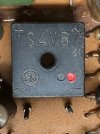
D1 Rectifier Bride Diode, forward 2.766, reverse -OL Nor sure I measured this right. I measured across the +/- as indicated on the top of the diode (pic attached)

Are D4, D5 and D6 good or bad? Shouldn't reverse read OL. Heading to a hardware store to get components for a Dim Bulb tester
 

Attachments

  • Rectifier bridge.jpg
    Rectifier bridge.jpg
    62.5 KB · Views: 4
If you're checking those diodes in-circuit, they may be ok. The voltage is probably finding a path around them. The rectifier is the one to look at right now. With a rectifier like that, it's a little tough to check, especially in-circuit but it doesn't appear shorted. I think you're ok to move on to replacing the fuse and checking it on a dim-bulb - about 40 watts and don't leave it on too long if the bulb stays bright.
 
These were tested in circuit. I’ll get the DBT assembled and let you know what happens. I may pull D4/D5 (easy to do) just to make sure.
 
I have good news and bad news. Good news is that I pulled the questionable diodes and they tested good. The bad news is I dropped one and it bounced into the floor drain.

I found a replacement. Can I replace just one or should I replace all the equivalent diodes on the power board.
 
While you're troubleshooting, there's a good reason to leave good (or good enough) parts in place. It helps make sure you don't introduce a new problem. So I'd say just replace the one you need to for now, then maybe later if you want you could replace the rest. But I probably wouldn't without a reason like an imbalance between the channels or something like that.
 
While you're troubleshooting, there's a good reason to leave good (or good enough) parts in place. It helps make sure you don't introduce a new problem. So I'd say just replace the one you need to for now, then maybe later if you want you could replace the rest. But I probably wouldn't without a reason like an imbalance between the channels or something like that.
OK, I reinstalled the output transistors as well as the replacement diode and fired it up using the dim bulb tester. The unit came on without blowing a fuse. The light was not full but was still reasonably bright. I left the unit on for 10 sec or so and then shut it down. Where to from here?
 
If you look below my response, you will see "Similar threads", they are are good place to start, is just amazing to me the knowledge and experience of AKers!
 
Back
Top Bottom