• The move to the new server is done. There are some software and database maintenance updates in process. This has us passing the hat around to help out. We appreciate any donations. Seriously, even a dollar helps. The payment page may be found here - https://www.audiokarma.org/support.html

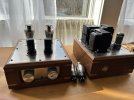
New 76/12J5 Line Stage Preamp Build

It might be that I got lucky with the 76’s. I did separate the power supply from the preamp- not sure if that is a factor. The issue that I’ve had is microphonics with 6sn7’s. I’ve changed out the 6sn7 for a pair of metal 6J5’s and that cured the problem.
 
It might be that I got lucky with the 76’s. I did separate the power supply from the preamp- not sure if that is a factor. The issue that I’ve had is microphonics with 6sn7’s. I’ve changed out the 6sn7 for a pair of metal 6J5’s and that cured the problem.
My power supply is separate as well, so not a factor. I’ll take a look at the 6SN7’s too as a possible culprit. Thanks for the response!
 
It might be that I got lucky with the 76’s. I did separate the power supply from the preamp- not sure if that is a factor. The issue that I’ve had is microphonics with 6sn7’s. I’ve changed out the 6sn7 for a pair of metal 6J5’s and that cured the problem.
 
I tried a pair of great looking coke bottle 6J5’ but they were also very microphonic. Too bad. When you get it sorted out, you’ll really like this preamp. It makes every amp I own sound better.
IMG_9304.jpeg
 
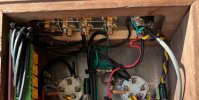
I just remembered a tip someone gave me on this preamp. I have a single bare copper ground bus running down the middle. The recommendation was to ground the most sensitive parts of the preamp at the front of the bus, and the noisiest stuff got soldered to the bus at the end of the line just before the ground enter entered the umbilical cord. That worked well for me. I hope this helps you too.
 
I just remembered a tip someone gave me on this preamp. I have a single bare copper ground bus running down the middle. The recommendation was to ground the most sensitive parts of the preamp at the front of the bus, and the noisiest stuff got soldered to the bus at the end of the line just before the ground enter entered the umbilical cord. That worked well for me. I hope this helps you too.
Thanks for this! I am sure my preamp doesn’t currently do this. Can you share a photo of what that looks like? Thanks!
 
The wad of green wires are the chassis grounds and the noisiest parts of the preamp getting on the bus before it goes into the umbilical cord. The most sensitive parts get on the bus at the bottom center of the second pic.
 

Attachments

  • bottom ground.jpg
    bottom ground.jpg
    89.8 KB · Views: 39
  • IMG_6226.jpg
    IMG_6226.jpg
    154 KB · Views: 40
The wad of green wires are the chassis grounds and the noisiest parts of the preamp getting on the bus before it goes into the umbilical cord. The most sensitive parts get on the bus at the bottom center of the second pic.
Thanks for the response. That doesn’t look familiar in comparison to my preamp. I’ll share with my builder and see if he thinks and additional tweaking needs to be done. I think the power in my house is partially to blame. I intend to take it to a friend’s house to see if I can replicate the same 240 hz buzzing. Thanks!
 
All, I have plans to the build the JE Labs RCA derived octal 6SL7/6SN7 RIAA phono stage followed by the Berman-inspired Type 76/6SN7 linestage. From the JE Labs blogspot, JE does do not recommend a cathode-follow (CF) output phono preamp with the Berman CF Type 76 linestage. However, what about the CF RIAA preamp with the updated Berman linestage employing a plate-to-line transformer instead of CF output? Any responses would be much appreciated.
 
updated Berman linestage employing a plate-to-line transformer instead of CF output?

A similar query was posted in my blog. But I forgot to address this particular question.

Back in the 90s, I built a 76 + Tango NP216N line stage preamp that was featured in my Sound Practices homebrewer article. Within the context of my hifi set up during that time (Altec 755A or Cs in open baffles), I favored Bruce Berman's 76 line stage sonically, which eventually evolved into my plate choke loaded 76 circuit.

If you want to try the 76 + line transformer, the Hashimoto HL20K6 has similar specs to the discontinued Tango NP216N.

DSC09707.jpeg

Recently, I revisited the transformer coupled line stage and used triode connected 6V6s or 6F6s + HL20K6s with Intact Audio nickel AVCs at the output for attenuation. With Altec 753Cs, it's a toss up between the plate choke loaded 76 vs. transformer coupled line stage.

Best if you build them, listen and decide what suits your musical taste.
 
Last edited:
JE, I really like the idea of the 6V6/HL20K6. I am proposing this as a starting point in my design. One point of confusion for me is this...I will be using this as a preamp in front of my SET amplifier that currently has an input impedance of 90k. This would result in a reflected impedance of much higher than 5K. I must be missing something. The use of a plate to line transformer is new to me.
 

Attachments

JE, I really like the idea of the 6V6/HL20K6. I am proposing this as a starting point in my design. One point of confusion for me is this...I will be using this as a preamp in front of my SET amplifier that currently has an input impedance of 90k. This would result in a reflected impedance of much higher than 5K. I must be missing something. The use of a plate to line transformer is new to me.
If you spent enough time in my blog and archive, you'll realize that my formal training is in classical music, not engineering. I learned tube/audio/DIY by reading the tube manual, hacking old dynakit preamps/amps (when they were plentiful and cheap), restoring classic tube gear, building circuits published in Sound Practices and retaining those which appealed to my ears + a good dose of trial and error. Thus, I don't feel qualified to comment on your design.

This much I know - an input impedance of 90K is a very easy load for the 5k:600Ω Hashimoto HL20K6 line output transformer because there's no loss in frequency extremes when driving my DIY amps, which have a 100k Ω input impedance.
 
Last edited:
Yes. Understood totally! I probably should just try different configurations and see what it sounds like to my ears. That works well for you!
 
All, I am considering a Bruce Berman derive Type 76/6SN7 preamp. However, in doing my homework, Mark Walker (Blueglow Electronics) recommended an article from "Positive Feedback" where Bruce Berman provided an article chronicling much of his history. In the article Bruce mentioned improvements made in his Type 76/6SN7 preamp which involved the use of a plate-to-line transformer. If I understand correctly, Bruce completely eliminated the 6SN7 CF stage. However, he may have kept the 6SN7 but used the plate-to-line transformer instead of the CF output. If anyone has insight or (even better) a copy of the final schematics, it would be much appreciated. An excerpt from the article follows.

1762217036884.png
 

Attachments

  • 1762216346147.png
    1762216346147.png
    48.8 KB · Views: 3
  • 1762217036904.png
    1762217036904.png
    48.8 KB · Views: 3
I also plan the JE Labs 6V6 with Hashimoto HL20K6 based on JE's recommendation. The reason I want to do a Type 76 with Hashimoto, is I have already built the base preamp with a Type 76 tube. However, my version not CF.
 
I also plan the JE Labs 6V6 with Hashimoto HL20K6 based on JE's recommendation. The reason I want to do a Type 76 with Hashimoto, is I have already built the base preamp with a Type 76 tube. However, my version not CF.
The wad of green wires are the chassis grounds and the noisiest parts of the preamp getting on the bus before it goes into the umbilical cord. The most sensitive parts get on the bus at the bottom center of the second pic.
I had been following your progress on the Berman derived line stage. Your amp and preamp are beautiful! Like you, I built a KT88 Blueglow amp. This was my first amp project. My initial goal was to just learn about how tube amps work. I was amazed at how nice it sounded and have since built another set of KT150 mono blocks. I did build a very basic single stage Type 76 preamp. It seems to work well, but I am having some hum issues (probably due to the remote powered volume control). I am really interested in tweaking my preamp and maybe following the Bruce Berman design. Let me know if you ever are in the Lexington KY area. You can audition my KT88 setup. Rick
 
I really like that JEL 76 line stage. It makes every amp sound better- including the ss amps. Good luck with your next build. The Hashimoto will sound wonderful, I’m sure.
My powered remote volume control is noisy but doesn’t cause hum. Just some motor static when in operation. Are your input wires in grounded, shielded cables? Get those cables located as far from the power side as possible.
I switch my amps around frequently but I seem to gravitate to the lower wattage ones. My favorite for sure is a type 45 SET. (also JE Labs) It’s around 1.5W per side and I can’t get enough of it. I use the 76 pre with it. The 45 has hum issues associated with the volume pot. It’s dead-quiet with low volume and when the volume is all the way up. There’s just hum between 10:00 and 2:00 on the dial. No problem, I just pin it full and use the 76 preamp to control the volume. I’ll fix it someday but for now I’m happy.
Thanks for the audition offer. Not sure when I’ll be in Lexington next. I used to be there all the time when I lived in Louisville but now I’m up in the Chicago suburbs.
 
Thanks for your thoughts. I am currently in boxes waiting for our house to be built. I will tweak the Type 76 when I get a chance. Probably stick with single stage 76 based on Bruce Berman's later version. He eliminated the 6SN7 CF stage and added the Tangos. He has since gotten rid of the 76 linestage altogether in favor of a TVC volume control. each system is different. Regarding my slight hum, I have an idea. Steve Deckert had a recent video where he discussed gain control. He puts a volume pot on his amps. That way the gain can be reduced at the amp. SInce my KT150 monoblocks do not have gain control, they are amplifying everything from the preamp full-on (including any noise from the preamp power supply). By attenuating the gain at the amp, I can now control the gain at the input of the Type 76 linestage and the PS ripple would not be fully amplified at the power amp. I've already added the stepped attenuators to my monos, but have yet to test my theory.
 
FYI, I have a friend who has built the same KT88 "Blueglow" amp that you are driving with your linestage. He changed out the Schade resistor with a slightly smaller Audionote resistor and says it really made a big difference. Looking back at the original Kegger notes from 2010 or so, he recommends trying different resistors for the Schade FB. I will likely try that on the KT88 at some point.
 
Back
Top Bottom