• The move to the new server is done. There are some software and database maintenance updates in process. This has us passing the hat around to help out. We appreciate any donations. Seriously, even a dollar helps. The payment page may be found here - https://www.audiokarma.org/support.html

New changes in Klipsch's Heritage series

Cask05

Active Member
Over on the K-forum, Mike Murgalo (user:MMurg) has been chronicling Klipsch's new changes to its Heritage series loudspeakers. Some of those changes include:

  1. Now using straight-sided midrange horns in the Klipschorn, La Scala, and Cornwall, replacing the 1962-vintage K-400 series collapsing polar exponential horns. This greatly improves midrange polar coverage control vs. frequency, especially in the vertical direction, and also improves the timbre of the loudspeaker in environments with low ceilings.

  2. The addition of tweeter throat-mounted "phase plug extenders" (throat diverging lens), which is effective above the 5.9 kHz half-wavelength fitting across the horn throat frequency (i.e., with a 2" throat driver/horn in spreading out the polars up to about 14.5 kHz (a currently patented device, and 11.4 kHz using a 1" throat driver/horn.

  3. Extension of the horn-loaded bass reflex concept from the Heritage Jubilee to the La Scala, adding internal bass reflex ports and reducing the size of the bass bin woofer from 15" to 12" (a 36% reduction in woofer projected area--which is significant, and gives me pause. This increases modulation distortion at a given output SPL.)

    [This is the only change that I personally don't agree with: more on this subject later--with data.]

  4. "Optional DSP": Mike Murgalo was pretty clear in his assessment on the effects of sound quality:
However, the real magic comes with the optional DSP. This allows time/phase alignment of all drivers. This also allowed the response to be really flattened out. However, this also means that the new La Scala and Klipschorn will require three channels of amplification per speaker when using the DSP crossover...

...However, once Roy switched the setup to the tri-amp DSP configuration, the improvement over the passive networks was astounding. The bottom end sounded fuller, the speakers sounded smoother [...and more timbre neutral...CLA], better integrated, and more like single sources...The sound was as close to the Heritage Jubilee sound as I’ve heard from any other Heritage speaker, just at a smaller scale and without the ridiculously deep bass of the Jubilee.

These are not your grandfather’s Khorns. In my opinion purchasing the new La Scala or Klipschorn without doing the tri-amp DSP setup would be a monumental mistake. The sound with the DSP is so much better...

By the way, anyone that owns La Scalas, Khorns or Cornwalls can do the same thing themselves. I actually recommend using a single midrange/treble horn like the JBL 2384 and something like a dual diaphragm compression driver like the BMS 4595ND instead of separate horns/drivers that Klipsch uses. Using a single driver/horn eliminates polar lobing and eliminates the need for the little throat diverging lens that Klipsch also uses.

Chris
 
Register to hide this ad
Ported bass bin performance (new La Scala):

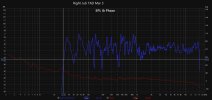
As promised, I wanted to post some data on why I believe the internally ported bass bin with 12" woofer is not a good compromise. First, we start with an amplitude and phase response plot of a 1st-gen Jubilee in my listening room:, with the cursor position at the nominal -3 dB point of the bass bin (about 30 Hz in this instance):

Jub1 transfer function.jpg

and the same plot for a 2nd-gen ("Heritage") Jubilee in another (and smaller) listening room (the cursor position was not moved from the prior plot):

Jub2 transfer function.jpg

To compare amplitude (SPL) responses for these two loudspeaker types, we can plot those together:

Jub1 and 2 SPL resp.jpg

Note that the 2nd-gen Jub is nominally at a -3 dB level relative to most of the 1st-gen Jub output (except below 70 Hz). This will become more important in later plots. Now a comparison of phase responses:

Jub1 and Jub2 phase ressponses.jpg
Note the huge rise in phase with decreasing frequency, mostly all due to the type of digital filters used in the Klipsch-provided DSP crossover (i.e., all-pass of its ~fourth order IIR filters). This is definitely audible (more on that subject later). Note the relative phase growth of the 2nd-gen Jub bass bin below ~100 Hz, This is due to the ported bass bin design of the 2nd-gen bass bin.

Chris
 
Now for group delay of the two Jubilee types:

Jub1 and Jub2 GD xomparison.jpg

Here, I shifted to psychoacoustic smoothing to tame the noisy nature of the GD plot (mathematically, the 1st derivative of the phase plot, which is a noisy process). Note the rise in average group delay looking to the left on the plot (downward in frequency) near the crossover frequency of nominally 310 Hz. This is audible when it passes 1 millisecond at midrange frequencies, which occurs near 500 Hz.

Also note the really huge rise in group delay below ~70 Hz, all due to its ported bass bin design. The blue trace (1st-gen) reaches a local maximum at its conventional horn-loading cutoff frequency of 30 Hz (and below that frequency, there is very little SPL output, so the GD curve for the 1st-gen bass bin has little effect).

Chris
 
So the imposition of the internal ports in the bass bin, ostensibly to decrease the -3 dB bass bin roll-off frequency--comes with a price: phase growth and group delay growth, both of which are audible.

When the woofer diameter is decreased in size from 15" (nom.) to 12" (nom.) to make room for the internal ports in the new La Scala bass bin, the immutable fact is that the SPL at the onset of audible distortion (i.e., modulation and harmonic distortion) decreases. This means that the 12" internally ported bass bin cannot keep up with the performance of the 15" non-ported bass (i.e., the configuration used by all prior La Scala designs as originally designed by PWK).

Looking at the Jubilee plots above for phase and group delay performance, and looking at the fundamental governing effect of woofer projected area difference between 15" and 12" woofer diameters, I don't believe that an internally ported La Scala bass bin will have the same or better performance of the current designs, in terms of hi-fi sound quality.

Chris

P.S. -- note that this forum allows the participants to express their unadulterated engineering views without marketing spin, unlike the current K-forum has demonstrated over the past 3 1/2 years. I recommend posting here rather than trying to echo the same concerns over on the other forum, since those comments will surely be omitted there.
 
Last edited:
In summary. the changes shown by the latest K-forum thread (referenced in this first post in this thread) largely are extremely beneficial--with the exception of the 12" woofer La Scala bass bin, which I feel is false economy in terms of acoustic performance, and the subject of which was discussed above.

I do have to mention that the changes to shift the design of the Klipsch Heritage line from passive to active digital crossovers is an enabling move--but only if Klipsch provides user control of the DSP crossover settings in-room to dial-in the loudspeaker's crossovers to minimize phase and group delay growth while also providing direct control of bass bin amplitude response. As you can see in the 2nd-gen Jubilee amplitude plot, above, Klipsch's decision to remove the ability to adjust PEQs, crossover filters, channel delays and limiters, etc. by the user has severely crippled the ability of users to dial-in their loudspeakers to match to the room acoustic needs.

Let's hope that Klipsch changes course and provides user control of its DSP settings, as every other DSP unit on the planet has provided to the user.

One more comment: the change toward using DSP crossovers is something that has been economically available to the users ~20 years ago. Let's hope that Klipsch, in the future, can provide such capabilities to their customers (as well as dramatically increased product reliability) in a much more timely manner. 20 years is far too long to provide state of the art innovation to its customers.

Chris
 
Last edited:
Okay...so I commented on two additional points of interest, above:

1) The lower overall SPL of the 2nd-gen Jubilee plot (above 70 Hz), and

2) Audibility of group delay being about 1 ms at midrange frequencies.


These points are discussed in a little more detail below:
_________________________________________________________________________

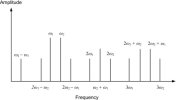
The type of distortion that is audible is actually modulation distortion, i.e., upper and lower sidebands that appear on a frequency plot when the same driver produces two frequencies at the same time (i.e., music is played, which always has more than one frequency playing at a time, even if it is only fundamental and harmonics of the lowest frequency being played by one instrument...even if a flute is playing solo. [This harmonic series, together with the fundamental frequency, gives us timbre--the sound of the instrument or voice.]

1741782688366.jpeg​

These types of distortion (harmonic and modulation), i.e., frequencies not in the captured signal to the recording microphone(s), are non-linear. This means that their level is not a linear function of SPL being produced. So loudspeakers playing at or slightly above their level of audible harmonic or modulation distortion will produce increasingly higher amounts of SPL distortion frequencies as the overall loudness increases linearly.

So for very good loudspeakers playing at SPLs around the onset of audible harmonic or modulation distortion, simply increasing the overall loudspeaker loudness by 3 dB will increase the distortion products by more than 3 dB. So for comparison measurements of distortion in loudspeakers, matching the overall SPL of the two loudspeaker types for measurement becomes much more important to see the relative levels of distortion of the two loudspeaker types. For the 1st-gen Jubilee measurements shown above, the distortion levels should be greater than 3 dB higher, but in general, they are not (another thread discussing harmonic distortion levels of the two Jubilee types is another subject)

1741782743573.jpeg​
________________________________________________________________________

Group delay distortion audibility thresholds are approximately defined by the following figure:

1741782884606.jpeg​

The actual thresholds, unfortunately, are a bit lower than shown in the figure above for certain environments (and a recent JAES paper by Liski, et al., shows these newer thresholds they found), but the above figure is pretty close.

Chris
 
In summary. the changes shown by the latest K-forum thread (referenced in this first post in this thread) largely are extremely beneficial--with the exception of the 12" woofer La Scala bass bin, which I feel is false economy in terms of acoustic performance, and the subject of which was discussed above.

I do have to mention that the changes to shift the design of the Klipsch Heritage line from passive to active digital crossovers is an enabling move--but only if Klipsch provides user control of the DSP crossover settings in-room to dial-in the loudspeaker's crossovers to minimize phase and group delay growth while also providing direct control of bass bin amplitude response. As you can see in the 2nd-gen Jubilee amplitude plot, above, Klipsch's decision to remove the ability to adjust PEQs, crossover filters, channel delays and limiters, etc. by the user has severely crippled the ability of users to dial-in their loudspeakers to match to the room acoustic needs.

Let's hope that Klipsch changes course and provides user control of its DSP settings, as every other DSP unit on the planet has provided to the user.

One more comment: the change toward using DSP crossovers is something that has been economically available to the users ~20 years ago. Let's hope that Klipsch, in the future, can provide such capabilities to their customers (as well as dramatically increased product reliability) in a much more timely manner. 20 years is far too long to provide state of the art innovation to its customers.

Chris
@Cask05 thanks for these posts about the new iterations of Heritage products.

I imagine that one of the demands Roy and the other engineers had to meet was to extend the bass response. You’ve pointed out the trade-off that doing so via a bass-reflex design entails. Apart from enlarging the bass bin (which might not have been desirable), what else could they have done?

Although I agree with you about the DSP, I see their approach as being limited to using DSP to tune the speaker to deliver a desired response. I can understand that approach — Klipsch configures the DSP’s output channels and the user configures the DSP’s input channels (perhaps via Dirac or some such) to tune the system for the room and their tastes. If that’s what they’re doing, that approach seems sensible to me, although I’d prefer if Klipsch allowed the user to change things as he/she wishes, and to be able to use the same DSP to tune the input channels.
 
Apart from enlarging the bass bin (which might not have been desirable), what else could they have done?
This problem with the La Scala and Belle is that the bass bin horn is a full exponential horn with a definite cutoff frequency. That cutoff frequency is determined by the expansion rate (for exponential, full tractrix, hyperbolic, and hyperbolic/exponential [hypex] horn profiles). Simply changing the rate of expansion and lengthening the horn path would have enabled a lower F3.

One of the reasons why PWK used "W" section bass bins (i.e., bifurcated dual mouth) is that it can lower the distortions associated with the tight folding/curvature of the horn. One way of making the bass horns more efficient and to have lower distortion associated with curvature or folding is to do those folds more smoothly and with a wide-but short height cross-section. One approach was this (the Western Electric 17-A, ca. 1930):

17-1.jpg

HornDesign.jpg​

Modern materials and methods of manufacture (including fiber-reinforced polymers) would actually weigh less, be stiffer and have a lower F3 than the La Scala or Belle bass bins. For instance:

gi.mpl.jpg

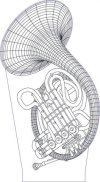
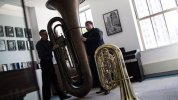
Take a couple of well-known shapes:

French Horn wireframe.jpg TUBA-videoSixteenByNine1050.jpg​
These shapes can have very compact envelopes and very low F3's but are still able to be easily carried around by a single person. (I think you get the analogy.)

There are better ways of designing loudspeakers than by using flat plywood shapes cut on NC router boards to form folded horns.

Chris
 
I can understand that approach — Klipsch configures the DSP’s output channels and the user configures the DSP’s input channels (perhaps via Dirac or some such) to tune the system for the room and their tastes.
This isn't actually correct. This is what Klipsch wants you to think. There are problems with doing it wrong and then trying to scab on some upstream DSP to try to correct the problems introduced by fixed DSP values.

Witness the "Heritage Jubilee"...to fix the problems seen in the transfer function response, you have to remove the Klipsch-provided DSP box and replace it with one that the users can adjust.

Chris
 
While technically correct with the 15" vs 12" distortion argument, is the difference going to be noticeable for the average user (I'd put most present here squarely in the 'above-average listener' class) at average listening levels? Probably not. I've been playing with a similar bass-reflex under ~100hz horn design for a few months. Simulations there, with a 35Hz bass-reflex tuning, 2x8", are showing a 1w x-max of .5mm @ 50hz @105dB. Max group delay of ~13ms at 35Hz tuning frequency. Should still be well below most audibility thresholds if BigK is hitting similar points. Maybe there's more distortion there, but at a 75dB listening level at the sofa it's doubtful much difference would be noticed.
 
While technically correct with the 15" vs 12" distortion argument, is the difference going to be noticeable for the average user
I can only speak for myself...I replaced the surround Cornwall bass bin/stacked AMT-1s in my setup because of the modulation distortion that I could hear from the surround loudspeaker bass bins (5.1). The Belle/AMT-1s did the trick of removing the modulation distortion, and I've been fairly satisfied with what I've got for the past 5-6 years now. When I get around to it, I'll probably replace the Belle/AMT-1 surrounds with smaller MEHs of a newer design (one which I haven't talked about yet).

Does that answer your question?

(I'd put most present here squarely in the 'above-average listener' class) at average listening levels?
Actually, I find a great tolerance on this forum and at the K-forum for direct radiating woofers and higher modulation distortion bass bins in general. Using a 12" woofer behind a La Scala bass bin would present much less modulation distortion than Cornwall bass bins, but running out of headroom during music transients is something that I don't like to hear.

It always goes like this: if you her the problems, then fix it. The least expensive audio systems that I see people owning are by people whose expectations are the lowest. If you're one of those people, I assume that you don't make a big deal of hearing distortion, and most people don't know that you don't really hear the difference.

I, on the other hand, am not so blessed. I am aware that my tolerance for distortion is apparently much lower than many "audiophiles" that don't know anything better than their little monkey coffins and overpriced electronics. (YMMV.)

For those that want to hear my setup, let me know. I can tell you that my setup is designed for minimum modulation distortion and low phase growth (as low as I can get without resorting to FIR filtering and large delays that the preamp/processor has to synchronize with video), and headroom for music transients--like you get with classical, latin jazz and percussion music

Chris
 
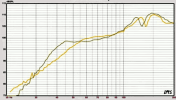
He got basically 10 more Hz and changed one board in the production--if you can hold through the whole video you can hear that production constraint loud and clear. Probably had to change one op and one page of instruction and one page of inspection documents for production. As an engineering task, it's basically free when you can re-use the already-tooled CW port/ducts. Tried 1, 2, and 4--2 was the choice. Like those cafes where you can order breakfast, lunch, or dinner. I'm with DE that it should be evident, but it also goes against all those PWK writings inside our heads screaming bigger driver lower excursion ergo lower distortion. It's on the product management people what to label/sell/promote and how hard.

Edit: Add crv
 

Attachments

  • al6_12in_v_prev_LS_raw.png
    al6_12in_v_prev_LS_raw.png
    291.4 KB · Views: 5
Last edited:
Chris, I'd love to hear your setup. Alas, a trip to Texas is DEFINITELY not in the cards this summer. Just hoping to get my 'living room horns' done before the #3 baby arrives. Maybe I'll bug you for a little de-mastered music in the near future....
 
The measured GD on my ported LS doesn’t climb above 10ms until below 55Hz.
It appears to have a peak at 33Hz which is likely the actual tuning frequency of the box volume and ports used.
I also measure lower GD through the lower midrange than the plot of the Heritage Jubilee you posted.

I definitely want to try going coaxial for the mid and tweeter and have had my eye on those JBL 2384 for some time.
 
This problem with the La Scala and Belle is that the bass bin horn is a full exponential horn with a definite cutoff frequency. That cutoff frequency is determined by the expansion rate (for exponential, full tractrix, hyperbolic, and hyperbolic/exponential [hypex] horn profiles). Simply changing the rate of expansion and lengthening the horn path would have enabled a lower F3.

One of the reasons why PWK used "W" section bass bins (i.e., bifurcated dual mouth) is that it can lower the distortions associated with the tight folding/curvature of the horn. One way of making the bass horns more efficient and to have lower distortion associated with curvature or folding is to do those folds more smoothly and with a wide-but short height cross-section. One approach was this (the Western Electric 17-A, ca. 1930):


Modern materials and methods of manufacture (including fiber-reinforced polymers) would actually weigh less, be stiffer and have a lower F3 than the La Scala or Belle bass bins. For instance:

View attachment 3451385

Take a couple of well-known shapes:

These shapes can have very compact envelopes and very low F3's but are still able to be easily carried around by a single person. (I think you get the analogy.)

There are better ways of designing loudspeakers than by using flat plywood shapes cut on NC router boards to form folded horns.

Chris
Thanks. My thinking had been limited so that I was thinking that the only other choice would have been to make the bass bin larger (something along the lines of a Peavey FH-1).

A curved horn (like a tuba or French horn) would have been a wild departure. I'd have loved to have seen something like that. It would have been particularly interesting to see how they could make it attractive in a home.
 
He got basically 10 more Hz and changed one board in the production.

Probably had to change one op and one page of instruction and one page of inspection documents for production. As an engineering task, it's basically free when you can re-use the already-tooled CW port/ducts.
I bet you've nailed it!
 
'm with DE that it should be evident, but it also goes against all those PWK writings inside our heads screaming bigger driver lower excursion ergo lower distortion. It's on the product management people what to label/sell/promote and how hard.
I'm not sure that I need to respond to this as the OP, but I think your assessment of the changes is basically "mix and match what we've already got", which I would agree with (if that was the statement).

I've always been mystified by the reticence of Klipsch to use more drivers and larger diameter woofers--where the application really called for it. The first time I realized this was the 1st-gen Jubilee bass bin (using two 12" woofers to replace one 15" woofer in the Khorn bass bin). I could see that PWK, while he was still alive, would probably have set the total woofer area as a constraint on the "Klipschorn II" design--which of course became the Jubilee 1st-gen bass bin (i.e., the KPT-KHJ-LF). I still think that this bass bin was a better design than what we have today, but that's just me.

I see all this stinginess of using smaller woofers, etc. as a "Roy thing", but I don't know what internal constraints and organizational forces have been at play in making these type of decisions.

(And yes, I could see Roy having to defend every single point of his proposed designs from Marketing challenges--and that isn't a pretty picture, to be honest). To me, it just makes more sense to provide more woofer area, since the price of an extra woofer is probably in the range of $75 wholesale to Klipsch.

PWK was a king at keeping driver costs down and in keeping replacement parts inventories at an absolute minimum,:reusing the K33 (in its various incarnations over the years) to all but the Heresy (where it wouldn't fit), the K-77 tweeter from EV, and the K-55 midrange driver (modified from Atlas). I'm sure this saved money, but did it also constrain the design space too much? I think it really did.

Chris
 
...I'd put most present here squarely in the 'above-average listener' class...
Just one anecdotal story here:

I once attended a "Jubfest" in 2009 with a class of perhaps 12-15 guys. One of the most interesting demos that Roy set up was a direct comparison of a KPT-942 (i.e., two 15" woofer bass bin under a K-402/K-69 HF horn) with a Jubilee (1st-gen) in the other corner. The music played was what I'd call "rough funk boom-boom". Loudly. It sounded like wood splintering on kick drum transients.

He repeated this with the KPT-942-4 (four 15" woofers).

Then he asked the people in the class what they thought of the sound quality differences and their preferences. (I really think that Roy was trying to calibrate the ears of his audience during this exercise). Most of the guys there said the that the two 15" woofer KPT-942 sounded odd and a bit opaque--only perhaps a couple of guys said it sounded pretty much okay. But when he asked about the KPT-942-4 (four 15" woofer cabinets), more than half of the guys (about 2/3s of the class, IIRC) said they liked the KPT-942-4 over the Jubilee bass bin (1st-gen). Perhaps one or two others (including myself) still preferred the Jubilee bass bin for it's un-exaggerated bass and neutral sound.

After that exercise, there was one other that compared in blind test fashion which preamp was a tube preamp [Juicy Music] and which was the low-cost SS preamp in the equipment rack next to the chamber in Hope. I pretty much had everyone's hearing calibrated at the end of that session and the comparison of bass bins exercise. It wasn't that pretty, to be honest, with a significant fraction of the guys not able to pick out the differences that I though were pretty clearly able to be heard. Only Roger (twistedcrankcammer, RIP) and perhaps a one or two others clearly heard the differences. (I was one of the others that heard the differences pretty clearly--but back then, I doubted my hearing such that I was pretty quiet about my pick of which was which).

One thing that you should understand is that I really don't consider myself (even back then when my hearing was better) to have "golden ears". But the accommodation of most of the guys to not objecting to bass modulation distortion for its "impact" was pretty telling, combined with trouble hearing the large differences in preamp slew rate performance of that tube vs. SS demo. Note that in all cases, we were using an EV Dx38 to dial in each loudspeaker configuration. Note that this unit has a very small veil of sound quality vs. something like a Xilica XP/XD series crossover.

Today, I'd probably have more trouble due to presbycusis, but if you turn the SPL up a little more than in 2009, I've found that my ability to hear those differences still exists.

People are not really trained to use their ears. I attribute my ability to practice in building DIY loudspeakers at home at an early age--leveling the SPL by ear (since we couldn't afford a calibrated microphone in the 1960s-early 1970s), and also being a trained classical musician. Being the son of a church organist and organ performance major also helped train my ears, too.

Chris
 
Last edited:
Just one anecdotal story here:


Then he asked the people in the class what they thought of the sound quality differences and their preferences. (I really think that Roy was trying to calibrate the ears of his audience during this exercise). Most of the guys there said the that the two 15" woofer KPT-942 sounded odd and a bit opaque--only perhaps a couple of guys said it sounded pretty much okay. But when he asked about the KPT-942-4 (four 15" woofer cabinets), more than half of the guys (about 2/3s of the class, IIRC) said they liked the KPT-942-4 over the Jubilee bass bin (1st-gen). Perhaps one or two others (including myself) still preferred the Jubilee bass bin for it's un-exaggerated bass and neutral sound.


Chris
I feel like its accepted that even most trained listeners in a blind test all other things the same will prefer a speaker that has more bass. Im definitely not saying everyone but I honestly can't say which crowd i'd have been in today. A year ago? definitely in the 942-4 crowd 100%. Having started my journey with 456 bins which are essentially 942s i couldnt agree more with everyone on how they are. We plan to brace the ever living heck out of the trio soon in their new home and see if that helps. they have one 2x8 or 2x6 going across the top and that's it.


As far as the 12" goes i think grindstone nailed the real answer here and it's just always going to come down to production on something like that.
My uneducated inquiry that only half applies is in relation to all of our Pro driver swapping in other speakers. We've seen what kind of performance a slightly higher quality 15" can do. Not that im suggesting this is something they would ever actually consider but is it possible to break even or do better when downsizing like that if you used a considerably higher performance 12" driver?
 
Did Chief Bonehead expand the volume of the doghouse into the mid/tweeter chamber?
I could see the change to a smaller driver being a step towards optimizing the bass reflex portion of the system.

I wasn't planning to go with a 2x8" setup on my project, but the improved reflex alignment was worth giving up a little modulation in the 45-60Hz range for a better 35-45Hz and better 300-600Hz. The 10" drivers I could find that worked into the available volume were 3x the price, and Italian. (Not that there's anything wrong with Italian drivers...)

Just gotta hope HornResp translates to the real world.
 
Back
Top Bottom