• The move to the new server is done. There are some software and database maintenance updates in process. This has us passing the hat around to help out. We appreciate any donations. Seriously, even a dollar helps. The payment page may be found here - https://www.audiokarma.org/support.html

New large caps are being manufactured below specified value. Request for measurements

Blue Shadow

Waiting for Vintage Gear from this century
After talking to a Nichicon Sales Engineer and finding out that Nichicon is producing higher capacitance caps at 10% below the rating (well within the ±20% tolerance) I asked if folks could measure some of the new caps they are using. Many can't measure caps over a hundred or so µF and most will not have the ability to measure at rated voltage. I'm not interested in peer reviewed scientific journal test results, just something to get an idea of who is doing what. The Nichicon guy indicated it is industry standard now to short us on capacitance because the manufacturing process is so much more accurate than back in the day.

The previous thread is 4 pages of discussion about measuring and such so no reason to add to that one. There were some results and here they are:

Kemet ALS-30 22k was 7% low (OMGCat!)
Kemet ALS-30 33k was 10% low (OMGCat!)
Nichicon LGY 6800 was 8-10% low (from northpaw)
Nichicon NGY 6800uf was 9.9% Low*
Vishay MAL 6800 was 2.5-4.4% High (from northpaw)
Kemets replaced by leesonic in an AU-717, 15000 were tested at 14.7-14.8k pretty close to spec, from 2019 thread linked in the old post.

*these were submitted by @IndyDucati and maybe he meant LGY, no NGY Nichicon caps listed on their site. Hope he will drop in and update the info from his May 2020 post in the other thread.

This info is helpful since many larger caps were specified as -10%/+50% meaning the cap probably was over the specified value and we are changing them and putting in new caps that are smaller than specified in the design since we buy the same value and it comes from the factory at 10% below specification.

So if you have measured new large capacitors would you mind posting the Brand, Model, Capacitance and readings? From the data above as limited as it is there are 2 companies cutting a bit of foil off the roll before it goes in the cap to save money and one that is giving us what we are paying for. This all is addressed in the other thread as it is happening in all industries...make stuff to the cheaper end of the tolerance. Doing this and not making parts accurately to specification is saving them loads of money and giving us a false sense of restoring gear properly.

For those concerned, it is probably recommended to buy the next size up for replacement large caps to get what the designers show in the schematic/parts list. Don't worry about the small caps they do seem fairly accurate, probably up to 100µF or more.
 
Register to hide this ad
This topic came up again in @saabracer23's thread about a 5-figure tube amp he is rebuilding due to poor build quality and a problem. In that thread, @Selmerdave added these data points
Just to add some data points since I had my meter out tonight (B&K), I tested a few caps on hand.

Electrolytic
Aerovox 330uF/450V - two tested, both 310uF
Nichicon 80uF/450V - four tested, 87/87/88/86uF
Panasonic 80uF/450V - one tested, 76uF

DC Link caps
Wima 30uF/630V - 30.09uF
Panasonic 10uF/630V - 10.02uF
TDK 50uF/630V - two tested, 52/54uF
Kemet 80uF/500V - two tested, 76/75uF

For kicks Russian FT-3 teflon 0.22/600V - 0.229uF


With this extension of the data to smaller caps, I'm open to having these added to this data collection. Seem the numbers get close at under 100µF.
 
Last edited:
Seems this thread is dead and getting no input but I did find this in the Yamaha forum talking about the B-2 PS cap options.

Most of every 22000uf KG caps from Nichicon I tested vary between 19000-21000uf. After talking to the Nichicon engineers, the pure reason for the lower capacitance value is less foil or economic / savings reasons.
 
installed a pair of 20uf / 600v Sprague Atom caps yesterday. Both measured 23uf.

the 1973 vintage caps that came out both measured around 34uf.
 
The Nichicon guy indicated it is industry standard now to short us on capacitance because the manufacturing process is so much more accurate than back in the day.
If manufacturing accuracy is so improved, why would the industry standard not be to make them, oh I don't know, the *exact* value as what's on the outside of the can? To save 1/100 of a penny on a capacitor?

This makes no sense to me.
 
To save 1/100 of a penny on a capacitor? This makes no sense to me.
Savings are significantly higher than that. These are the big caps and they are saving 10% of the stuffing costs. The can and connections are the same but cutting back on the guts on 100,000 really adds up. Industry standard but not proven. Nichicon admits it, haven't asked others, would like to see some measurements to see how Kemet, CDE, Panasonic and others do on this issue.

Makes no sense to us but it adds up to significant dollars for the manufacturer.
 
Last edited:
I've definitely noticed this on larger Nichicon caps. 4x 4700's I installed recently all measured 4250uF. A couple 6800's measured 6200uF. All right about 10% low.
 
How new is 'new'?

I haven't bought any large caps for over a year now. I don't know how long the ones I bought in 2022 sat on the shelf before I bought them.

I know there is a date code on at least some caps, but I don't have the magic decoder ring to decipher it.
I assume (but not 100% sure) it's consistent across manufacturers.
 
Last edited:
The Sprague at least require no decoding, its just year and week in a 4 digit string. I want to say the ones I put in, purchased a week ago, had late 2022 date codes on them. I don't expect that a big firecracker like an axial Sprague Atom is a high volume item.
 
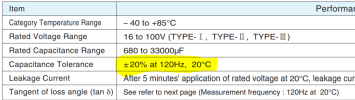
I might add that the capacitance value is taken at a specified frequency. When assessing how close to spec the C value is, the datasheet must be checked for the additional rating details.
1707769467386.png
 
The Sprague at least require no decoding, its just year and week in a 4 digit string. I want to say the ones I put in, purchased a week ago, had late 2022 date codes on them. I don't expect that a big firecracker like an axial Sprague Atom is a high volume item.
OK I have a Sprague Atom here with TVA1903 printed on it so that's 3rd week of 2019.
Its looks like maybe Nichicon and National do it that way too.

Others do not and some have nothing that looks like a date code at all. I think those are Chinese caps I bought on Ebay
 
Thats the model number. You're looking for a string of 4 after the value and voltage and all that other stuff. Should be the very last line printed.

The ones I put in were TVA1966.
 
I might add that the capacitance value is taken at a specified frequency.
Yes, for accuracy but we are just doing a straw poll here trying to see which manufacturers are not filling the can completely. Most folks at room temperature will be within 10° of the value specified 20C/68F and that is good enough. Measuring capacitance is probably more than just a quick meter of that is what we are looking for. The other threads have a post indicating that reforming is not necessary.

So just the Brand, Model number, rated and measured capacitance and we can decide which companies we need to up the capacity of the caps we order to get the same as what was designed for the units we are working on.
 
The other threads have a post indicating that reforming is not necessary.
awhile back i tested some filter caps with dats. then i held them just shy of rated voltage on my to-4 for 10 minutes. retested and had gains of 5-600uf.

granted, it's just dats and not a good lcr meter but i still showed a difference.
 
I've talked about this for years; it's nothing new. It's more than one company. If the cap maker can control the process tightly, which they've been able to do for quite a while, there's significant savings in fussy etched aluminum plates. If it meets the datasheet specs, there's nothing to complain about. Doesn't stop me though. ;)
 
I've talked about this for years; it's nothing new. It's more than one company. If the cap maker can control the process tightly, which they've been able to do for quite a while, there's significant savings in fussy etched aluminum plates. If it meets the datasheet specs, there's nothing to complain about. Doesn't stop me though. ;)
It would not be you otherwise :)
Thanks for chiming in.

I actually found the "cheeting" practice useful for certain applications where the intended replacement was closer to the value of the "replaced" as a result....but I agree that the "cheeting" it is technically a game most manufacturers are playing.


So just the Brand, Model number, rated and measured capacitance and we can decide which companies we need to up the capacity of the caps we order to get the same as what was designed for the units we are working on.
It is a boring exercise where we will likely be surprised to find out they all do it :)

I have a recent BORING video where I test some vintage caps ... not for this purpose, but next time I do have caps to test, I will add this exercise of testing the new replacements to the list.

See minute 12ish
 
Last edited:
A couple of years ago I bought some Nichicon LGY caps for a project and had some left over. I recently measured them with a PEAK Atlas ESR meter and they all tested much lower than their specified values. I thought that maybe they were sitting too long without being used so I bought some more for some new projects. The new ones measured the same as the old ones.

Nichicon UFW ................Actual Measurements

100 uF / 10 V...................91 uF to 92 uF..... (6 pieces)

220 uF / 16 V..................192 uF to 193 uF..... (6 pieces)

470 uF / 35 V..................450 uF to 453 uF..... (6 pieces)

Nichicon LGY ................Actual Measurements

560 uF / 100 V...............477 uF to 480 uF..... (10 pieces)

820 uF / 100 V..............702 uF to 704 uF..... (4 pieces)

3300 uF / 50 V................2908 uF to 2975 uF..... (10 pieces)

It reminds me of an Andy Rooney rant about how 1 LB of coffee became 13 OZ.....:wtf:
 
Last edited:
What's interesting is that although the tolerance is 20%, the actual measurements are very close to each other, within a couple of percent. This leads me to believe that the actual capacitance is tightly controlled and the 20% is ....:bs:
 
Back
Top Bottom