• The move to the new server is done. There are some software and database maintenance updates in process. This has us passing the hat around to help out. We appreciate any donations. Seriously, even a dollar helps. The payment page may be found here - https://www.audiokarma.org/support.html

New Owner JBL L100 Century

Yeah, it's testy getting at the L-Pads by removing the woofers, but it can be done with patience.

I'd reckon DeOxIt D5 would be the product of choice, but others might have a better recommendation in the DeOxIt line-up.

Once those are cleaned up, usually flat on both controls is where you want to start.

When inside, that will give you a chance to eyeball the innards. Carefully check all driver's mounting screws insuring they are all snug.
Best way to do it is to replace the lpads with fixed resistors. Much better that way. I find 9db of attenuation to be perfect. I use mills resistors.
 
Hmm, Replacing with a resistor…you could leave the Lpad in place for originality but bypass it with the resistor.

Is your PL-400 also White Oaked?
 
Is your PL-400 also White Oaked?

Not yet, but will be. At least partially. My 700B is full White Oak. Control board, back plane, etc. These 400s will have the new control boards, main capacitors, and transistors replaced. They will remain quasi-complimentary, whereas my 700B is full complimentary. (Technical terms that I’m just regurgitating)

These amps are my first Phase Linear experience. I was told the 400 has a warmer sound and sounds more full at lower levels. I can certainly agree after hearing both. The 700B is an amazing amplifier, it brings concert levels to my home and drives my 901s remarkably well…but the amp doesn’t shine until really driven. Maybe it’s just my amplifier, or maybe it’s rather common?

The 400 seems to be a great match for these JBLs
 
Thanks for all the advice and info!

I hooked up the Phase Linear 700b. They do get loud. The meters barely moved at that intense volume. The Phase Linear is more harsh sounding than the Marantz. I’ve noticed with this amplifier that it doesn’t really shine until it’s pushed hard. I use this amp for my Series II 901s and it seems to be the perfect match.

I much prefer the sound of my Marantz on these JBLs. I have a 2270 that I think will sound even better. It’s currently being serviced.

My stands and tweeter foams should come in tomorrow, I’ll post pics! I was hoping the foam grills would be in this week but I don’t think so.

So far I’m very impressed with these speakers, I’ve really enjoyed them. They’re a lot more detailed than my 901s.

I’ll remove a woofer tomorrow to see if I can clean the L pots
What preamp with the phase linear?

Couple things…Marantz isn’t exactly known for being accurate. The signal is rather modified. Things tend to sound rather “warm” with Marantz. Depending on the preamp used with the PL, it is likely much more accurate than the Marantz. The L100 does not have a flat response at all and this is by design. The mids are boosted. This was probably more prevalent with the PL than the warm sounding Marantz hence the preference for the Marantz.

Edit…I see you are using a carver pre with the pl 400….but isn’t the 700b a power amp?
 
Hmm, Replacing with a resistor…you could leave the Lpad in place for originality but bypass it with the resistor.

Is your PL-400 also White Oaked?
1 lpad has to be replaced with 2 resistors. 1 in series with the vc and 1 in parallel with the vc. Just to be sure you understand. Performs much better this way, relative to an adjustable lpad. Sadly, so many are afraid to do this and take the easy way out and stick with adjustable lpads.
 
1 lpad has to be replaced with 2 resistors. 1 in series with the vc and 1 in parallel with the vc. Just to be sure you understand. Performs much better this way, relative to an adjustable lpad. Sadly, so many are afraid to do this and take the easy way out and stick with adjustable lpads.
Please explain why it is better. Why would it sound different?
 
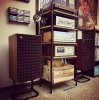
What stands are those?

I bought them off eBay. They are APARA Vintage Speaker Stands. They are powder coated and very high quality, to me at least. Lightweight and solid.

They were $149.00 for the pair, I wanted the original stands for these speakers but they were crazy expensive. These do the same thing and I’m very pleased.

Photo courtesy of the eBay listing

28CA6F60-6134-4EE3-A6A2-D605534E9C45.jpeg
 
Last edited:
Edit…I see you are using a carver pre with the pl 400….but isn’t the 700b a power amp?

I used my Carver 4000 for both the 700B and 400. The Carver is all original and they’re problematic to start with. I’m having it fully restored as well. I’ve had three of these 4000 Preamplifiers and every one of them gave trouble. I thought I learned my lesson with them, but I found this carver for a good price locally, couldn’t pass it up. I’ve never had one in good 100% order, so I’m sure I’ll be highly satisfied with the results.

It’s a very clear preamp, except you have to turn it up a bit to get that clarity. When the volume is all the way down, there is a distorted feedback coming through the speakers still. My other 4000s did the same. Very noisy preamplifier. Once you turn it up it sounds pretty good, I’m looking forward to having it restored.
 
Please explain why it is better. Why would it sound different?
A speaker L pad is a special configuration of rheostats or resistors used to control volume while maintaining a constant impedance on the output of the audio amplifier. It consists of a parallel and a series rheostat or resistor connected in an "L" configuration. As one increases in resistance, the other decreases, thus maintaining a constant impedance, at least in one direction. To maintain constant impedance in both directions, a "T" pad must be used. In loudspeaker systems having a crossover network, it is necessary to maintain impedance to the crossover; this avoids shifting the crossover point.

A constant-impedance load is important for vacuum tube power amplifiers, because they do not work as efficiently when terminated into an impedance greatly different than their specified output impedance. Maintaining constant impedance is less important for solid state amplifiers.

Quoted from:
https://en.wikipedia.org/wiki/L_pad
 
I bought them off eBay. They are APARA Vintage Speaker Stands. They are powder coated and very high quality, to me at least. Lightweight and solid.

They were $149.00 for the pair, I wanted the original stands for these speakers but they were crazy expensive. These do the same thing and I’m very pleased.

Photo courtesy of the eBay listing

View attachment 2637247
I like how the radio shack grilles look
 
Listened to my pair last night powered by a Scott LK-72. Just a great speaker.
Not the last word in fidelity but they always take me back to a different time and place.

Enjoy your good fortune, $10 sheesh. Paid a lot more for mine. :rolleyes:
 
Please explain why it is better. Why would it sound different?
Consider the rheostat style electrical connections within an lpad. It is far from ideal. Especially considering that it is in the signal path of a tweeter/mid which plays highly directional frequencies that the human ear is very sensitive to. The resistors in an lpad are wire wound and I highly doubt they are non inductive.

So, the resistors are of low quality and not something I would want in the signal path. The internal electrical connection is suspect, not what I would want in the signal path either. The electrical connection is something that gets worse with time too. Properly soldered joints with fixed resistors is much better than what you get inside of an lpad. Resistors such as mills is much better than what you get inside of an lpad.

In short, the connection and the resistors themselves = the suck. You could do much better.

Not to mention the dirt, corrosion and wear as they age. A fixed resistor set up won’t age on you.
 
It takes dirt, wear, and corrosion out of the equation.
I have never had a problem in the 40+ years I have owned JBL's. The only way I could tolerate speakers without variable L-Pads is with crossover switching such as the KLH Fives; three positions. To each his own.
 
Back
Top Bottom