

You are using an out of date browser. It may not display this or other websites correctly.
You should upgrade or use an alternative browser.
You should upgrade or use an alternative browser.
New Owner JBL L100 Century
- Thread starter AK577
- Start date

z-adamson
Addicted Member
All this tells us is that you are accustomed to the short comings of an lpad and thus are accepting to them. That does not mean that problems don’t exist. If you deal with a problem long enough, you come to not even look at it as a problem.I have never had a problem in the 40+ years I have owned JBL's. The only way I could tolerate speakers without variable L-Pads is with crossover switching such as the KLH Fives; three positions. To each his own.

Coolhandjjl
Embiggened Pompatus
I power my L100 speakers with a Marantz 250M power amp (125 wpc). Vintage correct, sounds full and lush! You wil know if you are driving them with too much power as these are not intended to be party speakers like Cerwin Vega D9’s.
You can also buy new metal control plate badges on eBay if you need to remove all the crossover screws. But on the topic of screws, those metal badges on eBay are priced so high, they are a screw job.
I like the idea of replacing the L-Pads with resistors, I’m going to look into that for mine.
There are some plans for new crossover schematics out there, but everything I’ve read seems to indicate that while these new crossover designs will provide a more accurate signal, they will loose that characteristic sound the speakers were built with. The caps in there should be fine AFAIK.
You can also buy new metal control plate badges on eBay if you need to remove all the crossover screws. But on the topic of screws, those metal badges on eBay are priced so high, they are a screw job.
I like the idea of replacing the L-Pads with resistors, I’m going to look into that for mine.
There are some plans for new crossover schematics out there, but everything I’ve read seems to indicate that while these new crossover designs will provide a more accurate signal, they will loose that characteristic sound the speakers were built with. The caps in there should be fine AFAIK.
Last edited:
Coolhandjjl
Embiggened Pompatus
What happens to the leads on the L-Pads? Snip them and use them for the resistors? Anyway you could draw us a quick schematic and post a cell phone pic of it?1 lpad has to be replaced with 2 resistors. 1 in series with the vc and 1 in parallel with the vc. Just to be sure you understand. Performs much better this way, relative to an adjustable lpad. Sadly, so many are afraid to do this and take the easy way out and stick with adjustable lpads.
Is 9dB of attenuation close to what you hear with the L-Pads set at 0?

I appreciate the work done to improve the crossover networks that people have done. Some really exhaustive research and tinkering with graphs to prove the improvements etc.
Personally and this is just my opinion, it would kill the character and charm for me.
If I want improved sonics I listen to some different speakers. In my case I listen to NS-1000's or some British monitors. Way more accurate and revealing but not as much fun or nostalgic when the mood strikes for vintage sound from my younger days.
I say keep them original but to each his own. One of the great things about this hobby. Enjoy them regardless.

Personally and this is just my opinion, it would kill the character and charm for me.
If I want improved sonics I listen to some different speakers. In my case I listen to NS-1000's or some British monitors. Way more accurate and revealing but not as much fun or nostalgic when the mood strikes for vintage sound from my younger days.
I say keep them original but to each his own. One of the great things about this hobby. Enjoy them regardless.
R Swerdlow
Active Member
Yes, the elements in a variable L-Pad are bare wound wire. The wiper tip and the coiled wire of the long element must be bare to make electrical contact. And that bare copper of the long element is what gets so oxidized and corroded. You have to clean off the oxidation as best as you can, but it’s a losing battle. With time, they get badly corroded. Replace them with new variable L-pads, and you still face the same problem.I'm confused. An L-pad is essentially two resistors. Your two resistors are just a fixed L-Pad. What is magical about two fixed resistors? The Wikipedia reference doesn't seem to say fixed resistors are better. Is it because the elements in a variable L-Pad are wire wound?
If you use 2 fixed resistors, arranged as an L-pad, you don’t suffer from corrosion of the contacts, and you get the benefits of more constant impedance. With solid state amps, the impedance can vary with much fewer problems than with vacuum tube amps.
https://en.wikipedia.org/wiki/Potentiometer#Rheostat

Every 40 years. You must live on the coast or have your stereo in a damp basement. One thing I wonder about is why 95% of all speakers have some form of adjustable tweeter lever control. If it is cheaper and better why didn't they do it at the factory. How many people are going to bring home a speaker, listen to it for awhile, check the desired L-Pad position, open the speaker up, measure the values of the two L-Pad ratios and bypass the control with two equivalent resistors? And what if your wife thinks the level is too high or too low? It's interesting that the vast majority of AK members who pick up vintage AR speakers with corroded controls clean them up or buy replacements off ebay (cleaned up by someone else) and are happy for many years.Replace them with new variable L-pads, and you still face the same problem.

BMWCCA
Addicted Member
Probably shocks the heck out of you every time someone finds an old pair of JBL and starts a thread about a tweeter not working . . . and gets this same answer. Several times a year. For over two decades.I have never had a problem in the 40+ years I have owned JBL's. The only way I could tolerate speakers without variable L-Pads is with crossover switching such as the KLH Fives; three positions. To each his own.
z-adamson
Addicted Member
Even a perfect variable lpad is inferior to a properly executed fixed resistor pad.Every 40 years. You must live on the coast or have your stereo in a damp basement. One thing I wonder about is why 95% of all speakers have some form of adjustable tweeter lever control. If it is cheaper and better why didn't they do it at the factory. How many people are going to bring home a speaker, listen to it for awhile, check the desired L-Pad position, open the speaker up, measure the values of the two L-Pad ratios and bypass the control with two equivalent resistors? And what if your wife thinks the level is too high or too low? It's interesting that the vast majority of AK members who pick up vintage AR speakers with corroded controls clean them up or buy replacements off ebay (cleaned up by someone else) and are happy for many years.
Folks being “happy” as you say with variable lpads means nothing. All this tells us is that the speakers don’t resolve well enough to expose the problem in it’s current state (it will get worse), the listeners hearing isn’t that great or that the listener is used to it sounding that way and thus it sounds “right”.
Measure distortion at the tweeter driver input with a variable lpad in the circuit then without the lpad in the circuit. Tell me which scenario gives the tweeter a cleaner signal.
And I’d love to see the research that led to the conclusion that 95% of speakers out there are equipped with variable lpads. Last I checked, you won’t ever find any lpad on a speaker that resolves well and is made by a reputable manufacturer within the last couple decades.

Rectilinear1
Professional Record Restorer
Wow, great info guys. Nice thread! My question is, is it possible to carefully and surgically remove the knobs on the L-pads and shoot DeOxit5 into the shaft to get it into the potentiometer enclosure that way? If so, Isn't that easier than dealing with the dreaded foil-cal? I've opened up my L-100's woofers and found that there are no holes on the pots at all in which to spray the DeOx into. I have heard of people drilling tiny holes into the casings but I do not want metal shavings in my pots. What do you guys think?
z-adamson
Addicted Member
This is what you do...What happens to the leads on the L-Pads? Snip them and use them for the resistors? Anyway you could draw us a quick schematic and post a cell phone pic of it?
Is 9dB of attenuation close to what you hear with the L-Pads set at 0?
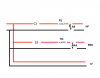
Look here for R 1-4 values.
http://www.sengpielaudio.com/calculator-Lpad.htm
These are 8ohm drivers, so look in the 8ohm section and determine how much attenuation you want. I use 9db and get good results for what I do.
Suggestions, use Mills resistors. Double them up to double power handling. For example if R1 is 5ohms, use TWO 10ohm mills resistors in parallel to get the 5ohms rather than a single 5ohm resistor. This doubles the power handling by spreading the heat across two resistors. Its the best way to do it. you get 24watts of power handling rather than 12.
Coolhandjjl
Embiggened Pompatus
.
Coolhandjjl
Embiggened Pompatus
-9dB is pretty close to 1/2 as much perceived volume, similar to the old L-Pad dial right in the middle?This is what you do...
View attachment 2642118
Look here for R 1-4 values.
http://www.sengpielaudio.com/calculator-Lpad.htm
These are 8ohm drivers, so look in the 8ohm section and determine how much attenuation you want. I use 9db and get good results for what I do.
Suggestions, use Mills resistors. Double them up to double power handling. For example if R1 is 5ohms, use TWO 10ohm mills resistors in parallel to get the 5ohms rather than a single 5ohm resistor. This doubles the power handling by spreading the heat across two resistors. Its the best way to do it. you get 24watts of power handling rather than 12.
Rectilinear1
Professional Record Restorer
Wait, I am confused. So are we trying to achieve 9db attenuation or -9db?
z-adamson
Addicted Member
I can't say for sure where 9db of attenuation is on the original lpad. Mine were too scratchy to get a reliable reading. I bought enough resistors to do some "mock set-ups" and test out various levels of attenuation through this I found that 9db of attenuation at the mid and tweeter works perfect for me. I do suspect it to be close to the mid point however.-9dB is pretty close to 1/2 as much perceived volume, similar to the old L-Pad dial right in the middle?
z-adamson
Addicted Member
. I am saying that fixed lpads at 9db of attenuation as per the lpad calculator above worked for me after trying out various other amounts of attenuation.Wait, I am confused. So are we trying to achieve 9db attenuation or -9db?
z-adamson
Addicted Member
Wow, great info guys. Nice thread! My question is, is it possible to carefully and surgically remove the knobs on the L-pads and shoot DeOxit5 into the shaft to get it into the potentiometer enclosure that way?
No matter how you go about it, any improvement you get by using deoxit on the lpad will be short lived. An lpad is not a pot like a volume control, balance control, tone control etc.
Rectilinear1
Professional Record Restorer
No matter how you go about it, any improvement you get by using deoxit on the lpad will be short lived. An lpad is not a pot like a volume control, balance control, tone control etc.
I see. Well then soldering in some resistors may be worth my time and effort. Did you say that you have done this with positive results?
z-adamson
Addicted Member
Replacing lpads with mills resistors has absolutely yielded positive results in my experience.I see. Well then soldering in some resistors may be worth my time and effort. Did you say that you have done this with positive results?

superdog
AK Member
I agree.I have the L100s and NS1000 and they are as they were.To each their own.I appreciate the work done to improve the crossover networks that people have done. Some really exhaustive research and tinkering with graphs to prove the improvements etc.
Personally and this is just my opinion, it would kill the character and charm for me.
If I want improved sonics I listen to some different speakers. In my case I listen to NS-1000's or some British monitors. Way more accurate and revealing but not as much fun or nostalgic when the mood strikes for vintage sound from my younger days.
I say keep them original but to each his own. One of the great things about this hobby. Enjoy them regardless.