• The move to the new server is done. There are some software and database maintenance updates in process. This has us passing the hat around to help out. We appreciate any donations. Seriously, even a dollar helps. The payment page may be found here - https://www.audiokarma.org/support.html

New tangospinner (tng-spinner) counterweight for Rega (Review)

flavio81

Turntable technician
Hi,

I just purchased and installed this counterweight:


This is a new product, another alternative to the aftermarket counterweights offered for Rega tonearms. In particular, i wanted to upgrade my RB220 tonearm since the counterweight on it is indeed cheaper and not as good as the one on the RB303/RB330 and upper designs.

Tangospinner (now TNG-Spinner) is a very well known brand in the world of Rega aftermarket upgrade parts.

I understand the following other companies also make counterweight upgrades for Rega tonearms:

- Groovetracer
- Iceni Audio
- Michell Audio

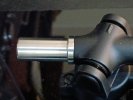
This is the latest offering in the world of aftermarket counterweights. Picture of the TNG-Spinner counterweight:

1723737726185.png
1723737739718.png
Posts will follow.
 
Register to hide this ad
The product arrived really quickly thanks to FedEx. It arrived properly packed, a cardboard box contained a two-piece plastic foam shell that encased a nice cloth pouch where the pieces were inside.

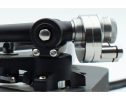
My goal was to replace the stock Rega RB220 counterweight which is this one:

IMG_20240814_174310.jpg

I understand the RB251 and RB250 uses the same counterweight setup so the upgrade apllies here.

This stock counterweight is clearly a cost reduction affair. It not rigidly attached to the stub, it will resonate or vibrate due to being held in position by just a spring-loaded pin. So here it is something that needs upgrade. Otherwise, I happen to like the RB220 tonearm (as fit on the latest Planar 2), it doesn't have the VTF adjustment spring which is believed by some to be detrminental to the sound.

The TNG-Spinner counterweight, as we will see, will add easy VTF adjustment to the RB220 tonearm and similar.

Also, the TNG-Spinner counterweight can be fit directly to RB303, RB330 and similar tonearms, as well (i will provide pics too).

So the first thing we do is to upgrade the rear stub, from a plastic Rega part to the TNGSpinner metal stub. A closeup shows the difference in quality:
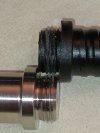
IMG_20240814_182850.jpg

Upgraded rear stub:

IMG_20240814_201506.jpg

The rear stub is of excellent quality and finish.

Doing this would already be a significant upgrade, since it allows a RP1 counterweight to fit on it, thus mimicking the arrangement on the RB303/330 tonearms.

IMG_20240814_201649.jpg

But we won't stop here, we'll gonna use the TNG-Spinner counterweight.

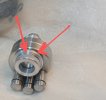
The counterweight assembly has three parts:

A. The counterweight itself. Available in three weight versions, here i'm choosing the heavier one. It can be augmented in weight by 1,2,or 3 outriggers, each one 10g in weight, allowing a nominal mass range of 110 to 140g. These outriggers just screw in. More on mass later.

B. The main cylinder, it supports the counterweight and mates with the rear stub. Here an internal rubber compliance gives some decoupling. This is a firm compliance, not floppy. Here is the main difference versus the Michell and Iceni counterweights: this is a decoupled design, as are the original Rega counterweights on all their turntables, up to the top P10 or Naia.

C. Counterweight retainer ring (see red arrows below). It fixes the counterweight in position. This is what enables lateral balance adjusment (see later).
IMG_20240814_173502~2.jpg

Installing the counterweight is just a simple matter of plugging it into the tonearm stub fully. However it is advised to lubricate the inside of the main cylinder (B) with a lubricant (Gus advised WD40) to make VTF adjustment easy. I confirmed that this was the case; it is a good idea.

I also recommend lubricating the counterweight thread so it centers itself easily while you slide the main cylinder (B).

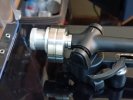
The picture below shows the counterweight on the stub. The correct installation would be to push it fully (it is not fully pushed in on this picture).
IMG_20240814_203801.jpg

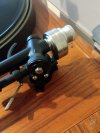
By the way, the counterweight fits directly on a RB303/330/similar tonearms, as mentioned above. Here it is on my RB303
(not inserted fully all the way in yet, but you get the idea)
IMG_20240814_180457.jpg

Once fit, it provides something that the stock counterweight (and most other counterweights) do not provide: lateral balance. You can skew (offset) the counterweight position so you compensate for lateral balance. Then you use the retainer ring (C) to keep the counterweight in the desired position.

Lateral balance allows the tonearm bearings to receive equal pressure, this increases sensitivity.

And, in this case similar to the other alternatives, it is an underslung counterweight that, thus, places the mass near the same plane as the stylus tip, just as in the SME 3009/III, SME IV, SME V, SME 309 and other great tonearms.

Fine VTF adjustment is possible by simply freeing the retainer ring (C) and then rotating (B), it allows adding or reducing VTF easily, if a bit slowly. If you are compensating for lateral balance, you will need to adjust lateral balance again after the VTF adjustment. If so, recheck the VTF afterwards.

The VTF adjustment itself is already an ergonomic upgrade. On the RB303/330 it also allows easier zero-in (balancing) of the tonearm before applying the regular VTF control dial.

As in any underslung counterweight, if you are using a VTF gauge make sure to measure VTF with the needle positioned at a height that is close to playing height. But you probably know that already.

 
Last edited:
It looks very nice on the P2:

IMG_20240814_204217.jpg


So, how does it sound?
Well, it sounds pretty good! But i need time to make proper tests and comparisons. I have the belief that my upgraded RB220 will sound as good as my RB303 using the same cartridge.

I am already happy to have a counterweight that looks much better, provides easy VTF adjustment and also allows for lateral balance compensation. Add an aftermarket VTA micrometer adjustment and you will have upgraded your Rega tonearm to all the adjustments a good tonearm should have!

Weight options

There are three options:

- Light: 90 to 120g
- Medium: 98 to 128g
- Heavy: 110g to 140g. This is the option I chose.

With the HEAVY counterweight on the RB220, i can balance out the AT-VM540ML cartridge to 2.0 grams with the counterweight sitting pretty close to the pivot. This is preferred -- counterweight as close to the pivot means less effective mass. (SME recommends this on the setup manual of the SME 3009/III, a tonearm with variable counterweight mass).

The AT-VM540ML weigths 6.4g, typical of many cartridges.

With the HEAVY counterweight on the RB303, i can balance out the AT-OC9XML cartridge(7.6g) to 2.0g VTF, also with the counterweight on the ideal position.

All this means that if you want to be able to use heavier tracking forces like 2.5g or 3.0g or even 4.0g with typical weight cartridges (6.0g), you would be better ordering the MEDIUM or LIGHT versions. Probably the MEDIUM version is the "one-fits-all" that will work fine with most cartridges.

It is obvious to me that the HEAVY counterweight will allow one to use heavier MC cartridges and/or all sorts of headshell spacers (Korf ceramic spacer comes to mind) and headshell accesories.

Customer feedback - Conclusion

I liked it so much that I have just ordered another one (MEDIUM this time), so both my Rega tonearms can have the upgrade.

My only complaint or suggestion for improvement is to make the retainer ring (C) thicker or easier to grip. It is not so easy to grip with the index and thumb. A minor complaint, really.
 
Last edited:
Safe to say you're a convert? Welcome to the dark side :eek:

If you have a little cash to spare you might want to try the headshell damper, too. It works, and Korf proved why.


All it takes is to put aside doubt and give it a listen. That goes for everything in this crazy hobby.

Enjoy!
 
You mean the Korf ceramic headshell spacer? It will try it sooner or later.
I meant the one I linked to at Canuck Audio Mart in the SME thread, but the Korf spacer should do as well; it's just much (much!) more expensive and may not provide the correct VTA.
 
I meant the one I linked to at Canuck Audio Mart in the SME thread, but the Korf spacer should do as well; it's just much (much!) more expensive and may not provide the correct VTA.
Hey ripblade I've been using the "headshell button mod" from the Canuckaudiomart link for a while now and it's been a real improvement.
Are you saying that, that mod will work harmoniously with an aftermarket counterweight like this groove tracer product?
'Cus I've been thinking 'bout swapping out the stock CW on my older planar3.
 
Hey ripblade I've been using the "headshell button mod" from the Canuckaudiomart link for a while now and it's been a real improvement.
Are you saying that, that mod will work harmoniously with an aftermarket counterweight like this groove tracer product?
'Cus I've been thinking 'bout swapping out the stock CW on my older planar3.
Yest it will, it's all cumulative. After the headshell damper, a CW is the most accessible improvement available for the Rega. I use the Riggle CCM which is a version of the OL structural upgrade, but I'm sure the TS is comparable. You can expect even more of the same: more clarity, dynamics and punch.

Enjoy!
 
So I just installed the TS Counterweight on my older planar3/rb-300, to which I had applied Ripblades "headshell damper" ( a few years ago).
First impressions are favorable. The most notable difference is in backing vocals (on Fleetwood Mac's Rumours). I can hear the different voices of each of the members singing in the background.
Before the addition of the new CW they were all there, but as a mass - not as separate and distinct voices, the way are now- after the new CW.
Overall tighter sounding drums and bass and more specific placement ( location in space) to vocals and instruments.
If anyone hasn't tried the rega tonearm damper ripblade suggested, it is dirt cheap and completely (easily) reversible.
By itself it made a big difference in what I heard. However, that mod plus this counterweight upgrade has my smiling from ear to ear!
 
What can I say, Gustavo is a wonderful person to do business with.
Ordered on the 6th - shipped from Argentina (?)
Arrived here in Ontario, Canada 9 days later.
 
I must admit, I was surprised to find the cheap plastic stub on the tonearm of my new Rega Planar 2 I bought a couple of years ago. While I'm pleased with the sound quality now, The steel stub and underhung counter weight looks like a nice upgrade.

I just don't know what weight range to choose with the stock Carbon cartridge, or if I upgrade to the Goldring E3 do I need a different weight.
 
Go to the TS website and send Gustavo a message. He will ask you some questions and help you choose what's right.
He's very helpful, quick to respond and easy to reach.
 
I have just installed the new counterweight on my Rega Planar25. Also the new air-isolated aluminum feet and the brass/vesconite bushing with the single belt Troilo subplatter. To lubricate the bushing, I used COMP cam and lifter lube and kept the good Goldbug Clement II moving coil. So far after playing one record, a shaded dog Mancini Combo album, I can say that the high end is more apparent and the separation of instruments. The bottom end is solid and noticeable increase in the stability of the presentation, on the order of a tuned Thorens TD125 Mark II. I give them a thumbs up.
 
Back
Top Bottom