ohmmmmmmmmmm
Big voltage and small current? So the 200 amps peak available from say MC1.2KWs is somehow inferior to the 275? Hmm, seems to me in your passion for tubes, you are trying to bend the Ohm's law once again...

As the impedance drops, it opens up the "flood gates" of current in any amp, that is something the SS amp is much more prepared to do over tubes. Not sure what your beef is with McIntosh SS amps but the 501s for example, will put out 1000w into a 2 ohm load from its 4 ohm tap. Try that with a tube amp.
It's all good though, I know you love tubes, I have nothing against them, if you find them to your satisfaction with the MLs, then that's all that matters.

Sometimes, I can't understand why all kinds of positions/attitudes are ascribed to me which I never expressed?
First of all. what I said was "watt-for-watt". Maybe it wasn't clear that what I meant was two amps of the
same rated output. Comparing a MC1.2KW's to MC275's is
hardly watt-for-watt. However, I
am indeed saying that for each watt in two equally powerful amps, the tube amp has a greater amount of current in each watt and the ss amp has more voltage, because . . .
Second, according to ohms law (and this is for DC but the principle is similar for AC audio signals) in electric circuits, power is a function of
both voltage
and current. However, power (P) is exactly equal to current (I) multiplied by voltage (E), rather than merely being proportional to IE. When using this formula, the unit of measurement for power is the watt, abbreviated with the letter "W."
It must be understood that
neither voltage nor current by themselves constitute power. Rather, power is the combination of both voltage and current in a circuit. Remember that voltage is the specific work (or potential energy) per unit charge, while current is the rate at which electric charges move through a conductor. Voltage (specific work) is analogous to the work done in lifting a weight against the pull of gravity. Current (rate) is analogous to the speed at which that weight is lifted. Together as a product (multiplication), voltage (work) and current (rate) constitute power. So when your 501 is pumping 1000W into 2 ohms, very little of that 1000W is made of current. It's mostly voltage. And that's terrific for driving speakers with lots of voltage hungry dynamic drivers.
So, not all watts are made the same way. Some have more volts and less current (ss amps into low impedance) while other watts have less volts and more current, and still others have pretty much equal amounts of both; like tube amps with output transformers and (McIntosh) ss amps with autoformers.
You're right, I do love tubes
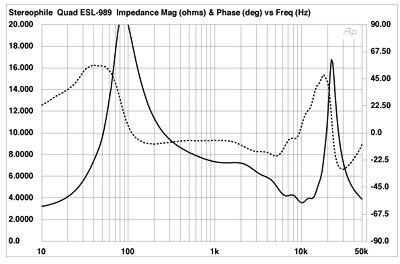
in their place! (and the same goes for ss:yes: ) If a transducer/driver thrives on lots of voltage being available, I go SS. If it thrives on lots of current being available, then amp for amp (same wattage output!) I go for a toobie. That's all. It's nothing arbitrary or subjective. Both can sound terrific properly applied. My point is that due to the nature of electrostatic transducers, a tube amp will naturally be the best choice from a
current delivery standpoint. Oh sure, you can buy a monster 1000W ss amp and there will be enough current, but really, does that make a lot of sense? Especially when electostats are naturally bright to begin with? Tube amps (good ones like the MC275) are famous for the sweetest midrange; and as Steve Hoffman says in his "Breath of Life" diatribe :yes: if ya ain't got great mid-range, ya ain't got nuthin'!
Gotta go now, hope I didn't upset anyone :thmbsp: