• The move to the new server is done. There are some software and database maintenance updates in process. This has us passing the hat around to help out. We appreciate any donations. Seriously, even a dollar helps. The payment page may be found here - https://www.audiokarma.org/support.html

New tweeters for old speakers, how do you match them?

Alex22

Well-Known Member
Hi I have an old pair of Wharfedale 507.2's rescued from the trash with one bad tweeter. My first speakers were 505.2's back in 1988 which I loved in my first hi-fi system. The 507.2 speakers are almost the same just ported at the back. They are not exactly the best speakers ever made but should be quite good for the garage or bedroom system.

Ideally I will pick up a used tweeter and do a straight swap but finding one may not happen.
How would I go about matching a new (cheapish) pair of tweeters to these speakers?

Both main drivers measure 5.6 Ohms and the one working tweeter is also 5.6 Ohms. The speakers are rated at 100w 8 Ohms and the sensitivity is (2.83v @1m) 87db.

The only specs I could find was this:
Wharfedale 507.2: two-way. reflex-loaded, stand-mounted loudspeaker. Drive-units: 0.75" aluminum-dome, ferrofluid-cooled tweeter, 8" mineral-loaded, polypropylene-cone woofer. Cross- over frequency: 5kHz. Frequency response: 40Hz-22kHz +3dB. Sensitivity: 87dB/W/m. Nominal impedance: 8ohms. Amplifier requirements: more than 15W. Dimensions: 19" H by 9" W by 11" D. Weight: 22.5 lbs/pair.

Am not sure how accurate this is as it is from an old magazine article and not manufacturers data.

Any advice would be very helpful. Oh and I really don't want to have to modify the crossovers.

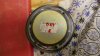
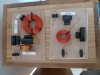
A couple of pics.
P1030776.JPG P1030793.JPG P1030784.JPG P1030789.JPG P1030790.JPG
 
Register to hide this ad
There are many options and prices. First thing is to find one that fits, measure the opening for the flange and cut out for clearance, then see if you can match the 87dB sensitivity, assume you need an 8 ohm impedance. I have replaced a few using Morel tweeters, a bit expensive but very good quality
 
There are many options and prices. First thing is to find one that fits, measure the opening for the flange and cut out for clearance, then see if you can match the 87dB sensitivity, assume you need an 8 ohm impedance. I have replaced a few using Morel tweeters, a bit expensive but very good quality

Yes they would need to be 8 Ohm. But 8 Ohm is just an approximation, would a meter reading of 5.6 Ohm like the original be more accurate? Or is it not so critical?
And I would definitely want to match size as I would still like to find an original tweeter eventually.

I like soft dome but would aluminium dome be better as it would more closely match the original?
 
One more thing, the speakers are rated at 100w do the tweeters need to be rated at 100w, or do they not get so much power delivered to them?
 
There is the dcr measurement and spec for the nominal impedance which combines the inductance that is frequency dependant.
100w is usually a music power spec vs a continuous sine wave spec
Soft or hard dome it comes down to personal preferences.
5kHz cross over frequency is pretty high but it depends on the fall off rate as well
 
I have been looking at cheap tweeters on parts express and tweeters that I used 12 years ago to make a pair of mtm speakers that I still use now and really like are still available. So I know that the tweeters are quite good for the price, don't want to spend a fortune to fix these little Wharfedales. Added bonus would be that if I find an original tweeter they could be spares for my diy speakers.

The tweeters are 50w 89db with a dc resistance of 5.4 Ohm, the originals are 5.4 Ohm.
I think that they may do the job at a reasonable price and I know that they work well although I do not know how they will perform in the Wharfedales.

I'M SUCH A FOOL!!!!!!! , why don't I whip one out of my speakers and see how it sounds in the Wharfedales?????

These are the cheapish tweeters https://www.parts-express.com/Dayton-Audio-DC28F-8-1-1-8-Silk-Dome-Tweeter-275-070.

Will give it a try tomorrow.

And yes I really only thought of trying them while writing this post.
 
Like you mentioned, the best option is to find an exact replacement tweeter. Now if you buy the Dayton silky, buy a pair. But you're still probably going to need to build an L-pad for that tweeter. It's at least 2dB hotter than the woofer. You will probably need more attenuation than that, because many speaker manufacturers like to stretch the truth about sensitivity on their spec sheets.

Now if you've spent any time on PE's forum, you probably already know that 99% of the time you can't just plop a tweeter into an existing design and expect great sound. Just too many variables that really need to be measured and then sorted out. If it's just for fun, or a desire to mess around with these, have a blast. Just don't expect audiophile quality.
 
Now if you've spent any time on PE's forum, you probably already know that 99% of the time you can't just plop a tweeter into an existing design and expect great sound. Just too many variables that really need to be measured and then sorted out. If it's just for fun, or a desire to mess around with these, have a blast. Just don't expect audiophile quality.

I agree with everything you just wrote.
When I made my speakers i used a pre-existing design, no chance that I could match components design a cabinet with the required volume and build, measure and asses the crossover etc.
Like you said the best possible outcome for me will be to get an original tweeter, I can wait for one to cross my path even if it takes some time, this is definitely what I will do.
But as I have these tweeters in my diy speakers I can as you said have some fun and mess around a bit, without buying anything. I don't expect a good result, but likely I will learn something at least.


I have e-mailed Wharfedale but as they have changed ownership at least once (I think more) I'm not expecting anything useful from them unfortunately.
 
Hi Alex22

With limited measuring and testing abilities, you are 99.99% guaranteed to get a much less than perfect result when using a new tweeter in an existing design. There are a lot of variables as mentioned above. Matching crossover components to a driver (tweeter in this case) and also matching two drivers (woofer and tweeter) are non-trivial tasks. Yes, it is true that you will see reports of success with this type of project. But those reports are the result of expectation bias...i.e. the doer believed he would be successful before undertaking the project, and his ears (read brain) verified success afterwards, just as expected. That is so much easier than the alternative. But I can promise you that frequency response measurements would tell a very different story in practically all of those cases.

My point is this, I think it would be best to only buy one replacement tweeter, and consider it to be a temporary fix. Keep the good original tweeter intact and keep checking ebay (or elsewhere) for a replacement original tweeter.

While waiting to find that original replacement, you will at least have one speaker playing with the original tweeter which is good for a couple reasons. First, whatever imbalance is introduced by the new tweeter, being unmatched to both the orig crossover and to the woofer, will not be multiplied x2. If the new tweeter is too hot, or the crossover point is wrong (both likely), then at least it will only be one tweeter that is out of whack. And secondly, keeping the working original tweeter intact will give you an audible point of comparison for the speaker with the new tweeter, for whatever you might choose to do in attempting to duplicate the original sound. L-pad was mentioned above, a simple series resistor is another option.

If you had means of measuring frequency response and impedance (impedance across the frequency range, not just the simple "nominal" impedance, and not just the simple DC resistance), then dialing in a tweeter (by modifying the crossover) would be possible. But without those capabilities, chances are not even as good as a crap shoot because the dice will show the numbers you want occasionally.

Assuming no testing/measurement and going only off of published specs, to choose one replacement tweeter this is what I would suggest. Some of this has already been suggested:
---matching physical size without hacking up the cabinets. If (or when) you do find original tweeter replacements you want it to fit as original
---as I see no attenuation resistors in your original crossovers, I will assume that the original tweeters are in the neighborhood of 87db sensitivity, which is low for a tweeter. In choosing a new tweeter I would try to stay as close as possible to 87db
---as for matching the DC resistance of 5.6, it is a low priority. There are two cases to consider: (1) if you do not intend to attenuate the new tweeter, then yes, keeping the DCR around 5.6 ohms might be a low priority goal (but you won't know how impedance varies across the frequency spectrum for either tweeter, particularly in the crossover region), (2) if you do intend to match the tweeter sensitivity to the woofer, that would require some resistance in series, so there is no need to choose something matching the original tweeter's DCR


Those are nice speakers. Looks like quality drivers and crossover components and some thoughtful touches. Having no electrolytic capacitors in the crossover is above and beyond many mid-tier commercial speakers out there. They made the effort to properly orient the coils in relation to each other. The woofer appears to have a cast frame, and a mounting gasket. IMO those Wharfedales are worthy of an extended search to find the correct original tweeter replacement. In the mean time, yeah something from Parts Express will do for garage duty.

good luck with your project
 
Last edited:
I've used several of the Dayton silk domes. I haven't been disappointed yet. The silk does I used were 1" and 1 1/8" inch. Both sounded detailed, yet smooth.

Yes I have used them in my only speaker build (Dayton Audio DC28F-8) 12 years or more ago, like them very much. Was thinking of trying them in the Wharfedales but now thanks to all those who have replied it doesn't look like they would be suitable. Still later today i will whip one out of my diy's just for fun to see (hear) what happens.
Honestly I think that anything is better than the sound of this speaker without a tweeter, I find it quite unsettling.
 
My point is this, I think it would be best to only buy one replacement tweeter, and consider it to be a temporary fix. Keep the good original tweeter intact and keep checking ebay (or elsewhere) for a replacement original tweeter.

I will absolutely be looking to obtain an original tweeter.
I actually hadn't considered replacing only one, a matched pair made more sense to me. You have shown me that there are better reasons to just replace the bad one as a temporary measure.
---as I see no attenuation resistors in your original crossovers, I will assume that the original tweeters are in the neighborhood of 87db sensitivity, which is low for a tweeter. In choosing a new tweeter I would try to stay as close as possible to 87db
Most of the tweeters I have seen on parts express are 90db and over, there are a couple around 87db.
Those are nice speakers. Looks like quality drivers and crossover components and some thoughtful touches. Having no electrolytic capacitors in the crossover is above and beyond many mid-tier commercial speakers out there. They made the effort to properly orient the coils in relation to each other. The woofer appears to have a cast frame, and a mounting gasket. IMO those Wharfedales are worthy of an extended search to find the correct original tweeter replacement. In the mean time, yeah something from Parts Express will do for garage duty.

I was actually hoping to find an electrolytic capacitor in the crossover, but that would have been too easy. I think these speakers were quite well thought of back in the day, at least in the UK. The enclosures are rigid and quite heavy, made from mdf so they are easily damaged on the corners, but apart from that are quite reasonable.

Thanks for such an informative reply.
 
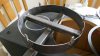
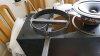
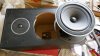
One thing about these speakers is that the drivers are a pig to get out, They need a special tool that was supplied to dealers.
I don't have that tool so had to try to make something to do the job. Even then they needed quite a bit of force to turn them.

Not pretty but it did the job.
P1030779.JPG

P1030780.JPG
 
Last edited:
Holy carp - that is insane. Great job on the tool fabrication! I wonder if they did that just to avoid unsightly screws? Maybe to keep users from messing with the innards? I personally think the engineers had a contest to see who could come up the craziest way to mount a woofer that the beancounters would approve.
 
Holy carp - that is insane. Great job on the tool fabrication! I wonder if they did that just to avoid unsightly screws? Maybe to keep users from messing with the innards? I personally think the engineers had a contest to see who could come up the craziest way to mount a woofer that the beancounters would approve.

Yes it is very strange. This was the 80's and I'm not sure that stopping people getting inside was the main objective, not like today. But who knows? it would have occurred to them that it would be difficult for the end user to get inside or replace drivers.
They were certainly in very snugly so it is an effective way of mounting the drivers. I thought that they were bonded to the enclosure by time and seasonal temperature changes but after removal there was no stickiness or other signs of self adhesion, they are just very solidly mounted.

I did try to tap with a screwdriver and hammer but quickly realised that it I would cause too much damage doing that, thus the improvised tool.

Wharfedale did have several models in this range using the same mounting system but it looks like they abandoned the idea. I'm guessing that they got too many complaints about it.

Personally I like your theory about the engineers having a contest.
 
I also had a tweeter die on me, but could not find one that matched the older Wharfes that I had. So, instead of replacing just the one in case of a poor match up with the other, decided to go with another European brand...I believe it was a Philips. The tech-guy where I picked it up said that it would be a good match, and that mids would be a tougher to replace.

After the new installs, I noticed little or no difference than from the origs.

FWIW


Q
 
Last edited:
Yes, that woofer mounting method is something I had not seen before. I am impressed by the tool you made to remove it.

I wonder what their reasons were for using that type of mounting? The speaker would definitely look nicer with no screws showing in either driver. I wonder if improved mechanical coupling of the woofer to the cabinet, or better air seal were also considerations?

I got curious and looked up the Wharfedale "507.2 Precision" in my 2005 Orion Blue Book. The book says those listed for $470 each and were made from 1988-1990. Although Blue Book is not known for great accuracy, I am going to believe that these were $470 each list. I have never had a pair of Wharfedale speakers. It seems to me that some care went into the design of this pair.

Something else...looking at the woofer in your second pic of post #13, it appears that perhaps that is a curvilinear cone?
 
Last edited:
Yes, that woofer mounting method is something I had not seen before. I am impressed by the tool you made to remove it.

It wasn't too hard to make just needed a little fine tuning with a file to get it to fit.

$470 sounds about right. I had some 505.2's that I bought in 1988 for 180 pounds almost the same speaker maybe an inch shorter and not ported.
I believe that they were both considered very good for the price.

They do indeed look quite well constructed.
 
My Blue Book shows the 505.2 at $560 per pair original list price, so $280 each. If the book is correct, your 507.2 speakers were a fairly significant step up from the 505.2 based on original list price.
 
Last edited:
My Blue Book shows the 505.2 at $560 per pair original list price, so $280 each. If the book is correct, your 507.2 speakers were a fairly significant step up from the 505.2 based on original list price.

I missed the "each" in your post. I saw an article from Stereophile jan 1989:
Wharfedale 507.2: two-way. reflex-loaded, stand-mounted loudspeaker. Drive-units: 0.75" aluminum-dome, ferrofluid-cooled tweeter, 8" mineral-loaded, polypropylene-cone woofer. Cross- over frequency: 5kHz. Frequency response: 40Hz-22kHz +3dB. Sensitivity: 87dB/W/m. Nominal impedance: 8ohms. Amplifier requirements: more than 15W. Dimensions: 19" H by 9" W by 11" D. Weight: 22.5 lbs/pair. Price: $940/pair. Approximate number of dealers: 120. Manufac- turer: Wharfedale Ltd., Sandleas Way, Crossgates, Leeds, West Yorkshire LS15 BAL, UK. Dis- tributor: Vector Research Inc., 1230 Calle Suerte, Camarillo, CA 93010. Tel: (805) 987-1312.

I thought that the price was a typo or something, maybe not as you have found similar information. They could be better speakers than I thought, I keep thinking that they are just slightly bigger 502.2's apparently not.

I guess that settles it I will put them aside and wait until I find an original teeter to get them working as intended by the designers.

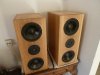
I don't think that they will best my diy Dayton III's I made ages ago with a saw, some sandpaper and scraps of oak. But that's not the point.

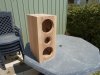
Some pics of my daily drivers. I love them, but I'm biased.

I could do a better job now as I have access to a friends well equipped workshop, still I am quite happy with them, and love he sound.
P1020134.JPG

Pretty dodgy crossover work but it was a first attempt.
P1020152.JPG


Ok live wood is not the best choice for enclosures but I just like real wood. And they are thick and solid.
P1020238.JPG
 
Back
Top Bottom