• The move to the new server is done. There are some software and database maintenance updates in process. This has us passing the hat around to help out. We appreciate any donations. Seriously, even a dollar helps. The payment page may be found here - https://www.audiokarma.org/support.html

New tweeters for old speakers, how do you match them?

Those are beautiful IMO :thumbsup:

Drivers are countersunk nicely. All the joints look very tight and the corners rounded. Very nice work. I am not certain on this, but I believe the main disadvantage to "live wood" as you call it, vs MDF or plywood, is being more likely to warp. But if the pieces used are well seasoned, or physically smaller, then warping is less likely. Those cabinets look rock solid to me.

Parts Express does have some good drivers and DIY speaker designs. I am only about 80 miles or so from them. And have ordered from P.E. many times, just small parts and drivers, haven't built any of their kits myself.

As for the 507.2's ...who knows you may never find an original tweeter. You might possibly be able to research that tweeter to see if it was used in other models, if it was your chances would be better. But even then...they are from about 30 years back. So please don't make any decisions based solely on my posts, especially if you have a good current use for those speakers. I am offering my opinions as part of the mix of ideas for you to consider. But unless you plan on going to the trouble of a proper crossover re-design (which would require a lot of time, a steep learning curve, plus some investment in a mic and possibly other tools), then I stick with my suggestion to only replace one tweeter.


As for the difference between the 505.2 and the 507.2 ...this is pure speculation as I have no direct experience with any Wharfedale speaker...but cast frames and curvilinear cones are two features that would add expense, and improve sound, of the 507.2 woofers. So I wonder if the 505.2 woofers lacked those features?
 
Last edited:
I have been looking at cheap tweeters on parts express and tweeters that I used 12 years ago to make a pair of mtm speakers that I still use now and really like are still available. So I know that the tweeters are quite good for the price, don't want to spend a fortune to fix these little Wharfedales. Added bonus would be that if I find an original tweeter they could be spares for my diy speakers.

The tweeters are 50w 89db with a dc resistance of 5.4 Ohm, the originals are 5.4 Ohm.
I think that they may do the job at a reasonable price and I know that they work well although I do not know how they will perform in the Wharfedales.

I'M SUCH A FOOL!!!!!!! , why don't I whip one out of my speakers and see how it sounds in the Wharfedales?????

These are the cheapish tweeters https://www.parts-express.com/Dayton-Audio-DC28F-8-1-1-8-Silk-Dome-Tweeter-275-070.

Will give it a try tomorrow.


IMHO Cheap might be OK, but generally you get what you pay for.
 
IMHO Cheap might be OK, but generally you get what you pay for. I wouldn't chance reducing the power rating, either. Looks like a fun "recycling" project!
 
I've built a couple of the smaller PE soeaker kits. The BR-1 kits I really like.

Interesting the BR-1 kit uses the same woofer and tweeter as my diy speakers, I imagine that they sound very nice indeed. I actually went for an MTM speaker mostly because I really like the look of them and I find the bass really pleasing. For budget components the woofers and tweeters are really satisfying.

If I ever make another set of speakers I think that I may go the TMW route, I really don't know if it is a good configuration or not but I like the idea splitting the frequencies into three separately handled parts.
 
Those are beautiful IMO :thumbsup:
Drivers are countersunk nicely. All the joints look very tight and the corners rounded. Very nice work. I am not certain on this, but I believe the main disadvantage to "live wood" as you call it, vs MDF or plywood, is being more likely to warp. But if the pieces used are well seasoned, or physically smaller, then warping is less likely. Those cabinets look rock solid to me.

Thanks for your kind words, they are very solid and heavy. i actually cut an old car inner tube into gaskets for the woofers and tweeters to seal them, I don't know if it is an acceptable strategy but it really seals them nicely, added bonus is that your local tyre guy will be more than happy for you to take a couple off his hands.
Haven't had any warping at all from the oak so no problem there but different woods vary greatly in stability. As you pointed out well seasoned wood (and seasoned to local conditions) should be stable.
I think that the possible drawback of wood is that it may resonate, think of a guitar body, not usually recommended fro speakers. I have heard that people have even made enclosures out of concrete, wouldn't like to carry them too far.

As for the 507.2's ...who knows you may never find an original tweeter. You might possibly be able to research that tweeter to see if it was used in other models, if it was your chances would be better. But even then...they are from about 30 years back. So please don't make any decisions based solely on my posts, especially if you have a good current use for those speakers. I am offering my opinions as part of the mix of ideas for you to consider. But unless you plan on going to the trouble of a proper crossover re-design (which would require a lot of time, a steep learning curve, plus some investment in a mic and possibly other tools), then I stick with my suggestion to only replace one tweeter.

I found out a couple of weeks ago that models 506, 508 and 708 use the same tweeters so that may come in useful in my search but they don't appear to be many around.

Don't worry you haven't put me off non-original replacements, it is more that the connections on the tweeters are opposite each other and not next to each other as on most tweeters so I would have to modify the openings, not a big deal but would like to avoid that. Wharfedale tweeters would fit without modification but would come without specs so introduce their set of challenges.

You are correct, much as I would love to know more about speaker design spending years learning isn't very practical for one-off situations like this.

Anyway I am on the lookout for originals or a Wharedale tweeter from a different model that physically fits as a temporary measure.
 
I found some interesting information on this page about the Wharfedale 708, which I believe is closely related to to the 507.2 and 505.2
https://www.whathifi.com/us/features/10-of-the-best-wharfedale-speakers-of-all-time.

Both the 708 and the 505.2 made that list and received a few paragraphs describing them. Quotes below are excerpts only, not the entire write-up for each model.

RE 708:

"The big news here was the enclosure material. Wharfedale’s chief engineer had just come over from Celestion where he did pioneering work on speaker cabinets using an aluminium honeycomb material in that company’s SL600 high-end flagship. This material’s rigidity and low mass resulted in vanishingly low levels of cabinet colouration compared to the wooden alternatives of the time. The same material couldn’t be used for Wharedale’s 708 because of their more modest selling price, so a more economical alternative had to be found. And it was.

The 708’s 28mm-thick panels were formed by sandwiching polystyrene foam between two sheets of Melamine. It worked really well from a performance point of view, giving the speakers an astonishing clean presentation for a model at their price."

and also...

"The engineers also did away with conventional bolt fixings for the both drive units, developing a camera-lens-like screw fit into the cabinet instead. The advantage was claimed to be more even clamping pressure, and let’s not forget it looked neater thanks to the lack of visible fixings."


RE 505.2:


"The 505.2 were another massive success for Wharfedale, sitting in the mid-market and delivering a sound of impressive polish and insight. They were a £169 two-way standmounter that echoed the clean-cut appearance of the mighty 708, but at around half the money. There was no fancy lightweight cabinet here, though, as the budget couldn’t accommodate such extravagancies.

The standard 505.2 used a basic chipboard box..."


I wonder if the 507.2 used enclosure material similar to, or the same as, the 708? :dunno:

.
 
A bit off-topic but the Dayton III's were my first (and so far only) speaker building project over 15 years ago, and they're still my daily drivers in my living room (although I recently swapped out my FIRE ENGINE RED paint for a maple veneer / off white paint combo). They're really fantastic speakers that make me smile every time I listen to them.

Mike
 
I wonder if the 507.2 used enclosure material similar to, or the same as, the 708? :dunno:

The 507.2 is particle board as you may be able to see from my photos, I keep calling it mdf but of course that is not quite correct. They are quite solid but are easily damaged on the corners if abused.

I can certainly attest to the clamping pressure being superior to screws as they were a bugger to get out, so much so that I thought they had bonded themselves over time to the enclosures. I guess we have are answer as to why the engineers came up with this design. Needing a special tool for servicing/repair could be why it wasn't used in speakers after this.
 
A bit off-topic but the Dayton III's were my first (and so far only) speaker building project over 15 years ago, and they're still my daily drivers in my living room (although I recently swapped out my FIRE ENGINE RED paint for a maple veneer / off white paint combo). They're really fantastic speakers that make me smile every time I listen to them.

Great to hear from another person who has made the Dayton III's. I am also very happy with the SQ of mine, I'm not sure how much i would have to spend to get a better sounding speaker off the shelf, so much so that I would be afraid to buy speakers because of the fear of being disappointed and wasting money.
 
Ok so I have an update for my old rescued Wharfedale 507.2's. Finally after more than a year I came across the correct tweeter on that auction site (by the way why do we avoid the sites name here?).

They were $14 each. I bought the pair so I will have a spare just incase. It is also possible that they are matched at the factory so buying the pair was hopefully good move.

They are installed and working but i haven't had time yet to really listen to them. I did love my 505.2's back in the day and I am interested on seeing how these compare, not that it is really possible to compare them to a 30 year old nostalgic memory!
 
Ok so I have an update for my old rescued Wharfedale 507.2's. Finally after more than a year I came across the correct tweeter on that auction site (by the way why do we avoid the sites name here?).

They were $14 each. I bought the pair so I will have a spare just incase. It is also possible that they are matched at the factory so buying the pair was hopefully good move.

They are installed and working but i haven't had time yet to really listen to them. I did love my 505.2's back in the day and I am interested on seeing how these compare, not that it is really possible to compare them to a 30 year old nostalgic memory!
Do you have a part number please? I'm in the same situation... Oh, and about that tool you made... ;)
 
Do you have a part number please? I'm in the same situation... Oh, and about that tool you made... ;)
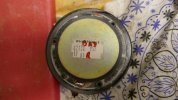
All I know about the tweeter is what is on the back in this picture. The 505.2 and the 507.2 use the same tweeter which could double your chances, could be other models use it as well but I have no information on that. As for the tool maybe you can come up with something similar or better, just don't go at it with a hammer and screwdriver the casting of the driver frame can shatter quite easily. I saw a post somewhere that a driver was destroyed this way.
The tweeters come out with three screws which are under a cover you can just pull off.


P1030790.JPG
 
Back
Top Bottom