• The move to the new server is done. There are some software and database maintenance updates in process. This has us passing the hat around to help out. We appreciate any donations. Seriously, even a dollar helps. The payment page may be found here - https://www.audiokarma.org/support.html

New W&F Analyzer + Polar Plots

JP

7480 74111110101115
My project this week was a web browser based W&F analyzer application. It complies with AES6-2008 / DIN 45507 / IEC 60386 / CCIR 409-2 standards. It runs completely within your web browser and processes whatever files you give it on your computer.

You can play with it here: W&F Analyzer

If you don't have your own W&F tracks recorded and want to play with it, this link will launch it with one of my test files.

Geek stuff here.

 
Last edited:
Register to hide this ad
I for one would love to see all of the TOTL Japanese Direct Drive tt measured this way. I don't doubt your objectivity for a moment.
 
  • Like
Reactions: JP
My project this week was a web browser based W&F analyzer application. It complies with AES6-2008 / DIN 45507 / IEC 60386 / CCIR 409-2 standards. It runs completely within your web browser and processes whatever files you give it on your computer.

You can play with it here: W&F Analyzer

Very nice. And the interface (UI) looks pretty neat.

So many useful scripts are often hard to install and use. This one looks as easy to use as possible.
 
Can't poke at it from here, but I'm assuming this requires a test record with a tone recorded at some frequency for the app to work with?
 
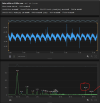
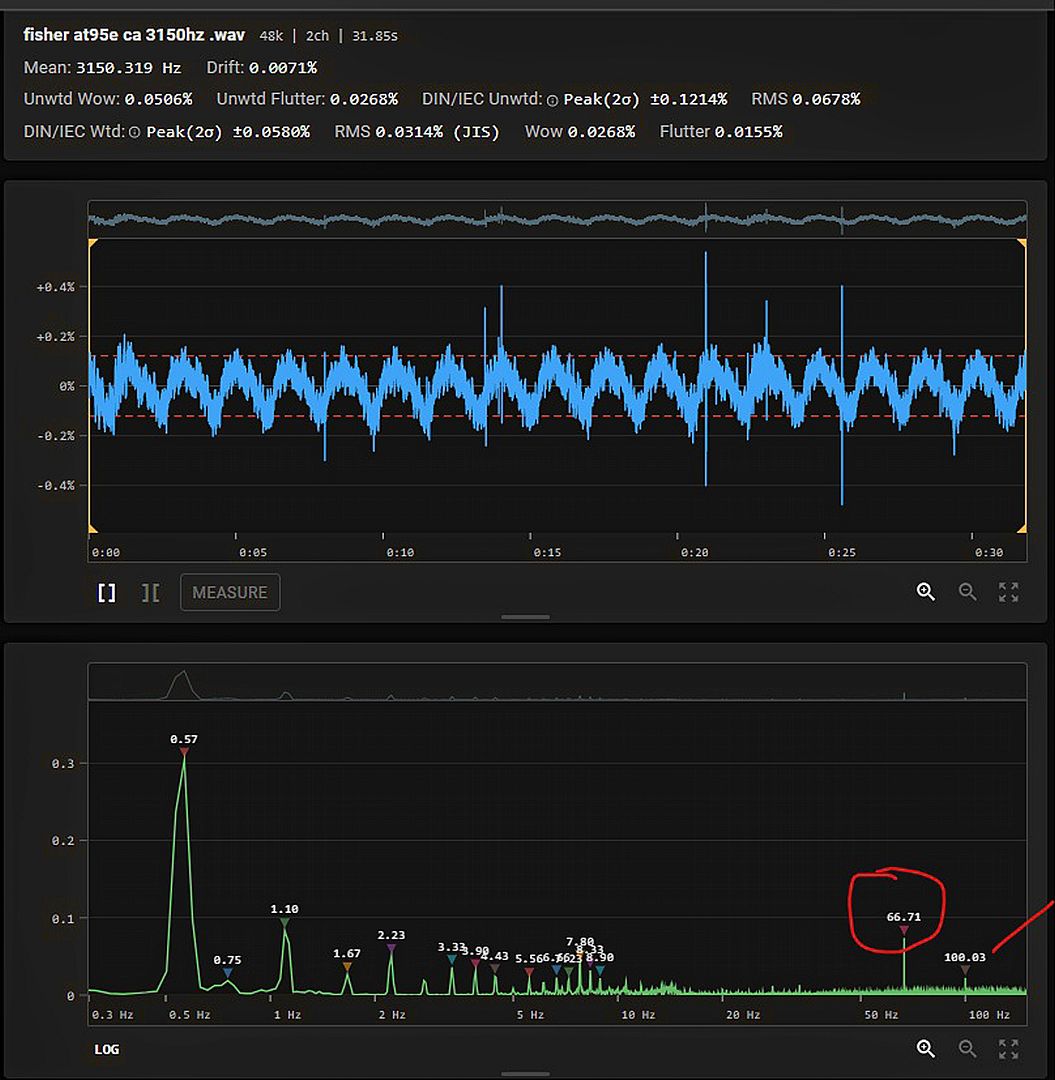
Here the plot reveals the DD players cogging at 66.7hz and 100hz transformer vibrations. And yes the cogging is audible…Note the test record eccentricity/off center has a major effect on the results
index.php
 

Attachments

  • IMG_2944.png
    IMG_2944.png
    103.9 KB · Views: 4
Here the plot reveals the DD players cogging at 66.7hz and 100hz transformer vibrations. And yes the cogging is audible…Note the test record eccentricity/off center has a major effect on the results

It says fisher... considering the 66.71Hz noise on the spectrum, i'm guessing this is the Fisher's 120-pole "linear" motor?
 
All plots from Shaknspin , not comparable with 3150 hz wav results, but done fore relative comparison

100 000 usd turntable...belt driven


1774290213616.png


Another high end TT 20 000 usd
1774289470733.png


High end DD 12 000 usd
1774290699283.png


1000 usd Turntable belt drive less than half speed variation than high end TT
1774289652433.png

Very well know DD player
1774289854848.png


My own belt drive. Used to be sold for 2000 usd before pandemic and vinyl took off, now over 5000 usd...crazy increase
1774290948741.png

My Denon 51F from 1982
1774291590628.png


and we can go on, cheap 70s entry level DD Sony PS-212 bought for 30usd, it has variation 2S value as the 100 000 usd TT
1774291769451.png
 
Last edited:
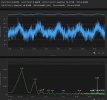
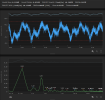
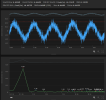
Here is mine, a belt drive, Linn Axis with an LP12 platter and Tacet test record, 3150 Hz signal. It is obvious there is a low frequency drift here. And 0.5 and 1.0 Hz which is below the usual rotation frequency, which I speculate is belt creep and belt "issue". Can be seen on other belt drives also.

Sk-rmavbild-2026-03-23-kl.-19.32.56.png


Sk-rmavbild-2026-03-23-kl.-19.33.09.png

Sk-rmavbild-2026-03-23-kl.-19.33.19.png
 
All plots from Shaknspin , not comparable with 3150 hz wav results, but done fore relative comparison

100 000 usd turntable...belt driven

Another high end TT 20 000 usd

High end DD 12 000 usd

1000 usd Turntable belt drive less than half speed variation than high end TT

Very well know DD player

My own belt drive. Used to be sold for 2000 usd before pandemic and vinyl took off, now over 5000 usd...crazy increase
My Denon 51F from 1982


and we can go on, cheap 70s entry level DD Sony PS-212 bought for 30usd, it has variation 2S value as the 100 000 usd TT

Absolutely loved this post.

Care to comment more about the 1st example? Exactly how the drive system is done? My instinct tells me this is a turntable where the belt is very tiny or is a silk thread or some exotic thing like that.
 
Regarding using silk thread or the Sulky polyester thread 0.004 inch/0.1 mm as a belt, there is an anecdote 2007 on a Swedish forum regarding reducing the dynamic wow/drift of the LP12 by parallell coupling the rubber belt with silk thread.

I might make an experiment, now when a good tool is present. Perhaps it could stabilise drift issues as well.
 
Can't poke at it from here, but I'm assuming this requires a test record with a tone recorded at some frequency for the app to work with?

Yes, or the motor FG of a direct drive. Basically, it's designed for a quasi-sinusoidal signal from 50Hz to 5kHz. Proper W&F tracks are either 3kHz JIS, or 3.15kHz DIN/IEC/CCIR. This tool doesn't care. You just need to be cognizant of low frequency carriers, as the carrier frequency is Nyquist for the measurement, so a ~100Hz FG signal will have a useable FM bandwidth of 40Hz. That's right at the limit of rotational artifacts, but technically below AES6 minimum bandwidth of 200Hz.
 
Absolutely loved this post.

Care to comment more about the 1st example? Exactly how the drive system is done? My instinct tells me this is a turntable where the belt is very tiny or is a silk thread or some exotic thing like that.
First post. Quite wide flat belt. Price has actually increased to 150 000 usd I see…I have many more plot of high end TT some are ok, very few really good, most are mediocre. It all comes down to belt quality in the end.Thomas Linn Axis post #8 beats all of them. Good belt and very skilled owner matters.
 
Last edited:
Yes, or the motor FG of a direct drive. Basically, it's designed for a quasi-sinusoidal signal from 50Hz to 5kHz. Proper W&F tracks are either 3kHz JIS, or 3.15kHz DIN/IEC/CCIR. This tool doesn't care. You just need to be cognizant of low frequency carriers, as the carrier frequency is Nyquist for the measurement, so a ~100Hz FG signal will have a useable FM bandwidth of 40Hz. That's right at the limit of rotational artifacts, but technically below AES6 minimum bandwidth of 200Hz.
Thats what I figured. I have a test record or two around somewhere, don't know what they happen to have. I know one has several different frequencies All of my stuff is AC synchro motors, either belt or idler drive so no connection to the generator unless I want to just poke something into the wall.
 
Regarding using silk thread or the Sulky polyester thread 0.004 inch/0.1 mm as a belt, there is an anecdote 2007 on a Swedish forum regarding reducing the dynamic wow/drift of the LP12 by parallell coupling the rubber belt with silk thread.

I might make an experiment, now when a good tool is present. Perhaps it could stabilise drift issues as well.

Mmm maybe it works similarly to sandwiching two different materials to diminish resonances on a platter.
 
49d1c9d0-4db7-49bc-8c54-cb1d0a16b165.jpg

Sorry to be an ignoramus. But what does the periodicity of the blue waves and the spikes of the green graph mean?

And what is considered normal or baseline?

Thanks!
 
Mmm maybe it works similarly to sandwiching two different materials to diminish resonances on a platter.
I don't know. Thinking of it more double belts will have different dimensions and cause confusion on speed. I think one has to keep to one belt, although belts could be constructed differently. The resonance caused by the belt compliance and weight is what matters.
 
49d1c9d0-4db7-49bc-8c54-cb1d0a16b165.jpg

Sorry to be an ignoramus. But what does the periodicity of the blue waves and the spikes of the green graph mean?

And what is considered normal or baseline?

Thanks!
Periodicity of the blue wave is speed variation vs. time. The larger waves are in most cases record eccentricity at 0.55 Hz if you use a test record. Centering it as good as possible reduces it. The green plot is the spectrogram of the file so you can see both the rotational frequency of the record/platter and other issues of the drive.
 
First post. Quite wide flat belt. Price has actually increased to 150 000 usd I see…I have many more plot of high end TT some are ok, very few really good, most are mediocre. It all comes down to belt quality in the end.Thomas Linn Axis post #8 beats all of them. Good belt and very skilled owner matters.
+In my case luck with a test record that is good enough. The main problem is drift. A higher precision of the belt might help a bit (reduce 0.25-0.5-1 Hz peaks). But that would be difficult to find.
 
Even if Shaknspin is noisy and do some strange calculations it eliminate test record variability. That is why I use it . It is very clear that there is no correlation at all between price of a turntable and speed performance. ( basic DD models from a well known DD or old DD from key producers medium level beat all belt drives on speed ) But Shaknspin does not show other problems caused by vibration and Intermodulation that test records reveal. When speed is correct there is still other issues to master
 
Back
Top Bottom