• The move to the new server is done. There are some software and database maintenance updates in process. This has us passing the hat around to help out. We appreciate any donations. Seriously, even a dollar helps. The payment page may be found here - https://www.audiokarma.org/support.html

New world of HiFi with Chinese Class D Amps.

Most amps have some protections for the speakers built in. Usually you'll hear a relay click a couple seconds after power on, connecting the amp to the speakers once the protection circuit is satisfied that the amp is behaving itself properly - i.e. no major DC offset, no crazy current draw.

The class D amps typically don't use relays, but they have smarter control circuits that monitor the output and will keep power to the output stage off if the amp is misbehaving. And of course, they monitor the amp output while it's playing, too. It protects both the amp from shorts on the output and the speakers from amplifier problems. I don't know if they monitor for things like high frequency oscillations that might destroy tweeters.
None of the Class D amps that I've used produce a thump (or similar) towards the speaker.
Some cheap ones have undesirable audible artifacts during playback though, the ZK range amps in particular. But only if you turn the amp all the way up and the source down, vice versa it's not too bad or even inaudible.
I also prefer to disconnect my cheap ones from the battery when not in (mobile) use. No problems keeping them hooked up with a wallwart however.
 
Last edited:
You waste power about 2-7% on low but at high the number is up to 50%. So yes if there is no power there is no high. Commonly the understanding is that low is more power hungry but it seems that no one is talking about the waste at high most as heat.
Well, that explains the exact opposite of the situation I experienced.
 
The sound of these things really does seem quite good, I have a 3255 based amp and I would have to get quite nitpicky to find much fault with it. My previous experience with class D was from a TPA3116 based cheapie from 10+ years ago, it was a prebuilt cheap amp but one that was somewhat raved about here on the forums as I recall it. Once you got over the "wow this tiny box actually puts out enough power for regular listening and sounds quite OK doing it" it was not a good amp even after upgrading some of the cheap caps etc. I maybe used it for about 2 weeks after which it has sat in a drawer waiting for the occasion I might need a tiny amp somewhere.

Anyway things really have moved on from that time it seems. The 3255 amp is not up to the level of my Class A/B reference, but then again that amp weighs like 30kgs and if I could buy it new, it would cost at least 10 times more than these cheap class D amps, probably more. Putting the class D amp against other amps that also failed against that reference, there's practically nothing in it and I wouldn't be surprised if the $100 class D amp actually came on top in comparisons if differences could be detected at all. I can also think of many amps that performed clearly worse.

On the negative side some of the value is a bit misleading and sometimes I feel like people judge these things to a different standard because they are so cheap, overlooking any little nagging issues they might have. Also many of these things offer barely any features, yet people regularly seem to compare them to integrated amps which also have a preamp, ton of inputs, a phono stage etc... if you get all that from these cheap boxes, suddenly you have a stack of them and the price difference to an "old brand" integrated is no longer quite as big and you have to manage the mess of cables and SMPS power bricks. I mean the amount of cables is not really any different to old school separates but the very tiny boxes that have barely adequate room to hold tightly spaced connectors doesn't make things easier, plus some of these things are so light they might not be able to resist the pull of cables.

Anyway they have seemed to reach a certain level of maturity.There are still some "issues" though, like some of these amps do stupid things to get fractionally better SINAD figures or whatever so that they seem more impressive in tests on one particular audio forum, or just out of sheer ignorance. I almost pulled the trigger on a Topping Mini 300 because it really seemed like a great little amp but luckily I didn't, because I later found out the input impedance for the RCAs is 1kOhm... that is so unacceptably low it's insanity. Input/output impedance of solid state gear used to be something you didn't really have to worry about, you could safely assume the output impedance was low and the input impedance was like 10kOhm at worst but more likely in the 20-100k range. That seems to no longer be the case, but I'm sure these companies will listen if people actually speak up about this issue. For some people it might not matter, especially if you are putting together a system from scratch and are aware of the issue, but how many people really are aware of it? The Topping Mini 300 is the worst offender I'm aware of, but that really is quite bad. I have a phono stage which doesn't have anything weird in it's design, but it expects to see minimum of 10k impedance at the next stage, which is simply not an issue with vast majority of amplifiers in existence. With the Topping it would have a -3dB point at 70Hz or something. Even many CD-players etc. could have issues with that low impedance. Heck you could buy a Mini 300 and Fosi P4 thinking you are putting together a great budget system out of recommended components and have 1:1 impedance between the pre- and poweramp. There's a lot of issues that can come with that. Even if it ends up working sort of ok, it's always going to be far from ideal.

Probably the best thing about class D is the effeciency and it has really made me think about the sensibility of my old amp... even though I like my old mosfet beast better, the difference is not that huge and judging from the amount of heat it produces, it probably draws something like 200 watts or maybe more just sitting idle and for it's rated power output we are talking well over 1kW. During winter time that's not really an issue unless the price of electricity happens to be very high, but you can bet I won't be firing that thing up during summer months unless the weather is particularly cool... These class D amps OTOH typically idle at something like 10 watts and the power difference between what you put in and what you get out is not that much at all.

Have you ever seen an amp that actually do what the specs say? Not many of them no matter where they are made. I think it would be better that you keep on your lane and enjoy the vintage stuff and let others enjoy their Class D amps.

You know, it's not actually rare at all for amps to do what the specs say. In fact a lot of older (quality) gear when tested would often surpass their rated power figures. At the budget end probably not.

Also it used to be if an amp claimed 0.005% THD and 100W into 8 ohms, that meant it would do that 100W with no more than 0.005% THD. Now many these class D claim something like 0.002% THD, but that's at 5W or something and max power is at 1% THD. Either the THD or power rating would be very different if they were not cherry picked like that. On the positive side the manufacturers sometimes provide actual measurements which tell the full(er) story.

The "300+300W" and other crazy numbers are easy to just ignore and manufacturers of old also did this with some vague, non-standardized power claims. Most companies seem to provide a chart which shows the available power brick options and a realistic max output power with each option, though at some point I bet cooling would become an issue. I have my doubts a palm sized amp with only the tiny chassis acting as heatsink can put out 200+200W for any length of time before thermal protection kicks in.

If anything it's a testament of overall sound quality these have reached that people are starting to treat them with same standards as "classic gear" and not just gloss over any issue with "but it's so small and cheap".

 
Off topic, but what do you see replacing streaming? Everyone going back to physical media and/or downloads?
We may not be using either 2.4 or 5 GHz wifi or BT any more, or any of the things that we currently do on them. Maybe it will all go to optical networking. Or maybe civilization will collapse and working computer/audio hardware may be hard to find and there may be limited availability of electric power. I try not to make predictions, especially about the future.
 
We may not be using either 2.4 or 5 GHz wifi or BT any more, or any of the things that we currently do on them. Maybe it will all go to optical networking. Or maybe civilization will collapse and working computer/audio hardware may be hard to find and there may be limited availability of electric power. I try not to make predictions, especially about the future.
I am looking forward to just having the muzack piped directly into your brain :rockon::rockon::rockon:

 
Remembered that some of these amps drop down in high frequency response depending on presented load fast plus that it's been ages since I charged the connected battery, so figured I might as well try charging the battery before opening the speaker again. And hey, presto, a charged battery means my tweeter is back in business again.
You're suggesting that the amp rolls off the high frequency response when the DC power input is low. That's kind of interesting. I haven't heard of that before, but most amps are line powered so that would never occur in normal use.

The load dependent high frequency response issue is solved in class D amps that use post filter feedback.

These are two different things...
 
We may not be using either 2.4 or 5 GHz wifi or BT any more, or any of the things that we currently do on them. Maybe it will all go to optical networking. Or maybe civilization will collapse and working computer/audio hardware may be hard to find and there may be limited availability of electric power. I try not to make predictions, especially about the future.
Two words:

Zombie. Apocalypse.
 
You're suggesting that the amp rolls off the high frequency response when the DC power input is low. That's kind of interesting. I haven't heard of that before, but most amps are line powered so that would never occur in normal use.
I am not suggesting it, I actually experienced it. And yes ít's odd to say the least.
 
Off topic, but what do you see replacing streaming?
AI.

They have to find something to do with this overhyped technology. I imagine you will instruct your AI, what you want to hear for a listening session and it will create all new music for the purpose on the fly. If you hear something you really like, it will save it for you.

Does anyone remember that back in about 1985 there were "fancy screen savers" that ran all sorts of kaleidescopic patterns on your screen as ENTERTAINMENT?

I imagine that if AI can't at least generate music it will be a complete financial disaster very quickly. No one is willing to pay for it, so that model is already dead.
 
Try to borrow a good cheap Class D amp and only listen to that amp for 2 weeks. Then go back to what you used before. It would be an interesting experiment.
I bought the 3255-evaluation board from Texas Instruments in (2016?). Then built a linear supply at around 48-50 volts for the eval board.
Still have the board and the supply, and it wasn't bad sounding at all...but it had a processed overall sound compared to say a directly heated single ended triode amplifier.
Or a push-pull AB vacuum tube amp for that matter. There is more of a natural sound with the speakers I use over the class D 3255 eval board.

Eventually I should try the post filter feedback with the evaluation board.
No bashing of class D, it's just the lane I've chosen...
 
The "audio amplifier problem" has been solved since about 1945. Which is just to say that in the chain of reproduction, there's just not much left to chase in amplifiers, is there? In a typical system, the speakers will be producing somewhere between 100 and 1000 times as much distortion as the amplifier. The job for the amplifier is somewhat simplistic from an engineering POV. AC in and more powerful AC out. The speaker OTOH has an almost impossible task with AC signal in and Acoustic pressure out. Oh, the pitfalls, and complexities make amplifiers feel like child's play.

What was left to wring out of amplifiers was: reduce the mass, increase the energy efficiency, lower the cost. That is what is happening for amps. For speakers, it's the same old slodge = get some cones, caps, resistors, coils and wood and cobble together another assemblage of "the same old thing."
 
One thing I've noticed is that even though a power amp's job should be to "add nothing" aka -a wire with gain, most all I've heard (even the better ones) do not accomplish this and add some color of their own. However, my Purifi Eval-1 class-D amp is the cleanest power amp I've ever heard, like a breath of fresh air that holds together extremely well at very high volumes with very little distortion, much better than other amps I've heard. It's extremely technical sounding. I know it's not a chinese amp, but is the closest of all the amps I've heard that seems to add nothing or take anything away from the music. I mention it because clarity of Class-D amps was mentioned earlier here and I can absolutely vouch for this. Maybe that's why it's called the Eval-1? It seems to allow for the evaluation of other connected equipment better without adding anything else to the signal so you can judge the other inter-connected components and equipment better.
 
Does anyone remember that back in about 1985 there were "fancy screen savers" that ran all sorts of kaleidescopic patterns on your screen as ENTERTAINMENT?
Like this?


or this:


Much better than watching needles in VU meters bounce...

That video is generated by MilkDrop. I have a computer with a low to medium grade graphics card generating the graphics synced to the music at 4k resolution, 60 fps, on 77" OLED screen in real time.
 
What was left to wring out of amplifiers was: reduce the mass, increase the energy efficiency, lower the cost. That is what is happening for amps. For speakers, it's the same old slodge = get some cones, caps, resistors, coils and wood and cobble together another assemblage of "the same old thing."
Unless you go for electrostatic, ribbon, or horn speakers. Electrostatics, in particular, are very low distortion drivers.
 
Unless you go for electrostatic, ribbon, or horn speakers. Electrostatics, in particular, are very low distortion drivers.
.....at reasonable volume, that is certainly true. Of course, when it comes to speakers, there are so many KINDS of distortion that it complicates all comparisons. With multi-cones, there is phase distortion, time distortion, and wild amounts of amplitude error to contend with. Some of that is in 'stats too. Horns? I've had a lot of Klipsch speakers and built a pair of Altec A7, so, I have had a lot of horns. I don't feel as though they solved the "speaker problem." The nice thing is that you can use smaller amps.

The other important speaker distortion (or maybe more accurately "presentation error") is the lack of a convincing presence in the room. If you had a couple musicians in your L/R you would right off the bat recognize that, "speakers don't sound like THAT!" They just don't really sound like trumpets and guitars and pianos and singers.

I am NOT a "home theater" guy - I only had one HT receiver for a short time. But, as I remember my 5.1 setup, it had a nice room presence if I used some of the HT settings - like they offer for HALL, or CHURCH, etc, etc. I don['t recall all the settings, but I did kind of like the attempt at making the room seem bigger than it was. I have not really pursued that much because, I don't really care about watching movies much, and when I do, it's not the sound that interests me as much as the rest of it.

I never did the experiment - but I always felt that we needed many speakers in some sort of 3D array.
 
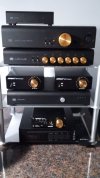
This is my mixed system for headphones and Bi Amping with some Chinese power. For arguments sake you need two separate Amps with volume controls to adjust the High and Low when you Bi Amp plus more power. AVR doesn't cut it. No control between high and low when the crossover has been disabled and most AVR's only splits the power between channels.
EQ I find important with Phono. Phono Masters are limited and EQ can fix some of it.
CD Transport/Player/Ripper from SMSL. For awhile I thought it was a bit of a disappointment because it didn't play gapless. But new Firmware update fixed the issue and now it does plus few other fixes.
Aiyima DAC I replaced all of the four Op Amps to opa1612. It is not bad and I use it as secondary for my Sennheiser HD515 headphones for TV and movies. Very good headphones for surround sound and special effects and very inexpensive.
Schiit DAC is the primary DAC that I think you can say forever DAC. To get better you need to spend lot more.
Schiit headphone Amp is for music and the preamp for the Aiyima amps. For the Schiit amp I have Sennheiser HD600 as Balanced.

How do they look together?
 

Attachments

  • DSC_0003.jpg
    DSC_0003.jpg
    74.7 KB · Views: 15
  • DSC_0006.jpg
    DSC_0006.jpg
    62.4 KB · Views: 15
  • DSC_0013.jpg
    DSC_0013.jpg
    67.3 KB · Views: 12
  • DSC_0014.jpg
    DSC_0014.jpg
    71 KB · Views: 12
  • DSC_0018.jpg
    DSC_0018.jpg
    75.5 KB · Views: 16
One thing I've noticed is that even though a power amp's job should be to "add nothing" aka -a wire with gain, most all I've heard (even the better ones) do not accomplish this and add some color of their own. However, my Purifi Eval-1 class-D amp is the cleanest power amp I've ever heard, like a breath of fresh air that holds together extremely well at very high volumes with very little distortion, much better than other amps I've heard. It's extremely technical sounding. I know it's not a chinese amp, but is the closest of all the amps I've heard that seems to add nothing or take anything away from the music. I mention it because clarity of Class-D amps was mentioned earlier here and I can absolutely vouch for this. Maybe that's why it's called the Eval-1? It seems to allow for the evaluation of other connected equipment better without adding anything else to the signal so you can judge the other inter-connected components and equipment better.
I wouldn't be so sure about it. All the components for those amps you can find from Aliexpress.
 
Back
Top Bottom