


FlaCharlie
Super Member
I recently noticed this new preamp that uses directly heated tubes.
Many people prefer the sound of directly heated triode tubes, though they are typically used as output tubes in SE (single ended) amplifiers. The most commonly used DHT output tubes are the 2A3 and the 300B, both of which are currently produced by a variety of manufacturers.
But preamps that use DHTs (directly heated triodes) are, as far as I know, very rare. This is the first time I've seen a mass produced DHT preamp.
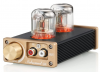
The tube used in the Nobsound E6 is the 2J27L, which is not very well known. You may also see the tube number translated a bit differently into English. This is common with Chinese and Russian labels. The actual label is 2Ж27Л. It's a pentode but it's connected in triode, as pentodes often are when used as a preamp tube. The tubes used in the popular FX are also triode-strapped pentodes.
One of the key features of the 2J27L is that its 2.2v filament draws very little current - only 56mA. Such low filament current tubes are often called "battery tubes" because they were generally used in battery powered radios where their low current draw ensures adequate battery life.
When I was breadboarding a variety of tube types for a preamp project a while back, one of the tubes I tried was a close cousin of the 2J27L called the 2P29L. In all, I tried about a dozen different tube types and the 2P29L was (to my ears) one of the top 3. The others were the 6V7G and the 1626. In the end I built the preamp, which I dubbed the Boogie Factor, using the 1626.
But the 2P29L was impressive and, although I didn't build anything with it, I posted a thread over on DIY Audio about the circuit I breadboarded since a lot of European DIYers are into Russian tubes.
https://www.diyaudio.com/community/threads/2p29l-preamp.336620/
Seeing that this new preamp used a very similar tube, my interest was piqued and I decided to give one a try. I've been listening to it for a couple of weeks now and I'm glad that I did.
At the time I ordered it they were on sale on eBay ($50 shipped) but I decided to pay a bit more and get it from Amazon ($60 shipped) just in case I decided to return it. They offer free returns and it's a very simple process. No need, though. I'll be keeping it.
I don't mean for this to be a full review, I just wanted to give others a "heads up" on it since inexpensive Chinese tube preamps like the FX are so popular here. Perhaps someone will do a head to head comparison between the two.
I don't own an FX but some may recall that I did breadboard the tube it uses during my earlier experiment. I tried it at the abnormally low voltages used in the FX and also at higher voltages, closer to what the tube data sheet recommends. At lower voltages it sounded better than I expected. Running it at more "normal" voltages was a huge improvement. Still, it was near the bottom of my list compared to the other tubes I tried. YMMV, as always.
I'm not very good at describing what I hear but so far I'm liking the Nobsound E6 a lot in terms of overall sound. It does require some break-in. Audio memory has its limitations but it seems very similar overall to what I heard with the 2P29L on the breadboard. So that's a positive.
And, unlike the FX, they claim that the tube is being operated at a higher voltage, supposedly 105v on the plate. When I breadboarded its cousin, the 2P29L, I was running very similar voltage (112v on the plates) and many DIY builders run 2P29Ls in the same range, sometimes even a bit under 100v. So, if the tubes are operated at normal voltages, that's another positive.
There some negatives, however. I'm not too fond of the layout with the input jacks in the back and the output jacks in the front next to the volume pot. I'd much rather see all of them in the back.
To some that might be a deal breaker. That said, anyone who has pulled tube amps from old console stereos knows that they commonly have their inputs in the front. I even have one whose input jacks are right in the middle of the chassis, surrounded by tubes. Not ideal, but I guess I've learned to overlook such issues if the sound is good.
Those who are heavily into tube rolling might also be disappointed. It comes with the Chinese version of the 2J27L which, like most all vintage Chinese tubes, is simply a copy of the Russian version. As far as I know, those are the only choices. I ordered some of the Russian ones from a Ukrainian seller so I'll eventually see how they compare. Most people seem to find that Russian tubes sound better than the Chinese ones. We'll see when they arrive. But, at this point, I'm happy with what I'm hearing.
My bench is currently occupied by a breadboarded, directly coupled SET, project which I've been working on sporadically, so it will be a while before I can open the E6 up and measure things. But one of the things I want to see is how they have the filaments wired and exactly what the operating points are.
Depending on the stoutness of the filament supply it's possible that the 2P29L can be rolled in safely since it uses the same pin arrangement. The 2P29L filaments run on the same voltage but they draw about 2x the current. Such a swap can be risky and this is not normally something I would try or recommend. On the other hand, the current draw of these "battery tubes" is quite low - a 2P29L draws less current than one of the tubes used in the FX, for example. And one of the FX tubes draws over 3x the heater current of the 2J27L.
So, if the filament supply is stout enough that it can be used safely, the 2P29L might provide another tube rolling option.
Another difference is that the 2P29L has a lower mu (amplification factor) of ~8 compared to ~16 for the 2J27L used in the E6. In comparison, I believe the tube used in the FX is somewhere in the 30 to 35 range, which is more than necessary in many cases. Some people complain that the volume control of the FX is too touchy - that it's difficult to make precise adjustments because it gets loud too quickly. This little Nobsound E6 doesn't seem to suffer from that problem. It's quiet too, no hiss or hum even with the volume at max.
Nobsound / Douk is also not totally forthcoming about another characteristic of the 2J27L. In stock form the tube is enclosed in an aluminum shell and has a plastic knob on the top to make it easier to insert and remove from its loctal type socket. Here's a pic:
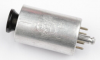
They obviously realized that a metal tube wouldn't fly in terms of marketing so they ditched the aluminum shell and removed the glass tube from it. It does look more familiar like that and I did the same thing with the 2P29L, which uses the same metal shell.
All the glow, however, comes from LEDs mounted under the tubes. None of the "battery tubes" I've tried had any noticeable glow due to their very low filament voltage and current. On the positive side, the LEDs used are orangeish and not ridiculously bright. Much better than green, blue or red, which just looks wrong to me.
While the description of the E6 suggests that you might want to try the Russian version of the 2J27L, what they don't tell you is that you will need to cut off the shell because, even if the looks don't bother you, the opening in the top of the preamp is too small to insert the tube unless you remove it from the aluminum shell. This holds true for both the Russian and the Chinese version of the 2J27L.
And removing it from the shell creates another issue that must be dealt with. These tubes use a loctal base which, just like the more familiar octal base, has a central locator pin that ensures that the tube is oriented correctly when you plug it in. When you remove the glass tube from the shell the locator pin is part of the aluminum base, which is discarded. So you need to mark the position of the locator pin on the glass before removing the tube from the base.
The description does mention that the stock tube is marked in this manner and that if you insert the tube wrong damage will occur but it doesn't give any background information.
Now if you forget to mark the position of the locator pin it is possible to identify the locator pin's position using a multimeter. That's because the pins on either side of the locator (pins 1 and 8) are the filament. So if you find two adjacent pins with continuity between them the locator pin would be between them. That said, it's probably safe to say that many who buy these little Chinese preamps don't own a multimeter.
I'd also note that while the tube type is marked on the aluminum shell, there are no markings at all on the glass tube itself since it was never intended to be removed from its shell.
So, while this preamp certainly has some quirks, you might consider giving it a try.
I'm not sure who developed it. Nobsound / Douk seems to be the distributor and their eBay listing shows it branded Cadisi, which I've never heard of. The one I purchased through Amazon is branded Nobsound. They are obviously the same, though.
As for the sound . . . I'm impressed but so far I've only listened to it for a limited time using a SE tube amp. I'll be trying it with my Aiyima A-07 Class D at some point I'm sure.
With the tube amp, mostly streaming jazz, I would say that it's very clear, open and detailed. This aligns with my previous experience with directly heated tubes. It has excellent imaging and the highs are very spacious and airy. It seems well balanced but, to be clear, I haven't been listening to any thumpy, bass heavy, material.
So only first impressions so far and YMMV, as always. Check it out if you're so inclined.
Many people prefer the sound of directly heated triode tubes, though they are typically used as output tubes in SE (single ended) amplifiers. The most commonly used DHT output tubes are the 2A3 and the 300B, both of which are currently produced by a variety of manufacturers.
But preamps that use DHTs (directly heated triodes) are, as far as I know, very rare. This is the first time I've seen a mass produced DHT preamp.
The tube used in the Nobsound E6 is the 2J27L, which is not very well known. You may also see the tube number translated a bit differently into English. This is common with Chinese and Russian labels. The actual label is 2Ж27Л. It's a pentode but it's connected in triode, as pentodes often are when used as a preamp tube. The tubes used in the popular FX are also triode-strapped pentodes.
One of the key features of the 2J27L is that its 2.2v filament draws very little current - only 56mA. Such low filament current tubes are often called "battery tubes" because they were generally used in battery powered radios where their low current draw ensures adequate battery life.
When I was breadboarding a variety of tube types for a preamp project a while back, one of the tubes I tried was a close cousin of the 2J27L called the 2P29L. In all, I tried about a dozen different tube types and the 2P29L was (to my ears) one of the top 3. The others were the 6V7G and the 1626. In the end I built the preamp, which I dubbed the Boogie Factor, using the 1626.
But the 2P29L was impressive and, although I didn't build anything with it, I posted a thread over on DIY Audio about the circuit I breadboarded since a lot of European DIYers are into Russian tubes.
https://www.diyaudio.com/community/threads/2p29l-preamp.336620/
Seeing that this new preamp used a very similar tube, my interest was piqued and I decided to give one a try. I've been listening to it for a couple of weeks now and I'm glad that I did.
At the time I ordered it they were on sale on eBay ($50 shipped) but I decided to pay a bit more and get it from Amazon ($60 shipped) just in case I decided to return it. They offer free returns and it's a very simple process. No need, though. I'll be keeping it.
I don't mean for this to be a full review, I just wanted to give others a "heads up" on it since inexpensive Chinese tube preamps like the FX are so popular here. Perhaps someone will do a head to head comparison between the two.
I don't own an FX but some may recall that I did breadboard the tube it uses during my earlier experiment. I tried it at the abnormally low voltages used in the FX and also at higher voltages, closer to what the tube data sheet recommends. At lower voltages it sounded better than I expected. Running it at more "normal" voltages was a huge improvement. Still, it was near the bottom of my list compared to the other tubes I tried. YMMV, as always.
I'm not very good at describing what I hear but so far I'm liking the Nobsound E6 a lot in terms of overall sound. It does require some break-in. Audio memory has its limitations but it seems very similar overall to what I heard with the 2P29L on the breadboard. So that's a positive.
And, unlike the FX, they claim that the tube is being operated at a higher voltage, supposedly 105v on the plate. When I breadboarded its cousin, the 2P29L, I was running very similar voltage (112v on the plates) and many DIY builders run 2P29Ls in the same range, sometimes even a bit under 100v. So, if the tubes are operated at normal voltages, that's another positive.
There some negatives, however. I'm not too fond of the layout with the input jacks in the back and the output jacks in the front next to the volume pot. I'd much rather see all of them in the back.
To some that might be a deal breaker. That said, anyone who has pulled tube amps from old console stereos knows that they commonly have their inputs in the front. I even have one whose input jacks are right in the middle of the chassis, surrounded by tubes. Not ideal, but I guess I've learned to overlook such issues if the sound is good.
Those who are heavily into tube rolling might also be disappointed. It comes with the Chinese version of the 2J27L which, like most all vintage Chinese tubes, is simply a copy of the Russian version. As far as I know, those are the only choices. I ordered some of the Russian ones from a Ukrainian seller so I'll eventually see how they compare. Most people seem to find that Russian tubes sound better than the Chinese ones. We'll see when they arrive. But, at this point, I'm happy with what I'm hearing.
My bench is currently occupied by a breadboarded, directly coupled SET, project which I've been working on sporadically, so it will be a while before I can open the E6 up and measure things. But one of the things I want to see is how they have the filaments wired and exactly what the operating points are.
Depending on the stoutness of the filament supply it's possible that the 2P29L can be rolled in safely since it uses the same pin arrangement. The 2P29L filaments run on the same voltage but they draw about 2x the current. Such a swap can be risky and this is not normally something I would try or recommend. On the other hand, the current draw of these "battery tubes" is quite low - a 2P29L draws less current than one of the tubes used in the FX, for example. And one of the FX tubes draws over 3x the heater current of the 2J27L.
So, if the filament supply is stout enough that it can be used safely, the 2P29L might provide another tube rolling option.
Another difference is that the 2P29L has a lower mu (amplification factor) of ~8 compared to ~16 for the 2J27L used in the E6. In comparison, I believe the tube used in the FX is somewhere in the 30 to 35 range, which is more than necessary in many cases. Some people complain that the volume control of the FX is too touchy - that it's difficult to make precise adjustments because it gets loud too quickly. This little Nobsound E6 doesn't seem to suffer from that problem. It's quiet too, no hiss or hum even with the volume at max.
Nobsound / Douk is also not totally forthcoming about another characteristic of the 2J27L. In stock form the tube is enclosed in an aluminum shell and has a plastic knob on the top to make it easier to insert and remove from its loctal type socket. Here's a pic:
They obviously realized that a metal tube wouldn't fly in terms of marketing so they ditched the aluminum shell and removed the glass tube from it. It does look more familiar like that and I did the same thing with the 2P29L, which uses the same metal shell.
All the glow, however, comes from LEDs mounted under the tubes. None of the "battery tubes" I've tried had any noticeable glow due to their very low filament voltage and current. On the positive side, the LEDs used are orangeish and not ridiculously bright. Much better than green, blue or red, which just looks wrong to me.
While the description of the E6 suggests that you might want to try the Russian version of the 2J27L, what they don't tell you is that you will need to cut off the shell because, even if the looks don't bother you, the opening in the top of the preamp is too small to insert the tube unless you remove it from the aluminum shell. This holds true for both the Russian and the Chinese version of the 2J27L.
And removing it from the shell creates another issue that must be dealt with. These tubes use a loctal base which, just like the more familiar octal base, has a central locator pin that ensures that the tube is oriented correctly when you plug it in. When you remove the glass tube from the shell the locator pin is part of the aluminum base, which is discarded. So you need to mark the position of the locator pin on the glass before removing the tube from the base.
The description does mention that the stock tube is marked in this manner and that if you insert the tube wrong damage will occur but it doesn't give any background information.
Now if you forget to mark the position of the locator pin it is possible to identify the locator pin's position using a multimeter. That's because the pins on either side of the locator (pins 1 and 8) are the filament. So if you find two adjacent pins with continuity between them the locator pin would be between them. That said, it's probably safe to say that many who buy these little Chinese preamps don't own a multimeter.
I'd also note that while the tube type is marked on the aluminum shell, there are no markings at all on the glass tube itself since it was never intended to be removed from its shell.
So, while this preamp certainly has some quirks, you might consider giving it a try.
I'm not sure who developed it. Nobsound / Douk seems to be the distributor and their eBay listing shows it branded Cadisi, which I've never heard of. The one I purchased through Amazon is branded Nobsound. They are obviously the same, though.
As for the sound . . . I'm impressed but so far I've only listened to it for a limited time using a SE tube amp. I'll be trying it with my Aiyima A-07 Class D at some point I'm sure.
With the tube amp, mostly streaming jazz, I would say that it's very clear, open and detailed. This aligns with my previous experience with directly heated tubes. It has excellent imaging and the highs are very spacious and airy. It seems well balanced but, to be clear, I haven't been listening to any thumpy, bass heavy, material.
So only first impressions so far and YMMV, as always. Check it out if you're so inclined.
Last edited:


![20221213_170045[1].jpg](/forums/data/attachments/2613/2613222-35edf0a108be6f3b7507eae26292ad69.jpg?hash=Ne3woQi-bz "20221213_170045[1].jpg")
