• The move to the new server is done. There are some software and database maintenance updates in process. This has us passing the hat around to help out. We appreciate any donations. Seriously, even a dollar helps. The payment page may be found here - https://www.audiokarma.org/support.html

Occasional loud popping noise

Ken Boyd

Super Member
Subscriber
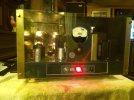
Last night I put the Altec 1570B amp in service and everything powers up as normal and music sounds fine, but over a period of time an occasional pop sound comes thru the speaker. It sounds like maybe a static pop amplified. It comes erratic and at random. I haven't tested it for anything yet; thing is big and heavy a pain to work on. I think I have replaced everything other than the one big oil can cap on top, and resistors.

Any ideas as to what might cause these symptoms?
 
Register to hide this ad
My first thought, rectifier tube. Especially if new production one.

That thing is a beast. Googled it. Talk about high voltage, 900V's on plates. I know what you mean about working on heavy equipment. I had a friend wanting me to look at his heavy old receiver. Told him I was too old to move that thing around. Told him to find someone else. Problem is there is no one else nearby that works on electronics anymore.
 
Is the pop coming from both speakers, or just one?
Common issues with pops I've come across were caused by various issues.
It can be cauaed by failing capacitor, a failing rectifier, driver or power tube, and even from cold or cracked solder joints.
In one of my amps it was the voltage gain driver tube failing. One section of the dual triode was having intermittent shorts and arcing. I even saw a flash happen inside that tube.
In one of my mono blocks I would get intermittent pops mostly at start up. It took me awhile to find the problem until one day I saw a small flash through a vent slot on top of the amp. It turned out to be a crack in a star ground solder joint. I didn't notice it before even with a magnifier. With the bottom off and lights out I turned the amp on with the bottom off and saw the small arc.
In yet another amp it was the power tube arcing internally.
The tubes that were failing caused a pop in one channel only, where as the bad ground solder joint caused a pop in both channels.
It could be a failing cap too though, or maybe even a bad resistor.
 
Last night I put the Altec 1570B amp in service and everything powers up as normal and music sounds fine, but over a period of time an occasional pop sound comes thru the speaker. It sounds like maybe a static pop amplified.
Bottom line is that it could be a multiple of things causing the pops. I'd start with the easiest thing, the tubes beginning with the rectifiers.
Do you have neon lights in close proximity? They can cause static noise.
 
Will check the Rectifiers first as that is easy, and all the small tubes. These rectifier tubes were recently purchased NOS and I think I tested them prior to leaving feedback but will retest them. I have no way to test the 811-3's But I have had issues with the plate caps on top these tubes coming loose and getting solder to stick on the conductor and the cap is a challenge.
 
Are you playing a record when that happens? ;)
Yes, it was when playing a record, but it is not anything from the record groove as my records are very clean and don't have that loud of a pop, and I can shut the table off and the pop will happen with no signal provided.
 
My first thought, rectifier tube. Especially if new production one.

That thing is a beast. Googled it. Talk about high voltage, 900V's on plates. I know what you mean about working on heavy equipment. I had a friend wanting me to look at his heavy old receiver. Told him I was too old to move that thing around. Told him to find someone else. Problem is there is no one else nearby that works on electronics anymore.

Will retest the rectifier tubes all 4 of them. I have some SS type plugin rectifiers, guess I could try them to see if that stops it. .
 
Is the pop coming from both speakers, or just one?
Common issues with pops I've come across were caused by various issues.
It can be cauaed by failing capacitor, a failing rectifier, driver or power tube, and even from cold or cracked solder joints.
In one of my amps it was the voltage gain driver tube failing. One section of the dual triode was having intermittent shorts and arcing. I even saw a flash happen inside that tube.
In one of my mono blocks I would get intermittent pops mostly at start up. It took me awhile to find the problem until one day I saw a small flash through a vent slot on top of the amp. It turned out to be a crack in a star ground solder joint. I didn't notice it before even with a magnifier. With the bottom off and lights out I turned the amp on with the bottom off and saw the small arc.
In yet another amp it was the power tube arcing internally.
The tubes that were failing caused a pop in one channel only, where as the bad ground solder joint caused a pop in both channels.
It could be a failing cap too though, or maybe even a bad resistor.
Yeah, I figured that to be likely but ideas to look at as starting points are helpful. I went all through this a while ago and everything seemed to be working correctly, but then I pulled it out of use, and it has been sitting on the sidelines for a while. All the caps were changed out, new multi can caps, choice tubes, I had a thread on these and thought I was done. I ordered some new knobs for the gain and tube checking selector but with all the crap I have finding where I put those new knobs is a mystery. I was thinking it sounds like a build up of potential and then a release almost like a spark plug would build up till collapse and then the energy is going thru the amp. I will check all the tubes first then will flip it over if not a tube, and check all my solder joints, and then maybe check the resistors.

I have not noticed any flickering of the tubes when the unit pops. Unlike a noise issue with another amp I had a few weeks ago, the gas regulators would flicker with the noise.

The only cap that was not changed out was that big oil type in the front next to the meter, but I don't think it is the problem, this was working a few months ago after I did the recap.

WIN_20260924_19_32_21_Pro.jpg
 
Last edited:
I had a pair of input cables cause noise before. The shield has torn loose inside at one end of the cable at the RCA plug. It was causing intermittent pops and a few brief drop outs. The shield was the negitive connection in those cables.
Also, have you tried another source besides the turntable? If I put my turntable to close to one wall it picks up noise from the Fridge on the other side of that wall. Cartridges and phono inputs are pretty sensitive to all kinds of emissions from other electronics and electrical devices.
 
It will only be the one speaker this is a mono amp, I use a pair for stereo playback.

No the table was the only source I tried, it works fine with all my other amps.

As far as the input cable, I guess an easy way to check that is to not connect it and let the amp run a while and see it the pop happens. This is simple cable one I made up, just a shield wire with two conductors one is the positive for the prong and the negative to the strain relief which should be the ground.
 
Last edited:
My first thought, rectifier tube. Especially if new production one.

That thing is a beast. Googled it. Talk about high voltage, 900V's on plates. I know what you mean about working on heavy equipment. I had a friend wanting me to look at his heavy old receiver. Told him I was too old to move that thing around. Told him to find someone else. Problem is there is no one else nearby that works on electronics anymore.
Yup these use four rectifier tubes for the power supply.
 
Really nice amplifier. I recently watched a video on an amplifier similar to that one that churches used instead of bells during WW11 when metal was in demand. Made to run 24 hours a day 7 days a week.

I would start with cleaning the pins of the tubes and the sockets. Simple things first. There are so many tubes and sockets in that amplifier any one of them with a bad connection would cause a pop. With NOS rectifier tubes unlikely they are the problem.
 
Did you clean all the connections with Deoxit D100L? Tubes, sockets, interconnects, removable connections within the amp, etc. Remove and reconnect many times (10 or more) to clean the surfaces well.

Start there. If the amp still has popping issues, I'd try the wooden chopsticks test (or a non-conductive probe) and TAP EVERYTHING. You are trying to induce that noise. This will help locate the issue. It could be a bad solder point, a bad grounding point, or bad traces (if the amp has circuit boards). A cracked resistor, a cracked disc capacitor. Really, just about anything.

Be systematic and follow a linear pattern from input to output stages. When you find the bad spot (and there may be more than one), use a magnifying glass to check the area.

Doing it this way saves me from going crazy replacing this, then that, then more of this, and still having issues.

Please keep your free hand off the hot chassis while tapping.

Good luck! I hope that you find the culprit!
 
Last edited:
Did you clean all the connections with Deoxit D100L? Tubes, sockets, interconnects, removable connections within the amp, etc. Remove and reconnect many times (10 or more) to clean the surfaces well.

Start there. If the amp still has popping issues, I'd try the wooden chopsticks test. Use it (or a non-conductive probe) and tap EVERYTHING. You are trying to induce that noise. This will help locate the issue. It could be a bad solder point, a bad grounding point, or bad traces (if the amp has circuit boards). A cracked resistor, a cracked disc capacitor. Really, just about anything.

Be systematic and follow a linear pattern from input to output stages. When you find the bad spot (and there may be more than one), use a magnifying glass to check the area.

Doing it in this manner, saves me from going crazy with replacing this, then that, then more of this, and still having issues.
We were on the same page. Simple things first. Good place to start anyways.
 
This is a good FAQ post to keep on your computer.

___________________________________

Posted by Jim McShane (D) on August 29, 2013 at 15:51:50

I have been deluged lately with people asking about issues with their tube gear that they have decided, for whatever reason, must be the tubes. Occasionally, it is, but in my experience, at least 75% of the time it is not. I wanted to share some tips to help people out.

1. The #1 cause of noise problems with tubes is poor contact between the tube pins and the socket. There are a wide variety of possible causes: dirty pins and/or sockets (in the case of a noisy new tube, the socket is the PRIME suspect), socket contacts that have been stretched out or worn out and don’t make good contact, or in a few cases, bad solder joints on the socket itself.

Tube sockets — even excellent ones — are not sophisticated, high-reliability connectors. You won’t see tube sockets used in critical applications because they aren’t reliable enough.

Do yourself a favor — clean the tube pins and sockets every time you change tubes. A bottle of DeOxit D5 and a handful of good old-fashioned pipe cleaners work great for octals and other large pin sockets; for the miniatures, D5 and the tiny dental brushes for cleaning between your teeth (another drugstore item) do a solid job. BTW, D5 is good to 400F, so don’t lose sleep over it because of something you read on the “Hi-Fi Hysteria” forum. And it doesn’t gum up, either. Spray some in a paper cup and let it evaporate— you’ll be able to see for yourself.

Sometimes, you swap a tube, and the new tube is okay. So the tube you removed must be bad, right? NO! Sometimes, the scraping action of removing and reinstalling a tube in that socket is enough to temporarily restore contact, fooling you into thinking the tube is bad. KEEP YOUR SOCKETS CLEAN!!

If you are installing new production tubes into vintage or older gear, keep in mind that most modern tubes have slightly smaller pins than the original stock tubes did. You may need to re-tension (or, in the worst case, replace) the original sockets that can’t make good contact with the smaller pins.

Honest — only a few % of the tubes I get back for noise are bad. Most go on to play fine in another socket.


2. The metal cans surrounding the tubes serve as shields designed to prevent external fields from inducing noise in the tube. Would a manufacturer spend the money to put them on there unless they were worth it? Will the tube run a bit warmer with it in place? Possibly, but be smart about removing shields!


3. Would you like to use KT-120s in your amp? It’s more than just a current increase in the heater that’s an issue. I’ve had a couple of cases where excessive grid circuit resistance causes unstable bias. The KT-120 has a maximum grid circuit resistance of 51 k-ohms. If your amp is above that, using the KT-120 carries a risk. Just like the EH and Tung-Sol 7591As, some KT-120s will be compatible with excess resistance, but others will not.


4. Don’t fry those expensive new power tubes! If your amp has an adjustable bias, turn the bias current DOWN significantly before plugging in new tubes. The bias that was correct for the older, worn tubes may not apply to the fresh, new ones. And it doesn’t take much overcurrent to damage a tube or shorten its life. Adjust the bias to spec, and make sure the amp is fully warmed up, including both the tubes and the internal parts. The whole amp should be warm, which takes at least half an hour, in my experience.


Keep one last thing in mind — often, you see a voltage “spec” on a schematic at the control grid of a tube. DO NOT TRY TO SET THE VOLTAGE AT THE GRID TO THAT SPEC! Set the negative voltage at the tube grid to the value required to achieve the specified cathode current. If the tube is passing the correct amount of current and the grid voltage is -20 volts, then to hell with the “spec” of -22.5 volts or whatever it is. Making the grid voltage more negative relative to the tube’s cathode is like reducing the pressure on a garden hose to restrict water flow. And if you let up the pressure on the hose, more water flows — that’s the same thing that happens if the tube grid is less negative.


5. Most tube testers do not test power or other high-voltage/high-current tubes at a sufficiently high voltage to be very meaningful. Current matching is pretty much out of the question for all but the few “lab grade” testers that can apply high voltages at reasonable current levels to the tube. What your tube tester says with 150 volts on the plate will differ significantly from what my rig says at 465 volts! Our old pal Steve Melkisethian (proprietor of Angela Instruments) used to say he didn’t even CARE what your tube tester said! It’s a little harsh, but not entirely unreasonable. Remember, a tube’s test results depend on the conditions under which you test it.


6. Other components, besides the tubes themselves, can make your matched tubes seem less well-matched. Power tubes may be matched for transconductance, but it is imperative that if you need matched tubes, they are matched for current - some say plate current, I say cathode current.


Why cathode current? Because between the cathode and ground of many (most?) power tubes, you will find a resistor in the circuit — low value; 10 Ohms is common — and that resistor’s purpose is to make it possible for you to measure the voltage across that resistor and use Ohm’s

Law to calculate the current. Measuring the current with an ammeter requires breaking into the circuit and inserting the ammeter. However, with a voltmeter, we don’t have to break into the circuit; we can measure the voltage across the resistor and determine the current flowing through it. For instance, if you measure 0.5 volts across a 10-ohm resistor, you can compute the current by dividing the voltage by the resistance. .5 volts divided by 10 Ohms = .05 amps, 50 milliamps.

However, keep in mind that not only the plate current but also the screen current flows through the tube cathode to the ground (of course, triodes have no screens, so this doesn’t apply). We’ll ignore situations where the grid is driven positively and current flows through it as well for now.

So that’s 50 mA. Did you just read the example above? That’s the plate current and the screen current combined (unless the tube is a triode). And that combined current is what is causing the voltage across the resistor. By knowing the total current, the cathode current, and the voltage across the tube from the plate to the cathode, we can easily calculate the tube’s total power dissipation. That’s important, since excessive dissipation (measured in watts) kills a tube.

Why would the readings be different on “matched tubes”?

a. The tubes are never perfectly matched — some tolerance exists

b. The screen and/or plate voltages are slightly different across the different tubes due to variations in the resistances of the output transformers’ primary windings.

c. The cathode resistors are never the same value.

d. Etc.


7. Variance in the brightness of the tube heater is normal and not an issue. When using tubes, it is essential to distinguish between the orange glow of the tube heater at the tube's center and the reddish glow of the large internal metal tube plate. The picture below shows one of a set of tubes with a reddish-orange tube plate. That is a problem for sure!

Now, look at the picture below. It shows some variation in the brightness/glow of the tube heaters, both at the top and bottom of the internal tube structure. This is entirely normal and results from minor variances in production. There is no cause for concern.

The amount the heater protrudes beyond the cathode sleeve varies from tube to tube; if one protrudes more than the other at the top, it will be brighter. It can also happen at the bottom of the tube; it depends on whether the heater protrudes more (as it does at the top). Don't worry! It is not a malfunction and is no reason for concern at all.

I just wanted to share a few things that maybe will help people struggling to understand why they had "problems" with their tubes. One of the points mentioned above is almost always the case!

 
Last edited:
Back
Top Bottom