• Please note that Audiokarma will be offline briefly for updates early on Monday morning, September 28th.

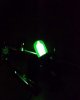
Odd bulbs

Register to hide this ad
They do look like a 'neon' type with internal phosphor coating. Emission color could be almost anything other than neon amber. Do they read open-circuit with an ohmmeter?
 
Yep, they read open-circuit.
They might have internal current-limiting resistors, but to be safe, I would power them up with about 100K in series across 120VAC.

Extra points if you can measure the putative internal resistor without access to the internal connection.
 
I was wondering when I saw something like that in an old Xenon flash gun, it had something that looked like a neon bulb but had this white stuff on the inside. Turns out it was exactly that, a green neon bulb that's used as a backlight to the exposure calculator. A regular orange one is used to indicate when the capacitor was charged up.

Was kind of interesting it was using the high voltage to light the exposure calculator, whether or not it uses less power than some incandescent, I don't know -- but definitely more efficient in terms of lm/w for those AA batteries.

 
Looks like an argon tube (by the color). Same effect - essentially an open circuit until voltage is applied.
 
They might have internal current-limiting resistors, but to be safe, I would power them up with about 100K in series across 120VAC.

Extra points if you can measure the putative internal resistor without access to the internal connection.

I powered up the bulb again with the 100K external resistor, adjusting the line voltage with my variac to exactly 120V. I measured the current draw as 0.61mA. So if my Ohm's law math is correct, the total resistance is 196k ohms. That seems to indicate that there's another ~100k resistor inside the bulb.
~
 
I think the right way to approach this problem is with a DC power source, because current flow is interrupted periodically with AC power. The lamp will strike at an elevated voltage, then operate with a lower fixed voltage across it that depends very little on the value of the current limiting resistor. The problem then reduces to an unknown fixed voltage in the load (like a Zener diode) with an unknown resistance plus a known resistance in series, powered by a known and variable DC voltage supply.
 
Back
Top Bottom