• The move to the new server is done. There are some software and database maintenance updates in process. This has us passing the hat around to help out. We appreciate any donations. Seriously, even a dollar helps. The payment page may be found here - https://www.audiokarma.org/support.html

Older Grado Identification

is it even possible to buy genuine grado replacement stylus? or all of them spare styluses are third party?
I don't understand this question, doesn't make sense (to me) at all or maybe I misunderstand something?

If you have a Grado then you know which one it is and then you find a replacement stylus. They are ALWAYS genuine Grado,
I never came across any 3-rd party Grado stylus.

Exception is of course for those who repair / retip cartridges such as Joseph Long (Needlestein):

I think for older Grado's such as the F/G/M-Series this is worth if it is one of those with a tappered cantilever, such as the F+, F1+, G+, G1+ etc.
or one of the Signatures.

The A-Series were Moving-Coils, so no replacement styli anyway, only retipping.
 
Last edited:
It looks to me like the Grado Model ...
Thanks for the info!
I was previously thinking 'A', and goaded AI into agreeing with me, but now leaning toward 'Grado EMG'
The lenco link with the Needlestein thread was helpful. Another poster added:

That is a Grado EMG. It was built on the same outer body as the Grado A which was a moving coil cartridge.​

...which makes sense given the similar appearance.
The lenco thread also referenced Vinyl Engine database, and I found this.
1790508526721.png
Not the same, but pretty close.
I could call the mystery cartridge a EMG MkI, but still no info, no photo, etc.
Is now a good time to complain about Joseph Grado's 'notoriously convoluted nomenclature over the decades' & lack of available data?
 
Thanks for the info!
I was previously thinking 'A', and goaded AI into agreeing with me, but now leaning toward 'Grado EMG'
The lenco link with the Needlestein thread was helpful. Another poster added:

That is a Grado EMG. It was built on the same outer body as the Grado A which was a moving coil cartridge.​

...which makes sense given the similar appearance.
The lenco thread also referenced Vinyl Engine database, and I found this.
View attachment 3845188
Not the same, but pretty close.
I could call the mystery cartridge a EMG MkI, but still no info, no photo, etc.
Is now a good time to complain about Joseph Grado's 'notoriously convoluted nomenclature over the decades' & lack of available data?
Not sure if this is the case.
If you compare it with the EMG in the Lencoheaven link:
and with this one:
Both are more likely the EMT.

The needle from your cartridge to me looks more like the early Grado A moving coil.
But I know too well that I could be wrong as I only know those early ones from photos.
The earliest I ever had were the F1+ and G1+ and a F3+

I knew Joe Grado personally, had longer phono conversations with him but this was during the late Signature times when he also brought out his
Laboratory Signature tonearm (had one here recently but it was a cheat, the guy must have dropped it, the bearings were beyond repair.

His nephew John Grado still listens with the same turntable and tonearm:
Micro Seiki DQX-500 with the Signature Laboraty tonearm.
 
Last edited:
Not sure if this is the case.
Agreed.
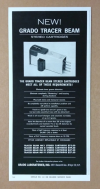
After more research, I believe this mystery grado is a 'Tracer Beam MkI'
1964 ad below. Zooming in, looks like MkII is shown.
1790516606447.png

Some refer to this as Laboratory series, and/or before A series.
Specs remain fuzzy. Most say early MC, with 9mV output (? units?). No reference to stylus. VTF 1g, or 6g!
Some AI slop that may be accurate:

The Grado Tracer Beam is a rare, vintage moving coil phono cartridge introduced by Grado Labs in the early 1960s.​
While modern audiophiles heavily associate Grado with its proprietary moving iron designs, the Tracer Beam hails from the historical period when company founder Joseph Grado actually pioneered and patented the stereo moving coil design. The Tracer Beam line represents the second and final basic moving coil platform produced by the company before they permanently abandoned the principle in favour of moving iron systems.​
Historical Timeline & Models​
  • Introduction: The initial experimental iterations surfaced as early as 1962 for a premium retail price of $75.00.
  • Tracer Beam "Lab" (1963): The first standardized model of this generation. It is physically identified by a narrow body and a flat front profile.
  • Tracer Beam Model A (1964): The secondary iteration, featuring a revised body shape with a noticeably rounded front.
I knew Joe Grado personally, had longer phono conversations with him but this was during the late Signature times when he also brought out his
Laboratory Signature tonearm .....
Cool! An Audio Hall of Famer!
 
Back
Top Bottom