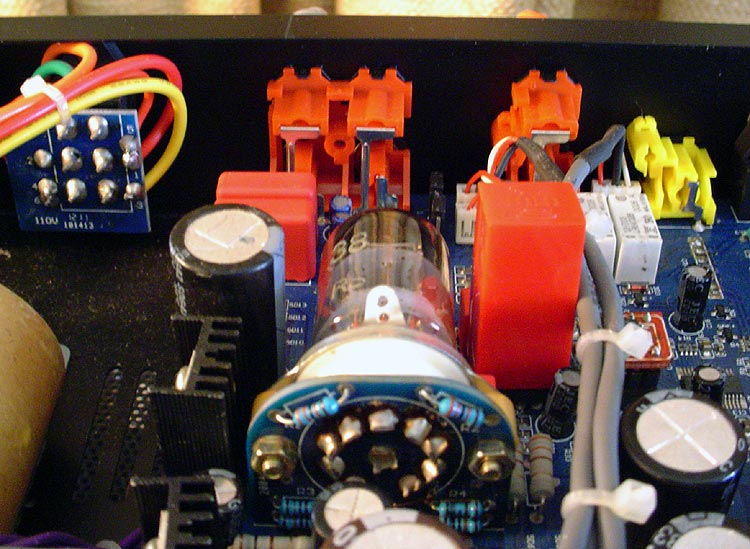
Those little black bricks, Op Amps are a mystery, they are a self contained amplifier, very easy to work with and very easy to swap out. There are the common "jelly bean" variety like the NE3552 and the boutique types like the OPA627 etc.
Seems easy enough to swap out a cheap type and put in a more expensive one and get much better sound, right, well the answer is yes and no. Sure better op amps sound better, but there is a "but" and it's if they are used in the right way.
But swapping out op amps can be fun and rewarding as long as they are stable, instability such as oscillation can have a huge detrimental effect on their performance. I remember when someone complained that they swapped out an OPA2134 for a pair of LME49990's on an adapter and complained they got really hot, I suggested that they add a 0.1uf ceramic capacitor across the V+ & V- supply pins and they reported they no longer got hot. So I guessed with some power supply bypassing the oscillations caused by instability stopped.
But sometimes it's not so obvious that the op amp is not stable, they seem to sound okay and don't get hot, so without a scope, distortion analyzer etc you can't really tell.
I was reading a discussion on supply bypassing across the power rails, and it was suggested that most op amps particularly boutique ones like the AD797, LME49990, LME49720 can benefit "sound" wise from adding a small electrolytic 4.7uf / 10uf and a small film cap 0.1uf. I actually found that this was suggested by the manufacturer of high speed op amps for stability purposes.
Hmmm, this was like a red rag to a bull, pulling the AD797's & LME49990's from my phono stage, I thought why not give it a try. It already has 0.1uf and 100uf caps on the supply rails but what about this notion that you can improve the sound by having caps across the rails?
I had some 10uf 35v Nichicon electrolytics and some 0.1uf Pet film caps in stock so why not, since the op amps were all SOIC's on adapters I simply soldered a 10uf and 0.1uf across the supply pins of the adapters, I had listened to Dire Straights Brothers in Arms earlier and wondered if there would be an audible difference good for bad.
Was I imagining it or was the background quieter, the separation better, the bass more defined, voices a lot cleaner and overall a smoother performance? Is it just the placebo effect, I was expecting either no or little difference but not what I found.
So here is a challenge for those people who love mess with things, and have a DIY phono stage, headphone amp, pre amp etc, I take no responsibility though if you damage anything, only those who are competent at soldering and want to take the risk need try it. And please do not try this on your new expensive piece of equipment where you will instantly void the warranty.
But if you have some 4.7uf - 10uf (No higher than 10uf, bigger is not better in this regard), and some 0.1uf film or even ceramics to try, give it a go and report back as to what you find. It's suggested that the better the caps the cleaner the sound, so Elna Silmic II's were found to be the best on another forum. But I just used the standard Nichicon's I had on hand, I will definitely try the Silmic's once I get some.
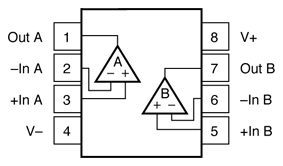
You need to know if you have dual or single op amps to work out the supply pins, for dual op amps the supply pins are 4 for - and 8 for + seen here, the little crater on the op amp is near pin 1.
Dual circuit op amps, OPA2134, LM4562, LME49720 etc:
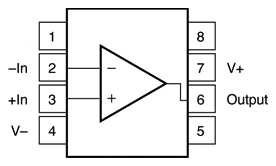
For single op amps the supply pins are 4 for - and 7 for + seen here, the little crater on the op amp is near pin 1 .
Single circuit op amp, AD797, LME49990, LME49710, OPA627 etc:
Don't forget if you are using polarized caps the usual convention applies, positive to positive and negative to negative.
The other consideration is the voltage rating of the caps, if your op amps are running at 12v + & - or 15v + & -, then you need to have 35v or higher caps, if you have over 15v + & - then you need to use 50v, you add both positive and negative voltages together to work out your cap rating.
So in summary I am not saying this will make a huge difference, as I am still skeptical of what I heard, but on face value it "seemed" to work for me, so I value others findings, good or bad.
Remember do this at your own risk, and past performance is not a guarantee of future performance.
Seems easy enough to swap out a cheap type and put in a more expensive one and get much better sound, right, well the answer is yes and no. Sure better op amps sound better, but there is a "but" and it's if they are used in the right way.
But swapping out op amps can be fun and rewarding as long as they are stable, instability such as oscillation can have a huge detrimental effect on their performance. I remember when someone complained that they swapped out an OPA2134 for a pair of LME49990's on an adapter and complained they got really hot, I suggested that they add a 0.1uf ceramic capacitor across the V+ & V- supply pins and they reported they no longer got hot. So I guessed with some power supply bypassing the oscillations caused by instability stopped.
But sometimes it's not so obvious that the op amp is not stable, they seem to sound okay and don't get hot, so without a scope, distortion analyzer etc you can't really tell.
I was reading a discussion on supply bypassing across the power rails, and it was suggested that most op amps particularly boutique ones like the AD797, LME49990, LME49720 can benefit "sound" wise from adding a small electrolytic 4.7uf / 10uf and a small film cap 0.1uf. I actually found that this was suggested by the manufacturer of high speed op amps for stability purposes.
Hmmm, this was like a red rag to a bull, pulling the AD797's & LME49990's from my phono stage, I thought why not give it a try. It already has 0.1uf and 100uf caps on the supply rails but what about this notion that you can improve the sound by having caps across the rails?
I had some 10uf 35v Nichicon electrolytics and some 0.1uf Pet film caps in stock so why not, since the op amps were all SOIC's on adapters I simply soldered a 10uf and 0.1uf across the supply pins of the adapters, I had listened to Dire Straights Brothers in Arms earlier and wondered if there would be an audible difference good for bad.
Was I imagining it or was the background quieter, the separation better, the bass more defined, voices a lot cleaner and overall a smoother performance? Is it just the placebo effect, I was expecting either no or little difference but not what I found.
So here is a challenge for those people who love mess with things, and have a DIY phono stage, headphone amp, pre amp etc, I take no responsibility though if you damage anything, only those who are competent at soldering and want to take the risk need try it. And please do not try this on your new expensive piece of equipment where you will instantly void the warranty.
But if you have some 4.7uf - 10uf (No higher than 10uf, bigger is not better in this regard), and some 0.1uf film or even ceramics to try, give it a go and report back as to what you find. It's suggested that the better the caps the cleaner the sound, so Elna Silmic II's were found to be the best on another forum. But I just used the standard Nichicon's I had on hand, I will definitely try the Silmic's once I get some.
You need to know if you have dual or single op amps to work out the supply pins, for dual op amps the supply pins are 4 for - and 8 for + seen here, the little crater on the op amp is near pin 1.
Dual circuit op amps, OPA2134, LM4562, LME49720 etc:
For single op amps the supply pins are 4 for - and 7 for + seen here, the little crater on the op amp is near pin 1 .
Single circuit op amp, AD797, LME49990, LME49710, OPA627 etc:
Don't forget if you are using polarized caps the usual convention applies, positive to positive and negative to negative.
The other consideration is the voltage rating of the caps, if your op amps are running at 12v + & - or 15v + & -, then you need to have 35v or higher caps, if you have over 15v + & - then you need to use 50v, you add both positive and negative voltages together to work out your cap rating.
So in summary I am not saying this will make a huge difference, as I am still skeptical of what I heard, but on face value it "seemed" to work for me, so I value others findings, good or bad.
Remember do this at your own risk, and past performance is not a guarantee of future performance.
Last edited: